
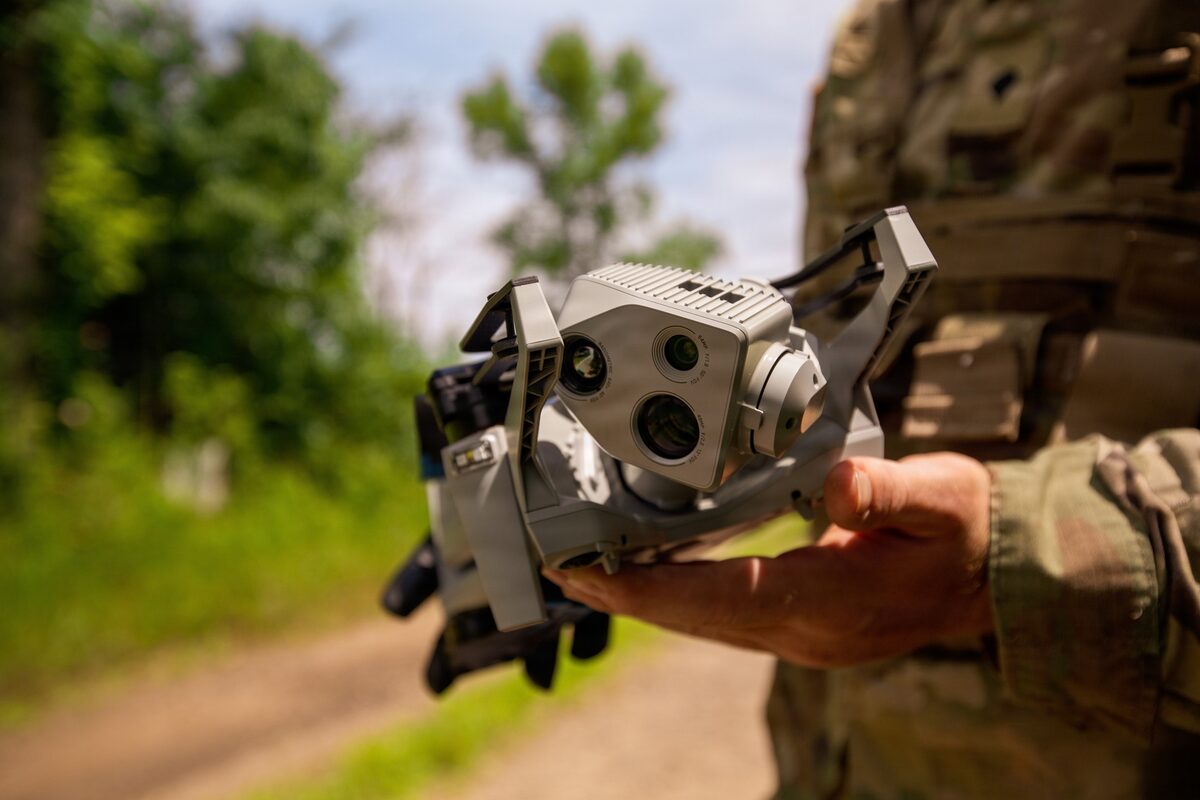
The Washington National Guard has completed new-equipment training on a mobile Anduril Industries counter-unmanned aircraft system (C-UAS), a milestone the Guard announced and detailed in an Army.mil report published July 29, 2026, with a corroborating account posted the same week by the National Guard's own nationalguard.mil. The unit behind the training, the 10th Civil Support Team, worked alongside the Guard's Counterdrug Program at Camp Murray, Washington, to bring the system to operational readiness — with an eye toward some of the highest-profile security assignments named in the reporting: Super Bowl and FIFA World Cup missions.
The training closes a gap that has become increasingly urgent for National Guard units nationwide: distinguishing a genuine airborne threat from the ordinary clutter of birds, weather balloons, and hobbyist quadcopters, in real time, without a false-positive response burning through limited personnel and resources.
What the System Does
According to the Army.mil account, the fielded system is not a single device but a networked kit of four components, each handling a different piece of the detect-track-identify chain:
- Long Range Camera Tower — an elevated, extended-range optical sensor for visual detection and tracking.
- WISP — a combined electro-optical/infrared and passive radio-frequency detection system.
- Pulsar — a dedicated passive RF sensor used to geolocate both a drone's position and its operator's location.
- Lattice — Anduril's artificial-intelligence-driven command-and-control software, which fuses the data streams from the other three sensors into a single operating picture.
That sensor fusion is the operational payoff. Per the Army.mil report and a corroborating write-up from National Guard's own nationalguard.mil, the software layer is what allows operators to reliably tell a drone apart from a bird — a distinction that has bedeviled cruder radar- or camera-only counter-drone setups, which tend to either miss slow, small targets or flood operators with nuisance alerts on flocks of geese. Forbes' July 31 coverage of the fielding led with this same capability, headlining its report on the tech's ability to distinguish drones from birds.
Maj. Ryan Dykes commands the 10th Civil Support Team, the unit that led the training. Washington's Adjutant General, Maj. Gen. Gent Welsh, was also quoted in the Army.mil and Forbes coverage, underscoring the state-level command emphasis being placed on the capability.
Why a Civil Support Team, Specifically
Civil Support Teams are specialized National Guard units built to respond to chemical, biological, radiological, nuclear, and high-yield explosive (CBRNE) incidents — the kind of domestic emergency response mission that puts them in direct proximity to large public gatherings, VIP movements, and critical infrastructure. Pairing that mission set with a counter-drone capability is a logical fit: CSTs already deploy to exactly the environments — stadiums, transit hubs, mass-casualty response zones — where an unauthorized drone incursion is now treated as a credible security concern rather than a curiosity. Lt. Col. Wes Watson, the 10th CST's former commander and now director of the Commander's Action Group for Counter-small Unmanned Aircraft Systems Operations, was quoted in both the Army.mil and Forbes accounts describing drones as an increasingly effective delivery mechanism for chemical, biological, radiological and explosive payloads — the exact hazard class CSTs are built to respond to.
The Counterdrug Program's involvement adds a second thread. That program has historically supported law enforcement partners with surveillance, detection, and intelligence capabilities aimed at interdiction — skills that overlap directly with tracking an unauthorized aircraft's flight path and point of origin.
Named Security Missions Driving the Fielding
Both the Army.mil article and independent trade coverage tie the fielding directly to Washington's role in securing major public events, explicitly naming Super Bowl and FIFA World Cup missions, alongside National Special Security Events and America 250 celebrations, as taskings the system is being prepared to support. In Forbes' July 31 report, Maj. Gen. Gent Welsh linked the acquisition directly to World Cup preparation, saying the counter-drone buildup came "from groundbreaking work in our Counterdrug program to recent Anduril acquisition as FIFA prep byproduct." Forbes also quoted Welsh describing Washington as continuing "to lead national efforts in planning, equipping and training forces to counter hostile drones" — a characterization from the Guard's own leadership rather than an independent Forbes assessment, but one echoed across the Army.mil, nationalguard.mil, and Forbes coverage alike.
Large-scale sporting events have become a proving ground for domestic counter-drone posture more broadly. Stadiums packed with tens of thousands of spectators, dense broadcast and VIP air-traffic considerations, and the reputational stakes of a security incident make them a natural forcing function for agencies to stand up capabilities they might otherwise defer. Washington's Guard appears to be positioning the Anduril system as reusable infrastructure — trained now, in a lower-stakes home-station environment, so it can be surged to event security missions without a compressed, last-minute qualification timeline.
Homeland Defense and Critical Infrastructure Angle
Beyond event security, a report from Army Recognition on the same fielding — which confirmed the deployment was announced July 29, 2026 — placed the system in a broader homeland-defense and critical-infrastructure-protection context, describing it as being evaluated for its detect, classify, and track capability against those use cases. That framing situates the Camp Murray training as one data point within a wider push by National Guard units and federal partners to close persistent gaps in domestic airspace awareness around fixed sites — power substations, ports, pipelines — that have historically lacked any dedicated counter-drone sensor coverage.
What's Notably Absent From the Public Record
The available reporting does not specify several details that will matter for how this capability actually performs in the field: no mitigation or defeat mechanism (kinetic, RF jamming, or otherwise) is described in connection with this system — Army Recognition's account is explicit that while National Guard personnel can detect, classify, and track unauthorized drones, mitigation measures require separate federal authorization not addressed in this fielding. The public reporting covers detection, tracking, and identification, not neutralization. Nor do the sources specify the system's detection range, the number of units being fielded across Washington or other states, a total program cost, or whether the Camp Murray unit is a pilot for wider National Guard adoption. Those are open questions that will likely surface as the system moves from training to its first real-world event deployment.
Why It Matters
This fielding is a concrete data point in a trend UASFeed has tracked closely: the National Guard's shift from ad hoc, borrowed counter-drone gear to purpose-built, AI-assisted sensor-fusion systems tied to specific named missions. Pairing a CBRNE-focused Civil Support Team with a Counterdrug Program on the same equipment signals that states are treating unauthorized drone activity as a cross-cutting domestic security problem — not solely a military airspace issue or solely a law-enforcement nuisance, but both at once. The explicit linkage to Super Bowl and FIFA World Cup security also matters for the industry: it signals that Anduril's Lattice-based architecture is well positioned to become a reference platform for state Guard units training ahead of high-visibility public-safety missions, and it sets a template other states will likely be measured against as they build out their own capabilities before similar events arrive on their soil.
Sources
- Washington National Guard advances counter-drone capabilities with new technology — Army.mil
- Washington Guard Advances Counter-Drone Capabilities — National Guard
- National Guard Troops Deploy Tech That Distinguishes Drones From Birds — Forbes
- U.S. Deploys Anduril Counter-Drone System to Strengthen Homeland Defense Against Drone Threats — Army Recognition
