
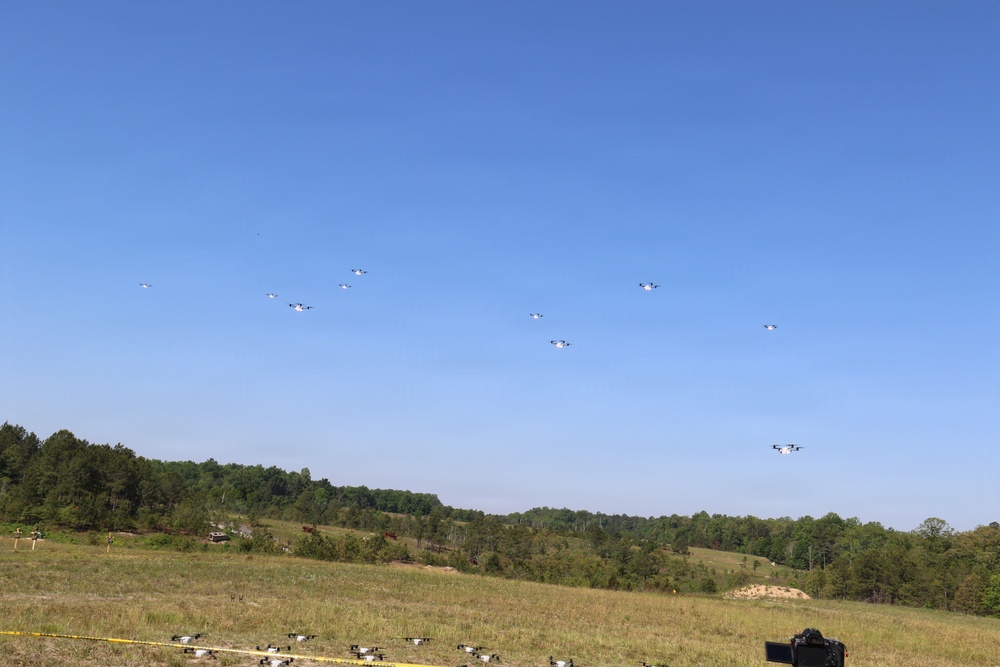
For roughly a week and a half in May, a stretch of pine forest and open range at Fort A.P. Hill, Virginia, became one of the most concentrated counter-drone proving grounds the U.S. Army has assembled to date. Seventeen industry partners brought lasers, radio-frequency jammers, and interceptor drones to the installation to face off against more than a dozen types of unmanned aircraft systems — including coordinated swarms — in what the Army's DEVCOM C5ISR Center is calling "Warden," its first-ever collaborative counter-small-UAS assessment of this scale.
The event, detailed in an official Army.mil article published July 22, 2026, and in corroborating coverage published August 1, 2026, was designed to do something the Army's acquisition and requirements communities have struggled with for years: generate comparable, standardized performance data on counter-UAS (C-UAS) systems from a wide range of vendors, tested against the same threat presentations, on the same range, in the same window of time.
What Happened at Fort A.P. Hill
According to the Army's account, Warden was led by the C5ISR Center — the research and engineering arm of the Combat Capabilities Development Command (DEVCOM), itself an element of the Army's Futures and Concepts Command, responsible for command, control, communications, computers, cyber, intelligence, surveillance, and reconnaissance technologies. The assessment brought together 17 industry partners whose systems spanned the core pillars of kinetic and non-kinetic counter-drone defense: high-energy lasers, RF jammers, and intercept UAS designed to physically engage hostile drones.
Those systems were tested against more than 12 distinct UAS types, deliberately including swarm scenarios that stress detection, tracking, and engagement systems in ways single-drone presentations do not. Swarms complicate every layer of the kill chain — sensors have to discriminate and track multiple simultaneous tracks, cueing systems have to hand off targets fast enough to matter, and effectors have to prioritize which threats to engage first, all while avoiding fratricide against friendly systems on a crowded range.
Coverage from Soldier Systems Daily, also published August 1, 2026, adds names and context to the Army's release. The event was overseen by project manager Clint Farrell, and C5ISR Center Director Beth Ferry is quoted discussing the assessment's goals. Soldier Systems Daily notes that Warden was conducted against the framework of the "Standard Guidelines for Test and Evaluation of Counter-Unmanned Aircraft Systems Technologies" — an indication that the Army is trying to move counter-drone testing toward a more repeatable, standards-based methodology rather than one-off vendor demonstrations.
A third account, published July 28, 2026 by Army Recognition's Chief Editor Alain Servaes, independently confirms the event's timeline and scope: a week-and-a-half-long exercise conducted in May 2026 at Fort A.P. Hill. Army Recognition's coverage also captures a broader thematic point from the event: that counter-drone capability is no longer viewed exclusively as specialized equipment assigned to dedicated air-defense units, reflecting a shift in how the Army expects units at every echelon, not just specialized air-defense formations, to be able to detect and defeat small drones.
What the Army Says It Got Out of It
The reporting points to several concrete technical outcomes from the assessment. Soldier Systems Daily's coverage highlights improved sensor algorithms and better data-sharing among systems, both aimed at the perennial C-UAS problem of separating real threats from background clutter without overwhelming operators. The Army's own article frames Warden's results as detecting and identifying incoming UAS threats from longer standoff distances, updating sensor algorithms to make C-UAS solutions more resilient, and easing data-sharing between sensors, soldiers in the field, and command and control. Army Recognition's reporting adds that participating companies also refined their algorithms to reduce false detections during engagements involving multiple drones — a result not independently corroborated in the Army's own release or in Soldier Systems Daily's coverage.
Equally notable is the event's attention to the dismounted soldier. Rather than focusing solely on vehicle- or base-mounted systems, Warden also evaluated low-size, weight, and power (low-SWaP) counter-drone equipment meant to be carried or worn by individual troops — including rifle-mounted and wearable configurations. That reflects the Army Recognition framing directly: if counter-UAS defense is expanding beyond dedicated air-defense units, the individual soldier and small unit need gear that doesn't require a truck, a generator, or a specialist crew to operate.
Why a Collaborative Assessment Model Matters
Counter-drone acquisition has historically been fragmented. Vendors demonstrate systems in isolated events, often on ranges and against threat presentations tailored to showcase their own strengths, making apples-to-apples comparison difficult for program offices trying to decide what to field. By running 17 vendors' systems against the same slate of more than a dozen UAS types — including swarms — over the same testing window, Warden is structured to produce something closer to a genuine bake-off, using the shared Standard Guidelines for Test and Evaluation of Counter-Unmanned Aircraft Systems Technologies as the scoring backbone.
That matters for a service trying to move quickly on a threat that has evolved rapidly in recent conflicts. Cheap, attritable drones and coordinated swarm tactics have forced militaries worldwide to rethink layered defense, and the Army's own messaging around Warden — that C-UAS is no longer just an air-defense specialty — suggests planners expect the requirement to spread across infantry, armor, and support formations alike.
Why It Matters
Warden is a signal of how the Army intends to buy its way out of the drone threat: not through a single program of record chosen behind closed doors, but through repeated, standardized, industry-wide assessments that generate comparable data across lasers, jammers, and interceptor drones alike. For the 17 companies involved, a strong showing against swarm scenarios and improved detection performance could translate directly into follow-on contracts. For soldiers, the emphasis on low-SWaP rifle-mounted and wearable systems points toward counter-drone capability becoming as routine as carrying a radio — pushed down from specialized air-defense batteries to the squad level. And for the broader C-UAS industry, the adoption of a shared test-and-evaluation standard means vendors will increasingly be judged on data gathered in events like Warden rather than curated demonstrations of their own design — raising the bar for what "works" actually has to mean.
Sources
- Army-industry collaboration advances counter-UAS technology — U.S. Army
- Army-Industry Collaboration Advances Counter-UAS Technology — Soldier Systems Daily
- U.S. Army Accelerates Counter-Drone Development Against Modern Aerial Threats with Industry Partnership — Army Recognition
