
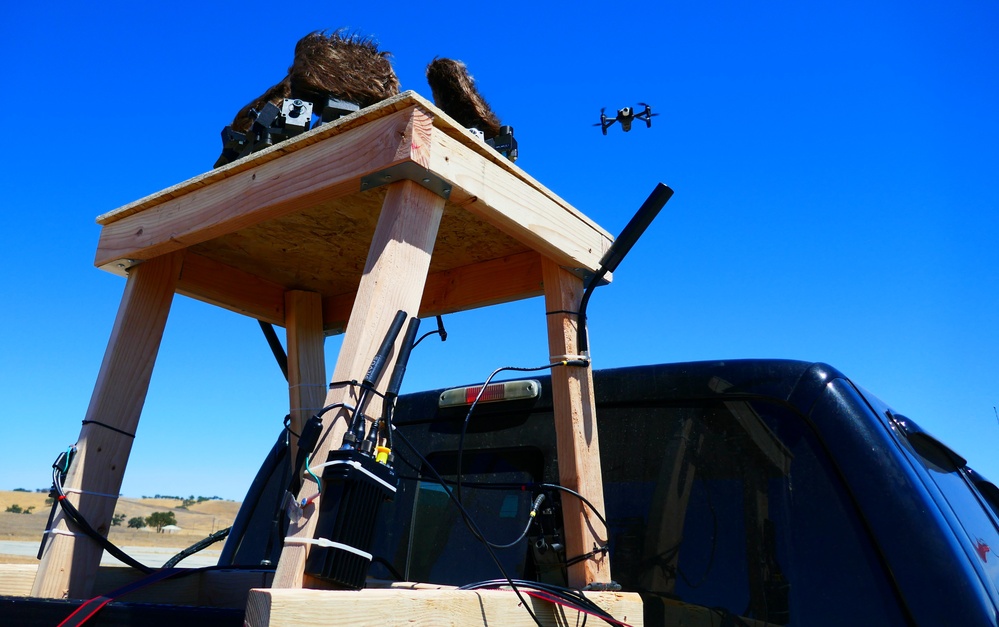
Most counter-drone sensors can be found by the drone they are hunting. Radar transmits. RF detectors depend on the drone's control link and video downlink. Optical systems face line-of-sight limits, and acoustic systems can be overwhelmed by background noise. A team led by Florida International University has tried a different approach: a sensor that sends nothing at all and listens for the faint magnetic field that a drone's electric motors leak into the air around them.
"Every detection method currently in use gives something away," Associate Professor Arjuna Madanayake of FIU's College of Engineering & Computing told Interesting Engineering. His group worked with Soumyajit Mandal of Brookhaven National Laboratory and Chatura Seneviratne of the University of Ruhuna in Sri Lanka. They report that their passive receiver classified drones with up to 98.5% accuracy at ranges up to 15 m (49 ft) in outdoor tests.
The peer-reviewed paper is in IEEE Sensors Journal. DroneXL reports that FIU announced the results on October 23, eight months after the paper first appeared online.
The Physics: Motors Are Magnets
Small multirotors fly on brushless DC motors, which use rare-earth permanent magnets. When those motors spin, and when the electronic speed controllers (ESCs) switch current through their coils, they produce time-varying magnetic fields in the extremely-low-frequency (ELF) band. Most of that energy stays close to the airframe. Some of it escapes, and it can be measured.
According to FIU's College of Engineering & Computing, the idea came from earlier work on ELF submarine communication, a field built on picking up very weak, very long-wavelength signals. Pointed at drones, the same idea works like this: an antenna listens passively for ELF emissions from motor magnets, and an algorithm treats the resulting signatures as fingerprints for each drone type.
The signatures differ because the hardware differs. Interesting Engineering reports that different motor configurations give different electromagnetic fingerprints. DroneXL gives one example: the DJI Phantom 3's motors have 12 coils and 14 poles, and its ESC switches at 8 or 16 kHz. Pole count, coil count, switching frequency and rotor speed all shape the spectrum the sensor records.
The Hardware
The receiver is simple. DroneXL describes the setup in the paper:
- Antenna: a 1 m circular loop.
- Front end: a custom low-noise analog front end.
- Digitizer: a Texas Instruments C2000 microcontroller sampling at 3.46 million samples per second.
- Processing: signals are converted, via FFT-based analysis, into spectral correlation function images.
- Classifier: those images go to a VGG16 convolutional neural network, a standard image-recognition architecture.
Turning a one-dimensional magnetic signal into a two-dimensional image is a familiar trick. It lets a well-understood image classifier separate signal classes that would be hard to tell apart by hand-picked spectral features.
Cost is the main selling point. "While the range of our method is limited for now, it costs only a few hundred dollars to develop and could run continuously without any specialized support, unlike radar systems," Madanayake said in FIU's College of Engineering & Computing write-up.
What the Tests Showed
The headline figure is up to 98.5% accuracy at up to 15 m. FIU's own write-up rounds this to "up to 98%" and says range depends on the drone type and the algorithm used.
The harder test was classification across four classes: three different drone models plus an empty sky. Accuracy there was 83.5%, according to DroneXL. The smallest drone was the hardest to classify, which fits the physics. Smaller motors with smaller magnets leak weaker fields, so the signature sits closer to the noise floor.
Those numbers are useful in a narrow way. They show that ELF motor signatures exist outdoors, that they can be picked up with cheap parts, and that they carry enough structure to tell airframes apart. They do not show performance at the distances where most counter-UAS engagements are planned.
A Four-Year Line of Work
The project did not start this year. A 2022 paper presented at the USNC-URSI National Radio Science Meeting, "Extremely-Low Frequency (ELF) Radio Sensing of Unmanned Aerial Systems" by Madanayake, De Silva, Glickstein and Mandal, described the same basic idea: RF-based UAS detection without transmitting, using a sensitive magnetometer and digital signal processing to pick up rare-earth-magnet motors. Preliminary results with a 1x2 receive coil showed reliable detection of a small UAS at several meters.
DroneXL reports that the 2022 prototype was built from a wooden frame and magnet wire and detected a DJI Phantom 3 at about 16 ft. It was partly funded under NSF award CCSS-1904382. The new work roughly triples that range and adds classification on top of detection.
The next step is already in review. A follow-on paper, "Spatial ELF Sensing of Small UAS" (by R. Hapuarachchi and colleagues, per DroneXL), which looks at sensor arrays, has been submitted to IEEE Access. It has not been peer-reviewed yet. The current paper's first author is Dilshara Herath, and DroneXL says the dataset is on IEEE DataPort as a subscription dataset.
Why It Matters
The appeal is less about range and more about what the sensor does not depend on. Interesting Engineering points out that active radar, optical and acoustic systems are limited by line of sight, background noise and rules on transmitting, while a passive ELF sensor is not affected by weather or acoustic noise. And because it emits nothing, Interesting Engineering says it is invisible to hostile forces trying to jam or locate defensive sensors.
The bigger point is about what the sensor hears. RF detection, the backbone of many commercial counter-drone kits, relies on the drone talking to someone. Drones flying pre-programmed routes in radio silence, and fiber-optic FPV drones that send control and video over a physical cable, defeat that method by design. Neither can avoid spinning electric motors to stay in the air. A detector keyed to the propulsion system rather than the data link goes after something the drone cannot switch off.
Money matters too. Interesting Engineering cites a Department of War fiscal 2027 request of $74 billion for drone and counter-drone technology. Against that budget, a sensor that costs a few hundred dollars and can run continuously without specialist operators could be deployed as a cheap layer in large numbers. FIU names forward operating bases and border crossings as likely uses.
The limit is just as clear. A 15 m detection bubble is not perimeter defense; by the time a drone is that close, it is already over the target. A realistic role is a last-layer or point sensor: a ring of inexpensive loops around a doorway, vehicle park, ammunition point or checkpoint, filling in where radar clutter, RF silence or noise blind the other sensors. Whether arrays can stretch that bubble far enough to matter is the question the unreviewed IEEE Access work is trying to answer.
Open Questions
Several things are still untested in public reporting. The published results cover three drone models; how the classifier copes with unfamiliar airframes, mixed swarms or several drones at once is not addressed. Electrically noisy places such as generators, power lines and vehicle engines may prove the hardest test for ELF sensing, though the sources do not report field tests there. And with classification at 83.5% across four classes and the smallest drone the hardest case, more work is needed before the system can reliably tell what it is looking at as well as that something is there.
Still, the result shows that a drone flying with no radio emissions still gives off a detectable magnetic signature from its own motors, and that cheap hardware can pick it up.
Sources
- From the Dean's Desk: A Drone Detection Discovery (FIU College of Engineering & Computing)
- FIU Detects Drones By The Magnetic Leak From Their Motors, No Radar (DroneXL)
- US scientists detect incoming drones from 49 feet using motor signals (Interesting Engineering)
- Extremely-Low Frequency (ELF) Radio Sensing of Unmanned Aerial Systems (FIU Discovery, 2022 URSI paper)