
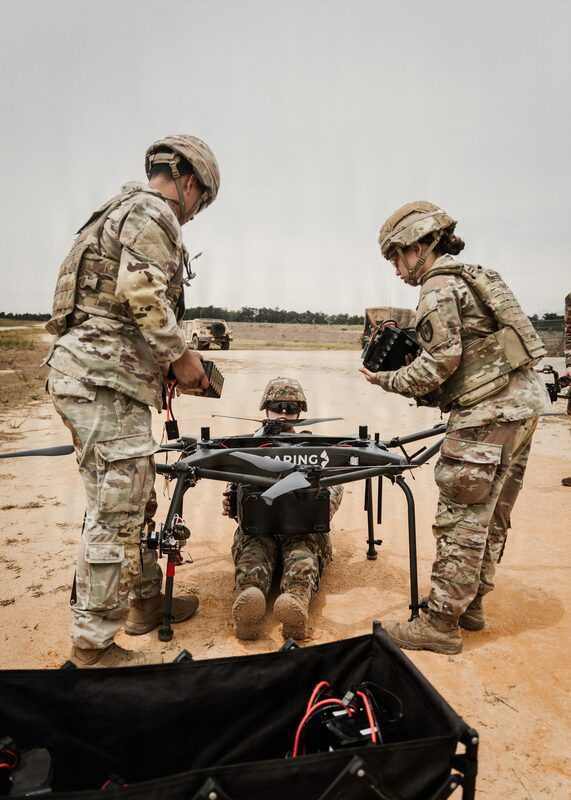
On August 1, 2026, a drone in James City County, Virginia, became the first aircraft of its kind in the state cleared to fly real-world missions carrying a defibrillator toward a person in cardiac arrest. The county's drone, callsign "Air10," is part of a clinical study that pairs the county's existing drone-as-first-responder program with cardiac researchers at Duke University and Virginia Commonwealth University (VCU), under funding from the American Heart Association (AHA). James City County is the first Virginia locality — and only the second in the nation — to move an AED-delivery drone program out of testing and into live pilot operation.
The numbers behind the announcement are what make this more than a routine drone-program press release. In test flights, Air10 delivered an automated external defibrillator (AED) via a tether in 2 minutes and 30 seconds. The county's average fire department response time over the same ground, within a five-mile radius of Fire Station 1 in Toano, is 8 minutes and 6 seconds. That gap — roughly five and a half minutes — sits squarely inside the window where survival odds for sudden cardiac arrest fall fastest.
How the Program Works
The pilot is built on infrastructure the county already had in place. James City County launched its drone-as-first-responder (DFR) program in April 2025, and the AED mission is an extension of that platform rather than a standalone deployment. Under the RESTORe-CARE study — funded by the American Heart Association in partnership with Duke and VCU — Air10 is dispatched toward reported cardiac arrest calls within five miles of Fire Station 1 in Toano. Rather than landing at the scene, the drone lowers the AED to responders or bystanders via a tether, shaving time off both the flight and the handoff.
County officials framed the launch around that time differential. Police Chief Jamison and Fire Chief Ashe both provided remarks tied to the release, alongside Dr. Monique Starks of Duke University, who is affiliated with the RESTORe-CARE study. The county's own announcement — titled "James City County Achieves Virginia's First Drone AED Delivery in Breakthrough Test Flights" — frames the August 1 date as the transition point from controlled test flights into the study's real-world pilot phase.
Q&A: What's Actually New Here
Is this the first drone AED delivery in the country?
No. James City County is described as the second such program to reach real-world pilot status nationally, and the first in Virginia. The announcement does not name the first-in-the-nation program.
Is the drone replacing the fire department?
No. The drone delivers the AED; ground responders and, in many cardiac-arrest cases, bystanders still perform the resuscitation. The value proposition is entirely about compressing the time before a defibrillator is physically present and usable, not about replacing EMS response.
What is RESTORe-CARE?
It's the clinical study framework under which this pilot operates, funded by the American Heart Association and run in partnership with Duke University and VCU. Duke's Dr. Monique Starks is quoted in connection with the study in the county's release.
How does the drone actually deliver the AED?
Via tether — the drone does not land at the incident scene. It lowers the defibrillator down to responders or bystanders, and dispatchers give audible instructions to bystanders with no prior AED training.
What's the coverage area?
A five-mile radius from Fire Station 1 in Toano, Virginia, which is also the response zone used for the department's 8-minute-6-second average comparison figure.
Why It Matters
Sudden cardiac arrest is one of the few emergencies where the clock is measured in single-digit minutes and where the standard treatment — early defibrillation — can be delivered by a machine rather than a paramedic. Survival rates for out-of-hospital cardiac arrest are widely understood to decline sharply for every minute that passes without defibrillation, which is why fire and EMS response-time benchmarks exist in the first place. A tool that can shrink that interval by roughly five and a half minutes, even in a limited five-mile test zone, is a meaningful data point for the broader public-safety drone sector — not because it proves drones will replace ambulances, but because it gives researchers a real, measurable delta between drone delivery and ground response under actual dispatch conditions rather than simulation.
It also matters for the drone industry specifically because this is a study, not a marketing pilot. RESTORe-CARE's AHA funding and academic partnership with Duke and VCU means the James City County data is being collected with an eye toward clinical validation — the kind of evidence base that could eventually support wider AED-drone adoption, insurance and regulatory conversations, or FAA policy discussions around routine BVLOS emergency-response flights. For a state that had no live AED-delivery drone program before August 1, and for a DFR program that only stood up in April 2025, the jump to a funded clinical pilot in about 16 months is a notable acceleration for a public-safety drone use case that has mostly lived in demonstration flights and proof-of-concept coverage until now.
