
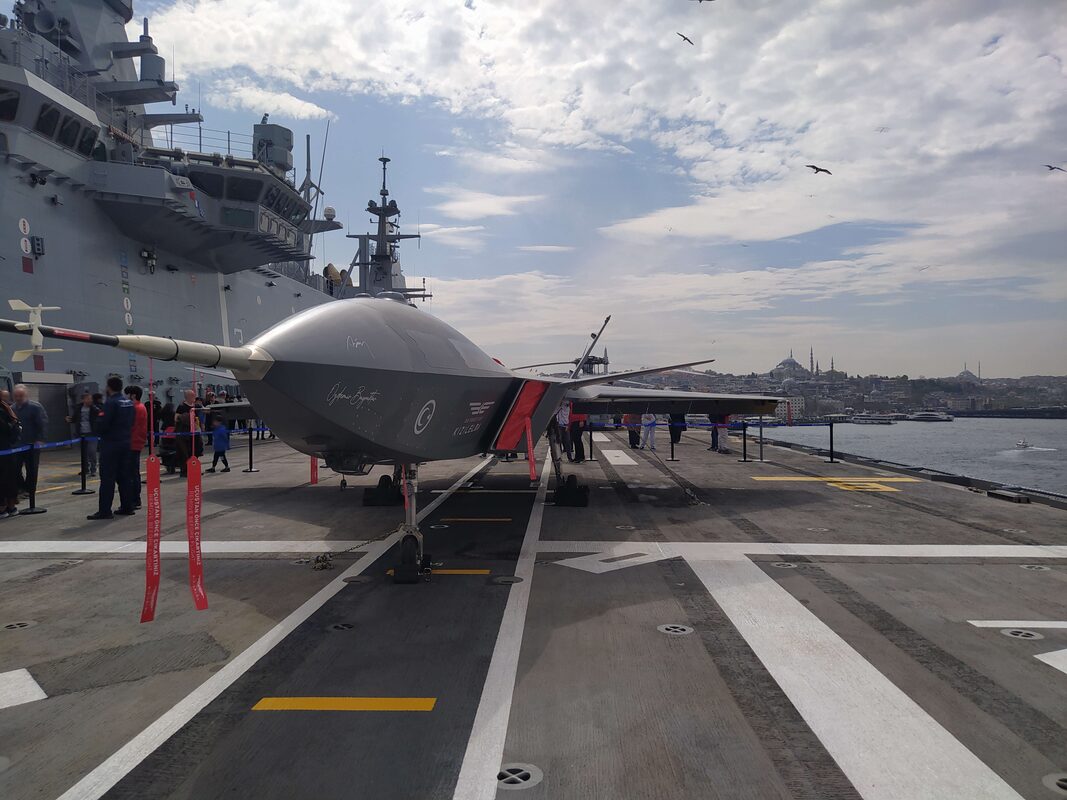
Baykar announced on November 19, 2026 that the first three Kizilelma uncrewed combat aircraft had passed acceptance testing and been delivered to Turkish security forces. In its own words, "an unmanned fighter jet has been operationally inducted into service for the first time in global aviation history." That is a big claim from a company with a strong export business behind it. Read closely, the announcement leaves out three things you would expect it to cover: which service received the jets, what they can carry, and how much they can do without a human making the decisions.
None of this makes the delivery less real. Turkey's armed forces now hold a jet-powered, reduced-observability uncrewed combat aircraft in their inventory, which is more than most air arms can say. But "operational" is a word worth unpacking before it hardens into a headline.
What Was Actually Delivered
According to Janes, three aircraft were delivered on November 19, and Baykar announced the delivery the same day. The Turkish defense outlet SSBulten says the type completed acceptance testing before the handover. The War Zone reported on November 24 that the aircraft entered the inventory after that testing.
The program has moved fast. Janes traces Kizilelma from its public reveal in July 2021 to a first prototype entering production in March 2022 and a maiden flight in December 2022. All three outlets cite Baykar's figure of about 600 test and training sorties.
The milestones Baykar has advertised point toward a real fighter mission, not just a stealthy strike drone:
- November 2025: an air-to-air shot with the domestically developed Gokdogan missile against a jet-powered target, with the target designated by an Aselsan Murad AESA radar, according to TWZ. TWZ calls it a beyond-visual-range engagement.
- December 2025: two prototypes reportedly flew in close formation using what TWZ calls intelligent fleet autonomy. SSBulten describes this as swarm flight.
- May 2026: autonomous formation flight alongside an Italian M-346 jet trainer.
- 2026: live-fire launches of the supersonic Jet-230 missile, according to SSBulten.
SSBulten adds that the aircraft integrates a domestic engine, AESA radar, electro-optical systems and an internal weapons bay. Janes lists low observability among its design features, though TWZ cautions that stealth was not the overriding design driver.
Who Got Them? Nobody Is Saying
Baykar's announcement refers only to Turkish "security forces." It does not name a branch, and Baykar declined to name the end user to Janes. The reporting splits on who it is.
Janes notes that imagery from the handover showed an officer believed to be from Turkish Land Forces Command. SSBulten, by contrast, frames the induction as a step in the Turkish Air Force's transition. These readings aren't necessarily in conflict. One is based on uniforms in photos and the other on how a domestic trade outlet describes the program's intent. But they point to different conclusions about how Turkey plans to use the aircraft.
This matters more than it might seem. An uncrewed jet sent to an army aviation command would likely fly deep strike and close support under an army concept of operations. An uncrewed jet sent to an air force would sit inside an air-combat structure next to crewed fighters, airborne radar and air-defense networks. The "fighter jet" label fits the second case much better than the first. Until Ankara or Baykar names the end user, the doctrine behind this induction is a guess.
The Payload Number Doesn't Agree With Itself
Janes and TWZ agree on most published performance figures: Mach 0.9 maximum speed, Mach 0.6 cruise, endurance over three hours, a 500-nautical-mile mission radius, a 40,000-foot ceiling and a 25,000-foot operational altitude. Janes also lists a length of 14.5 m, a 10 m wingspan, a maximum takeoff weight of 8,500 kg, and the ability to operate from short-runway aircraft carriers.
Payload is where they part ways. Janes gives 1,500 kg. TWZ reports approximately 3,000 pounds. Converted, 1,500 kg is roughly 3,300 lb, so the two figures are about 10 percent apart. That's not a huge gap, but it isn't a rounding error either. For a fighter-class aircraft it could matter for how many weapons it carries. The difference may come from separate data sheets, internal versus total stores, or different configurations. Neither source explains it.
What "Operational" Does and Doesn't Prove
Delivery after acceptance testing means the aircraft has entered the customer's inventory. As TWZ notes, it does not necessarily mean full operational capability: readiness for combat, the initial mission set, and the extent to which its air-to-air weapons have been cleared for operational use all remain unclear. Three airframes is an initial batch, the kind of number a service uses to build tactics, train crews and maintainers, and find problems.
The bigger open question is autonomy. TWZ states plainly that the extent to which Kizilelma can independently detect, identify, track and engage hostile aircraft remains unclear. Formation flying and fleet autonomy have been demonstrated, and so have missile shots against targets. Whether the aircraft finds, classifies and decides to engage a threat by itself, or whether humans do that over a datalink and the aircraft executes, is the line between an uncrewed fighter and a very capable remotely piloted weapons carrier. TWZ notes the aircraft can rely on man-in-the-loop control and still carry out various missions. Baykar's announcement doesn't settle it.
The "world first" claim also deserves care. It comes from Baykar, and Janes and TWZ both attribute it to the company. TWZ itself says it is unclear whether the claim withstands closer scrutiny, and what counts depends heavily on how a "fighter jet" is defined.
Why It Matters
Even with those caveats, the induction is significant, and the US comparison shows why. TWZ points out that the US Collaborative Combat Aircraft program, which saw the Air Force award production contracts in June 2026, is being developed entirely around collaborative operations with crewed platforms. CCA drones are meant as wingmen, extending the sensors and weapons of crewed fighters rather than standing in for them.
Baykar is marketing Kizilelma differently, as a fighter in its own right. TWZ places it somewhere between the two concepts: intended for fighter-type missions including air-to-air combat, but also expected to perform air-to-ground missions and eventually operate in a crewed-uncrewed team. The milestones support at least part of that ambition: an onboard-radar-cued beyond-visual-range missile shot, an internal weapons bay, and a design Janes says can operate from short-runway carriers. The M-346 formation flights show crewed-uncrewed teaming is also on the menu, so the gap between the two approaches may turn out to be more about emphasis than kind.
There's an industrial angle too. SSBulten reports that Baykar recorded $2.2 billion in exports in 2025. A "first operational uncrewed fighter" label is a strong sales line for a company with that export base, which is a reason to read the announcement partly as a marketing document and to wait for independent evidence.
What to watch next: an official statement on the receiving service, a single published payload figure, and any public detail on how targeting decisions are split between the aircraft and its operators. Those three answers will show whether Turkey has fielded a new kind of air-combat asset or an advanced strike drone with a fighter's silhouette.