
Mexico's government has said on the record that US unmanned aircraft flew over Sinaloa in the days before the Nov. 20 capture of Fausto Isidro Meza Flores, the Sinaloa Cartel figure known as "Chapo Isidro" and one of the FBI's Ten Most Wanted fugitives. At President Claudia Sheinbaum's Nov. 23 press conference, Defense Secretary Gen. Ricardo Trevilla Trejo said Mexico asked for the flights itself. He also described, more fully than Mexican officials usually do, how a request like that gets approved.
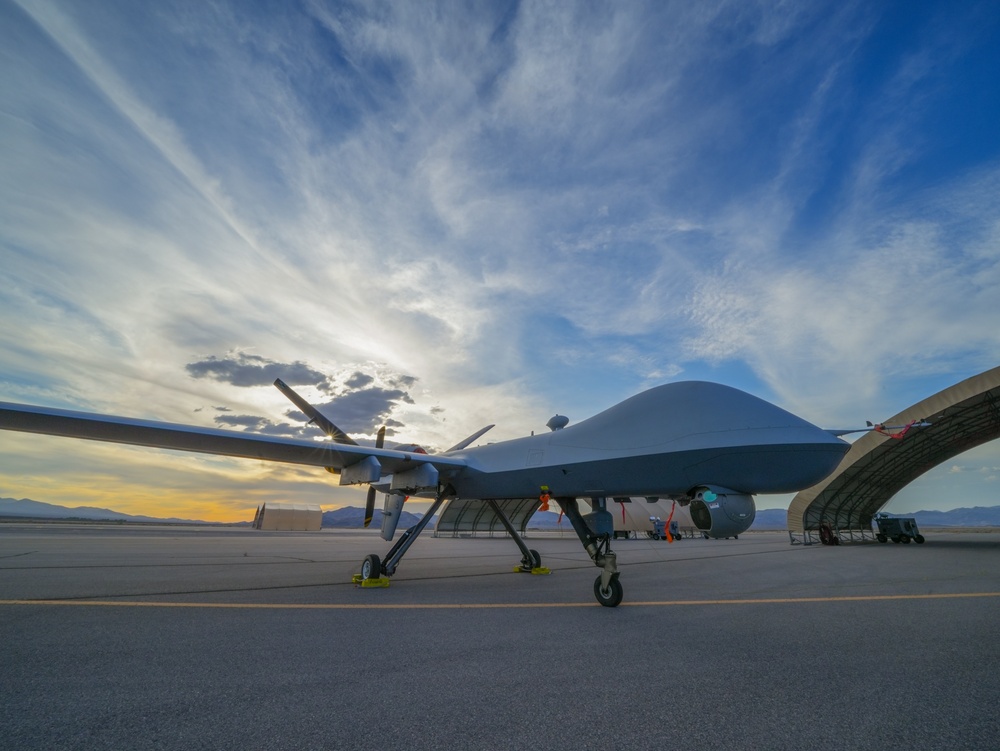
The admission settles one question and leaves several others open. Mexican officials now say the flights happened, roughly when they happened and under what legal authority. Nobody on either side of the border has said publicly what aircraft flew, who operated it or what it collected.
What Mexico Said
According to the government's official transcript of the Nov. 23 conference, published on gob.mx, Trevilla said Mexican analysts picked up new leads, including phone numbers, about a week before the operation. The defense ministry then asked for aeronaves no tripuladas (unmanned aircraft) through the Security Cabinet and the National Security Council.
Trevilla laid out what goes into such a request. The requesting ministry submits it to the National Security Council and has to state the objective, what is being sought, where the aircraft will survey, the route and the type of aircraft. The Security Cabinet then meets and decides whether to approve it. As the defense secretary described it, this is a formal, case-by-case authorization at cabinet level, not a standing permission for foreign aircraft to fly over Mexican territory. He said the work contravened nothing in the Constitution, the National Security Law or the Airspace Protection Law, and that Mexican analysts kept interpreting what was collected until they located Meza Flores on Nov. 20.
Trevilla put the drone request in the context of a longer intelligence relationship. He said that for the past three months, by agreement of the National Security Council, Mexico had shared intelligence from its tracking of Meza Flores with the United States, and he described the exchange as "very, very important" ("muy muy importante"). He also said requests of this kind to the US government are "not new" and have been made for many years.
The Associated Press, reporting from the same conference, said Mexican officials described the authorization as covering the week before the capture and said the mission complied with Mexican law. Sheinbaum stressed the limits: according to the AP, she said US forces are not allowed to operate on the ground in Mexico and that the governments are only sharing intelligence. DroneXL, translating her remarks, reported that she said Mexico asked for one of these drones because it does not yet have the capabilities for certain types of platforms the United States has.
What the Raid Looked Like on Mexico's Side
Mexican forces carried out the capture itself, which the government called Operation Centella. According to the transcript, the operation used 361 personnel and 14 aircraft from the Secretaría de la Defensa Nacional:
- 5 UH-60 Black Hawk helicopters
- 1 Cougar EC725 helicopter (the transcript says the helicopters were armed)
- 5 Texan aircraft
- 2 heavy transport aircraft
- 1 Mexican Air Force unmanned aircraft
That last item is easy to miss. Two different drone stories are tied to this operation. One is the US flights, which Mexico requested and which happened in the week before the raid. The other is Mexico's own Air Force drone, which the transcript lists as part of the Centella air component. Some coverage merges the two. The record keeps them apart.
Meza Flores was captured in Guasave, Sinaloa, and flown to Mexico City, where he arrived at 05:20 on Nov. 21, according to the transcript. The AP reported Trevilla as saying that the capture of Meza Flores and 16 members of his group resulted from the intelligence sharing with US authorities. Security Secretary Omar García Harfuch paid tribute at the conference to four soldiers who were killed and 10 who were wounded in the operation.
The violence in Guasave was heavier than the arrests alone suggest. The AP reported that 20 people died in the city, among them four soldiers and 16 suspected criminals, according to Mexican officials. DroneXL's account of the conference gives the same breakdown.
What Washington Has and Hasn't Said
The US Justice Department's release on the arrest says that Meza Flores was captured on Nov. 20 in Guasave in a Mexican military operation, following a Homeland Security Task Force investigation. Attorney General Todd Blanche called it a combined interagency effort and a bilateral effort, and the release quotes DHS Secretary Markwayne Mullin. It also reports the arrest of Germán Rolando Gálvez Meza, known as "El Serafín," and notes that a federal grand jury in Washington, D.C., returned a second superseding indictment against Meza Flores on Sept. 25.
The release does not mention drones. According to the AP, the US government highlighted its intelligence support but did not immediately give details on the drone flights when asked. DroneXL reports that, until Monday, US drone involvement rested on unnamed officials quoted by The New York Times, and that the Mexican Defense Ministry's Nov. 21 follow-up statement did not mention drones. In DroneXL's account, the on-record description of the flights came from the host country, not from the country that flew the aircraft.
The Open Questions
What platform flew? Unknown. DroneXL found no official who had publicly named the US aircraft as of Monday evening, and Trevilla described the approval process without saying which aircraft was approved. Since a request has to name the aircraft type, the Mexican government knows the answer. It has not made it public.
Who operated it? Unknown. The DOJ credits a Homeland Security Task Force, and DroneXL cites a US Northern Command statement, as reported by Bloomberg, that its Joint Interagency Task Force-Counter Cartel "supported the targeting effort." Neither government has said whether a military unit, a law enforcement agency or another body flew the US aircraft.
One aircraft or several? The public statements don't match. DroneXL notes that Sheinbaum spoke of a single aircraft while Trevilla used the plural. The AP headline refers to "a drone." For now the number of US aircraft is unclear.
Is there precedent? Yes, by Trevilla's own account. In the transcript he said such requests are not new and that the 2023 capture of Ovidio Guzmán in Jesús María, on Jan. 5, 2023, was handled in a similar way. That suggests Mexico is presenting the Meza Flores flights as part of an established procedure rather than a new step.
What did the drones contribute? Trevilla said analysts interpreted the intelligence products until they located Meza Flores on Nov. 20, and the AP reported that the flights were meant to help Mexican forces surround him before the capture. Neither government has said what the aircraft sensed, how the flights related to the phone-number leads, or what they added beyond what Mexican forces could already do. The publicly known sequence is a request about a week before the raid, an authorization for that window, and a capture on Nov. 20.
Why It Matters
US surveillance flights over Mexico are politically sensitive in Mexico, and the way Mexican officials talked about them shows how Mexico City intends to handle them. They emphasized several points. Mexico made the request. A Mexican ministry specified the target, area, route and aircraft type. A Mexican cabinet body approved it. The flights complied with Mexican law. US forces are not allowed to operate on the ground. Mexican soldiers made the arrest, and four of them died in the operation.
Laying out the approval process publicly gives the government a way to defend foreign ISR flights as an exercise of sovereignty rather than a loss of it. It also sets a standard for future requests. If every flight needs a named target, route and aircraft type plus cabinet approval, then Mexico's position is that it controls US unmanned surveillance over its territory and that there is no open-ended access.
For people who follow unmanned aircraft, the case shows how drone use in counter-narcotics operations is disclosed. The host government confirmed the flights and explained the legal basis. The government that flew them has said little about the aircraft. Until US officials, or Mexican officials pressed for specifics, say more, nothing is publicly known about the platform, its sensors or its precise role in finding one of the FBI's most wanted fugitives.
Sources
- Versión estenográfica, conferencia de prensa de la Presidenta Claudia Sheinbaum Pardo del 23 de noviembre de 2026 (gob.mx)
- Senior Leader of Sinaloa Cartel and One of FBI's Ten Most Wanted Fugitives Arrested in Mexico (U.S. Department of Justice)
- US flew drone over Mexican territory to help capture drug lord in Sinaloa (Associated Press via News4JAX)
- US drones flew over Sinaloa at Mexico's request to find FBI fugitive (DroneXL)