
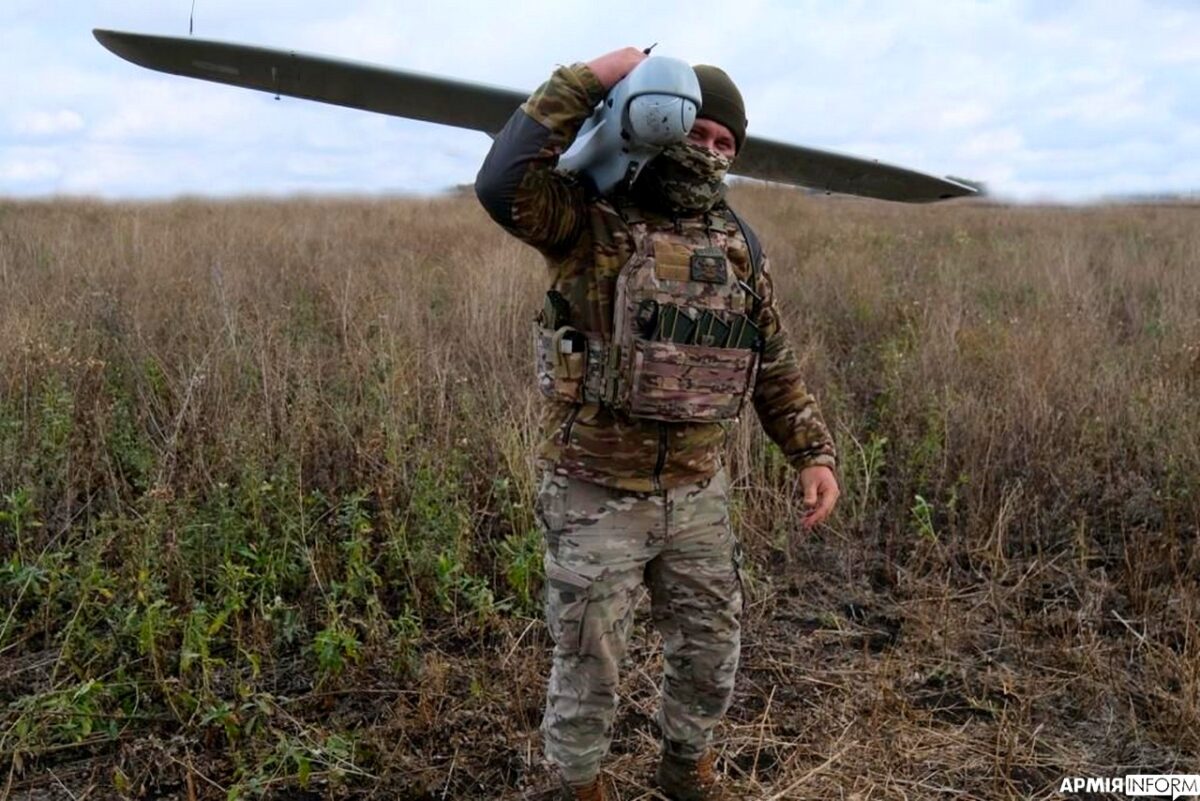
Germany will pay to build a Ukrainian reconnaissance drone on German soil. On Monday, Nov. 23, Defense Minister Boris Pistorius met Ukrainian Defense Minister Khmara in Berlin, and the two signed an implementation agreement for a new joint production project. According to a press release from German drone maker Wingcopter, Pistorius committed roughly EUR 34 million to set up domestic production of the Babka, a small fixed-wing tactical reconnaissance aircraft that Ukrainian forces already fly.
The ministers gave the money and the intent. They left out most of the operational detail. None of the three public statements says where the factory will be, when production starts or what each aircraft will cost.
What Was Signed
The Ukrainian Ministry of Defence's account describes the deal in general terms. A Ukrainian company and a German company are setting up a joint venture in Germany, and that venture plans to manufacture "several thousand" Ukrainian tactical reconnaissance and surveillance drones in 2027. The German side will pay for the production, the production capacity needed to support it and further support. The ministry also leaves room for larger deliveries to Ukraine's Defence Forces later.
Kyiv counts this as its 12th joint defense production project with foreign partners. Six of the 12 are with Germany. "Germany is one of the leaders in supporting Ukraine's defence industry," Khmara said, according to the ministry.
The ministry page does not name the drone or the companies, and the text gives no euro figure. Wingcopter's release, dated Nov. 24, supplies those details. It quotes Pistorius saying that "the Ukrainian BABKA reconnaissance drone will be produced in Germany in the future—specifically for Ukraine." DroneXL reports that the German ministry's account names the Babka but not the companies, so Wingcopter's announcement is where the manufacturers are identified. DroneXL also reports that Pistorius said the Babka has proven itself in Ukraine's defensive fight.
Who Builds It
The joint venture pairs TAF Industries, acting through its subsidiary Shadow Flytech LLC, with Wingcopter Security & Defence. Wingcopter says the partners formed the venture earlier this year, after signing a memorandum of understanding at the Munich Security Conference. Their stated goal is to become the largest German manufacturer of fixed-wing reconnaissance drones.
The venture will produce two aircraft. Alongside the Babka it builds the Wingcopter 262, a larger eVTOL design. Wingcopter says the venture will first supply the Ukrainian Armed Forces at scale from production sites at undisclosed new locations in Germany, and that the systems will also be made available to German and NATO forces.
The Aircraft, by the Manufacturer's Numbers
All of the performance figures below come from Wingcopter. DroneXL notes that the release cites no independent flight data to check them.
- Babka: 30x optical zoom, about 3 hours of flight time, 50 km tactical range, 3 kg (about 6.6 lb) weight, 130 cm wingspan.
- Wingcopter 262: eVTOL configuration, 80x zoom, about 6 hours of flight time, 150 km range, under 10 kg, 262 cm wingspan.
The two aircraft cover different jobs. Wingcopter describes the Babka as a low-cost design simple enough for mass production, which fits the "tactical" label in Kyiv's description. By Wingcopter's figures the 262 doubles the endurance, triples the range and offers a far higher zoom. As an eVTOL design, it takes off vertically. The agreement as described by the Ukrainian ministry covers tactical reconnaissance drones, and the money announced is tied to the Babka.
What Nobody Has Said
The open questions matter as much as the headline figure:
- Factory location. Wingcopter refers only to "undisclosed new locations in Germany" and does not name them.
- Start date. The Ukrainian ministry gives 2027 as the target year for output of several thousand units. DroneXL found no production start date in any of the three statements.
- Unit price. No per-aircraft price has been disclosed. Simple division of EUR 34 million by "several thousand" drones would be misleading, because the German side is also paying for production capacity and "further support," not just airframes.
- Volume. "Several thousand" is the only number given. There is no contract quantity and no delivery schedule.
Read together, the statements set out a political commitment and the money behind it, not a production contract with milestones. When the joint venture names a site and a first-delivery date, the program can be measured.
Why It Matters
The deal follows a pattern in how Europe now arms Ukraine. Instead of buying Western systems and shipping them east, governments are paying to build designs that have already been used in combat in Ukraine, inside their own industrial base. DroneXL's editor argues that this gives Ukrainian designs factories that Russian missiles cannot easily reach, and gives Germany production lines for drones that have been used in combat. Wingcopter's release says the systems will also be made available to German and NATO forces.
The deal also adds a competitor to Germany's reconnaissance drone market. DroneXL reports that the venture will compete with Quantum Systems, the maker of the Vector and Falke, which it reported last December was in line for a EUR 210 million German Army reconnaissance contract. The Babka money is much smaller, about a sixth of that reported figure (34 divided by 210 is roughly 0.16). Still, it gives the Wingcopter–TAF Industries venture a state-funded program and a fielded Ukrainian product to point to as it competes for German and allied orders.
For Ukraine, a sixth German project in a portfolio of 12 shows how central Germany has become to co-production; the ministry calls Germany one of Ukraine's largest partners in joint production. The open question is timing. Several thousand drones in 2027 is Kyiv's figure, and it only helps if the factories are built and staffed on schedule. The public record does not yet show where those factories are or when they will open.