
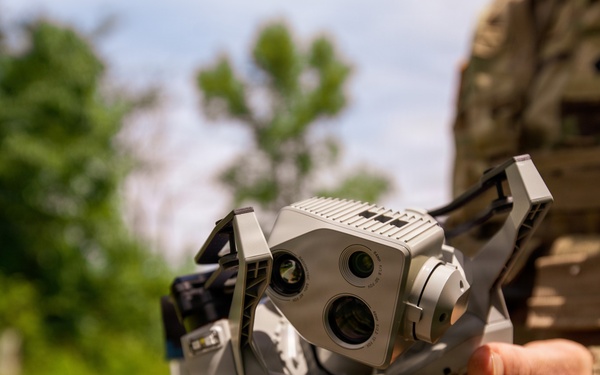
The federal government expects roughly 1,500 state, local, tribal and territorial law enforcement agencies to certify under the SAFER SKIES counter-drone rule within the next two years, giving local police the legal authority — for the first time — to detect and, in some cases, disable unauthorized drones over their own jurisdictions.
SAFER SKIES was signed into law December 18, 2025, as a joint effort of the Department of Justice and Department of Homeland Security, with the Pentagon, FAA, FCC and NTIA all holding pieces of the implementation. Its interim final rule took effect July 1, 2026, and the authority it grants is set to sunset December 31, 2031 unless renewed. Congress passed the underlying legislation, S.3481, as part of the annual defense authorization process rather than as a standalone bill, a route that moved it through both chambers with bipartisan sponsorship without a prolonged floor fight of its own.
Two Tiers, One Big Gap
The rule splits authority into two certification tiers. The first, Detection and Warning, requires only a roughly one-hour online course and is auto-issued on completion — it lets an agency spot and flag unauthorized drone activity but not act on it. The second, Mitigation, is far more consequential: it permits jamming a drone's control link or physically downing it with reasonable force, but only after resident training at the FBI's National Counter-UAS Training Center.
That gap between the two tiers is where the rule's real bottleneck sits. As of the rule's July 6 publication, only 61 officers across roughly 46 agencies nationwide held the mitigation certification. Since the rule took effect, about 500 more officers have gone through training — still a small fraction of the 1,500 agencies expected to eventually participate.
Guardrails on the New Power
Mitigation isn't unconditional. Agencies that jam or down a drone must report the action within 48 hours, notify air traffic control within five minutes of activating any system, and can retain intercepted communications for a maximum of 180 days. Civil fines for rule violations run as high as $100,000 per incident — a deliberate check against trigger-happy or improperly documented takedowns in shared airspace.
The FCC's Piece of the Puzzle
The FCC moved fast to clear its own regulatory obstacles once the interim rule took effect. On July 2, the agency's Office of Engineering and Technology waived certain equipment-authorization requirements so manufacturers can market and import approved counter-drone systems that appear on the SAFER SKIES Authorized Systems List without waiting on the traditional certification process. The FCC also granted broad temporary spectrum authorization to certified state, local, tribal and territorial agencies, and its Wireless Telecommunications Bureau issued a declaratory ruling clarifying Section 333 of the Communications Act — confirming that certified agencies, federal contractors and manufacturers testing counter-drone equipment are protected from liability tied to signal-jamming activity. The agency described the combined actions as intended "to ensure that trained local authorities have the ability to respond quickly when drones pose credible threats."
Why It Matters
The urgency behind SAFER SKIES was on display at this year's FIFA World Cup, where federal agencies detected more than 1,600 unauthorized drones across the tournament's 11 American host cities, seized over 700 aircraft, opened around 120 federal cases and made a dozen arrests — all without the benefit of local agencies sharing detection or mitigation duties. Army Brig. Gen. Matt Ross, addressing the broader drone threat, put it bluntly: "I think we've got a ton of work to do." With the certification pipeline still thin, that work now falls to thousands of local agencies racing to get trained before the next mass-gathering event tests the gap between legal authority and operational readiness on live airspace rather than in a training exercise.
