
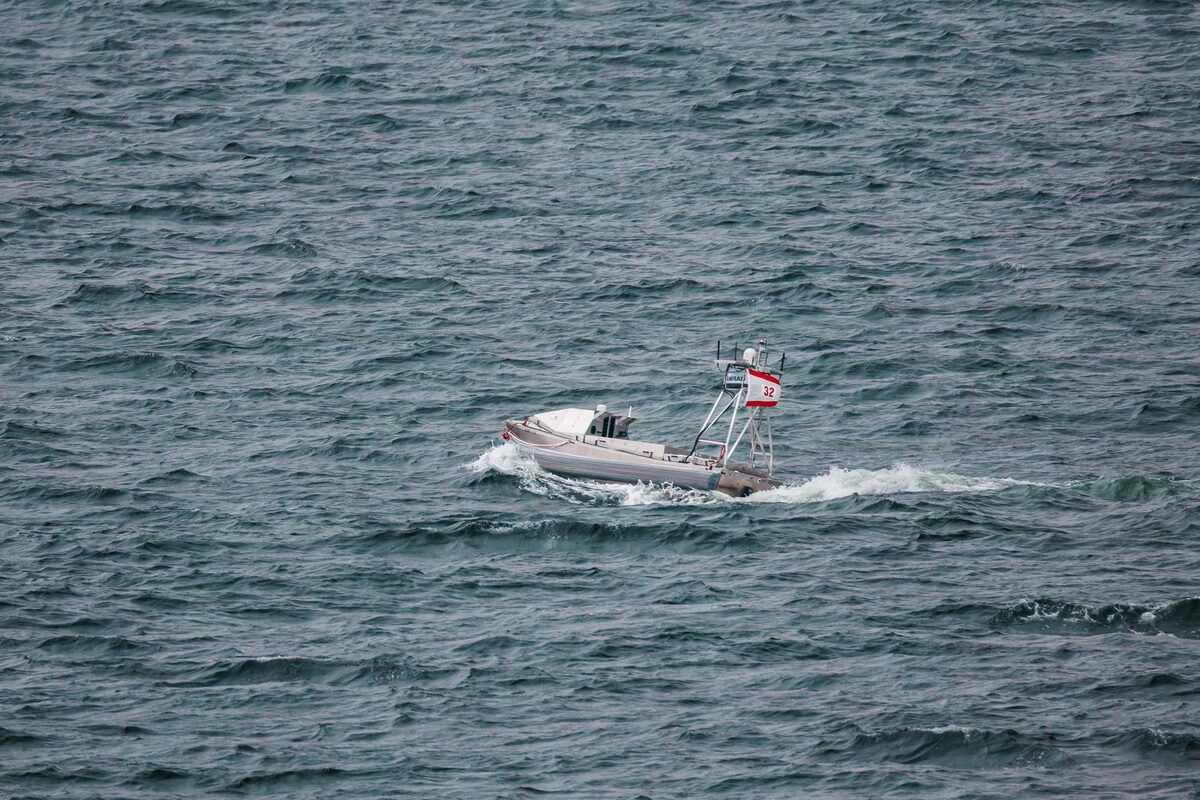
A drone that flies by skimming just above the water, riding a cushion of compressed air between its wings and the surface, spent thirteen days in July proving it can operate in a Navy exercise environment rather than just a company test tank. REGENT Craft's autonomous Squire seaglider completed a multi-day freshwater demonstration at Silent Swarm, an experimentation event held in Michigan's Northern Lower Peninsula at the Alpena Combat Readiness Training Center, run by Naval Surface Warfare Center Crane Division (NSWC Crane) on behalf of the Pentagon's Office of the Under Secretary of Defense for Research and Engineering.
The trials mark a series of firsts for the Rhode Island-based startup's uncrewed platform: its first time operating in freshwater, its longest sustained run of exercise participation to date, and its most substantial exposure yet to the kind of mixed military audience — uniformed operators, engineers, spectrum managers and assessors — that ultimately decides whether an experimental craft becomes a program of record.
What Is a Wing-in-Ground-Effect Drone?
Squire belongs to a small and unusual family of vehicles called wing-in-ground-effect (WIG) craft, sometimes nicknamed "ekranoplans" after Soviet-era experiments with the concept. Rather than climbing to cruising altitude like a conventional aircraft, a WIG vehicle flies within a wingspan or so of the surface below it — water, in Squire's case — where the ground effect dramatically increases lift and cuts drag. The result is a craft that behaves something like a boat and something like an aircraft: faster than a surface vessel, more efficient than a low-flying plane, and largely invisible to radar systems tuned to look upward rather than skim the wave tops. REGENT — an acronym for Regional Electric Ground Effect Nautical Transport — has built its business around that niche, and Squire is the company's uncrewed, defense-oriented derivative of the concept. According to reporting on the craft's specifications, Squire is engineered to carry up to 50 lb (23 kg) of cargo at speeds up to 81 mph, numbers that put it well ahead of a small maritime surface drone while still hugging the water rather than flying a traditional profile.
From First Flight to Freshwater
Squire's public test record has moved quickly. The craft made its first ground-effect flight in April 2026, followed by saltwater trials conducted near REGENT's Rhode Island headquarters. Silent Swarm represented the platform's first outing in freshwater conditions, a distinction that matters for a company aiming to sell an amphibious-capable system to a military customer that will eventually want to operate inland waterways, rivers and lakes in addition to coastal and open-ocean environments — each of which stresses a marine vehicle's propulsion and hull differently.
During the event, REGENT's team ran Squire through what the company's Director of Defense Mission Integration, Becky Russo, described as a full slate of experimentation activities: multi-domain field experiments alongside other systems at the event, government-run modeling and simulation work aimed at risk reduction, and structured feedback sessions with the operators, engineers, spectrum managers and assessors who attended. The craft also demonstrated its ability to mount sensors and payloads both internally and externally — a configuration flexibility that matters for a military buyer weighing whether to use the platform for logistics, surveillance, or some combination of both.
Thirteen Days, Longest Run Yet
The duration of the Silent Swarm campaign is itself notable. Squire's participation stretched across thirteen days, described in coverage of the event as the longest sustained exercise the platform has taken part in to date. For an experimental uncrewed system, extended multi-day participation in a live event is a different bar than a single demonstration flight — it requires the craft, its ground support, and its operators to sustain repeated sorties, handle maintenance turnaround, and keep performing in front of assessors who are evaluating reliability as much as capability.
Who Ran the Event
Silent Swarm itself is organized by NSWC Crane, the Navy's Indiana-based warfare center known for its work on electronic warfare and expeditionary systems, operating under the sponsorship of the Pentagon's Office of the Under Secretary of Defense for Research and Engineering — the department's top research and technology office. That sponsorship places Squire's demonstration inside a broader Defense Department push to rapidly evaluate uncrewed and autonomous systems through hands-on experimentation events rather than lengthy traditional acquisition cycles, giving REGENT direct exposure to the mix of technical and operational personnel who will shape whether wing-in-ground-effect craft find a place in future Navy or Marine Corps concepts.
Why It Matters
Wing-in-ground-effect vehicles have circled the edges of military interest for decades without breaking into mainstream use, largely because building a craft that reliably transitions between water contact and sustained ground-effect flight is a hard engineering problem, and because the operational case for a low-altitude, radar-evading transport has historically had to compete with cheaper or more mature alternatives. REGENT's pitch is that autonomy changes that calculus: an uncrewed seaglider that can move cargo or sensors at speeds far above a boat's, low enough to avoid most airborne detection, without putting a pilot at risk, fits neatly into the Pentagon's current appetite for distributed, attritable, and hard-to-target platforms — particularly for contested littoral and archipelagic environments where a fast, low, hard-to-see connector between islands or ships could matter.
Silent Swarm's structure — real field experiments paired with government modeling and direct operator feedback, run by a warfare center on behalf of the Pentagon's own research office — is exactly the kind of venue that turns a promising demonstrator into program interest, or exposes gaps that keep it a science project. Moving from saltwater to freshwater testing, sustaining thirteen consecutive days of exercise participation, and proving out both internal and external payload carriage in front of uniformed evaluators are the specific, checkable milestones that separate a vendor's flight-test footage from a system a service is willing to keep testing. For REGENT, each is a data point supporting the case that Squire is maturing from a novel flight-physics demonstration into a platform the Navy is willing to keep putting in front of the people who write requirements.
Sources
- REGENT Craft completes Squire demonstration at Silent Swarm — Janes
- Regent Completes Exercises For Military With Autonomous Seaglider — Aviation Week
- REGENT Demonstrated Autonomous Seaglider At Navy Drone Event — Defense Daily
- America's Only Wing-in-Ground Effect Drone Does 13 Days of Military Drills for the First Time — autoevolution