
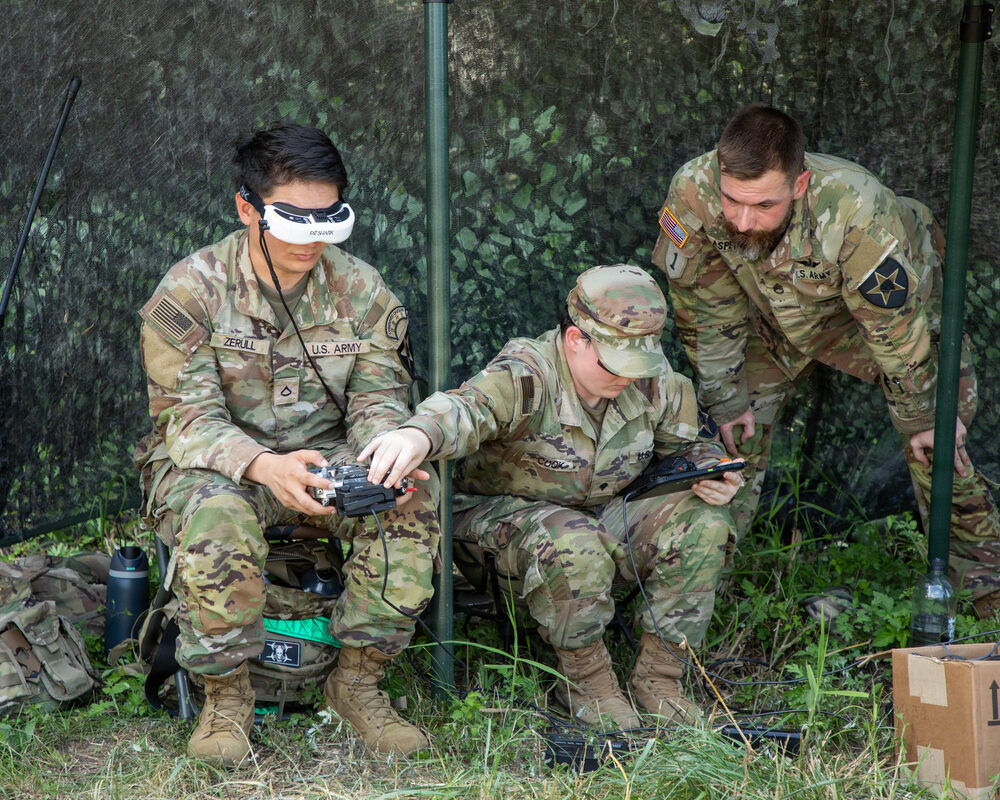
The Pentagon has spent most of 2026 talking about drone dominance. In an Oct. 31 Bloomberg factory tour, relayed by DroneXL, one of the officials running the effort said where the US actually stands. Travis Metz, acting head of the Defense Innovation Unit (DIU), said the United States is "starting from basically zero" on mass-producing cheap drones.
That could pass for a sound bite. The numbers from the Drone Dominance Program's first two "Gauntlet" competitions show it is closer to a plain description. The program's targets are large in Pentagon terms and small next to what the active drone powers produce. Its delivery record so far is mixed, and the parts inside the drones still lead back to China.
The Scale Problem
Start with the goal. According to DroneXL's account of the Bloomberg reporting, Drone Dominance aims for about 250,000 drones by the end of 2027, with roughly $1.1 billion committed. DefenseScoop's September coverage of Gauntlet 2 described the target as more than 200,000 uncrewed aircraft systems by 2027. The two figures differ slightly, but they describe the same order of magnitude.
Now compare it with other countries. Ukrainian intelligence expects Russia to build 7.3 million small expendable drones this year, per DroneXL. Ukraine says it will make 10 million. Bloomberg Intelligence estimated in February that China could surge to 500,000 drones per month. At that rate China would pass the Pentagon's two-year goal in about two weeks.
The US target is not meaningless. A quarter-million attritable drones would be a large step up: DroneXL reports the Army took delivery of 8,500 small drones through Gauntlet and service programs in fiscal 2026. But the goal would still amount to roughly 3 percent of Russia's expected output for this single year.
Gauntlet 1: Ordered Short, Delivered Late
The program's first round shows how hard it is to turn competition results into hardware. Per DroneXL, Gauntlet I paid 11 companies $150 million in March for 30,000 one-way attack drones, at an average price of about $5,000 each. By mid-September, only three of those companies had delivered every drone on the program's public leaderboard.
The order book was also smaller than announced. Inside Unmanned Systems reports that Gauntlet 1 ended up ordering only 22,320 drones of the planned 30,000, or about 74 percent. So the first round fell short twice: fewer drones were ordered than planned, and most vendors had not finished delivering about six months after the awards.
Gauntlet 2: Better Aircraft, Bigger Orders
The second round was larger and, on performance, clearly better. DefenseScoop reports that Gauntlet 2, held at Fort Carson, Colorado, logged 1,858 sorties across 23 platforms from 19 companies. Range improved sharply. All 11 platforms evaluated at long distance reached 15 kilometers, while in Gauntlet 1 only 24 percent of drones reached 10 kilometers, according to DIU.
The field was narrowed beforehand. According to Inside Unmanned Systems, the program vetted 78 drones from 49 companies in Michigan before 19 companies qualified for Fort Carson.
The two leaderboards, as reported by DefenseScoop:
- Deep strike: Perennial Autonomy, Hyperscale, Neros, Skycutter, Swarm Defense Technologies.
- Close quarters: Neros, ORQA US, XTEND Reality, Vector, ModalAI.
Neros placed in both categories and, per Inside Unmanned Systems, is reportedly in line for about 14,000 drones. Orqa, XTEND and Vector Defense won this round after missing the Gauntlet 1 leaderboard. The top five close-quarters entries averaged 80.72 points, compared with 70.68 for deep strike, according to Inside Unmanned Systems. That gap may indicate the short-range FPV category is more mature than the long-range one, though the two categories were scored on different missions.
The commercial terms are strict. Inside Unmanned Systems lists price ceilings of $5,500 for long-range drones and $4,500 for short-range. Winners must deliver half their order within 2.5 months of contract placement and the rest within 4.5 months. Orders from this pool can reach about 60,000 drones in total, though Inside Unmanned Systems notes that is not guaranteed. DefenseScoop reports that a Gauntlet 2.5 round focused on "bomber" drones comes next.
Those delivery windows are the real test. Gauntlet 1's vendors mostly missed full delivery over roughly six months. Gauntlet 2 plans up to about twice the volume on a somewhat shorter schedule.
What the Factory Floor Looks Like
The Bloomberg tour, as summarized by DroneXL, shows a supplier base that is real but small. Vector Defense, in Bluffdale, Utah, makes a few hundred small quadcopters a month. CEO Andy Yakulis calls the product ammunition, "a mortar round or a bullet or a hand grenade that just happens to fly." A few hundred a month is far from wartime munitions volume.
Teal Drones, part of Red Cat, is larger. It builds about 1,000 Black Widow drones and 2,000 Fang FPVs a month, according to the report. Teal did not make the Gauntlet 2 close-quarters leaderboard, per DefenseScoop. That leaves one of the bigger domestic producers outside the latest round's top tier.
Performance Drone Works is making the most ambitious financial bet. DroneXL reports it holds $820 million in Department of Defense loans and aims to produce 1 million critical components a year by the end of 2028.
The Army is buying on a separate track. Per DroneXL, Col. Danielle Medaglia told Bloomberg that more than $850 million has flowed through an Army drone marketplace, while the Army itself has bought 450 small drones from 21 vendors through it. The report does not reconcile those two figures, and neither do we. Army Materiel Command, meanwhile, is targeting 50,000 brushless motors by the end of fiscal 2027.
The Parts Problem
That motor target points to the biggest weakness in the effort. DroneXL reports that China dominates the supply of batteries, brushless motors and propellers for small drones. Red Cat COO Chris Ericson told Bloomberg that motors and cameras are among the most expensive parts on a drone and that "you can buy them cheap in China." Teal pays a premium for compliant parts instead, per the report.
Skydio CEO Adam Bry says his company has effectively eliminated direct dependence on China, but he cautions that "Anybody who says their dependence on China is purely zero is probably deluding themselves," because suppliers sit several layers below the companies that assemble the aircraft. Even a manufacturer that has largely cut direct ties does not claim a clean break from Chinese supply chains.
The constraint bears on cost. Inside Unmanned Systems reports that Gauntlet 2 introduced stricter requirements for secure, indigenous or allied components, including motors and batteries from proscribed countries as of this August, which it says may also disrupt deliveries. Vendors who pay a premium for compliant parts must still stay under price ceilings of $4,500 to $5,500. Efforts like Army Materiel Command's motor target and Performance Drone Works' component plan are attempts to deal with this, but they are measured in tens of thousands to a million units over several years.
Why It Matters
Ukraine has shown that small, expendable drones now function as an ammunition category, built in the millions. Measured that way, the US is building a new munitions industry almost from nothing. Metz's "basically zero" is an honest place to start.
The Gauntlet process is working as a filter. Aircraft performance improved clearly between rounds, and new winners emerged. Filtering is not the same as manufacturing, though. The program's success will depend on three things: whether Gauntlet 2 vendors meet the 2.5- and 4.5-month delivery deadlines that most Gauntlet 1 vendors missed, whether orders reach the announced totals instead of the 74 percent seen in round one, and whether a domestic parts base can grow fast enough to keep prices under the ceilings without relying on Chinese suppliers. The answers will show whether 250,000 drones by 2027 is a production plan or a slogan, and how far behind the countries already producing in the millions the US remains.
Sources
- Pentagon At 'Basically Zero' On Cheap Drones As Russia Builds 7.3M (DroneXL, Oct. 31, 2026)
- Pentagon unveils top performers in latest 'Gauntlet' for Drone Dominance Program (DefenseScoop, Sept. 18, 2026)
- Nine Companies Win DDP Gauntlet 2 FPV Drone Competition (Inside Unmanned Systems, Sept. 25, 2026)
