
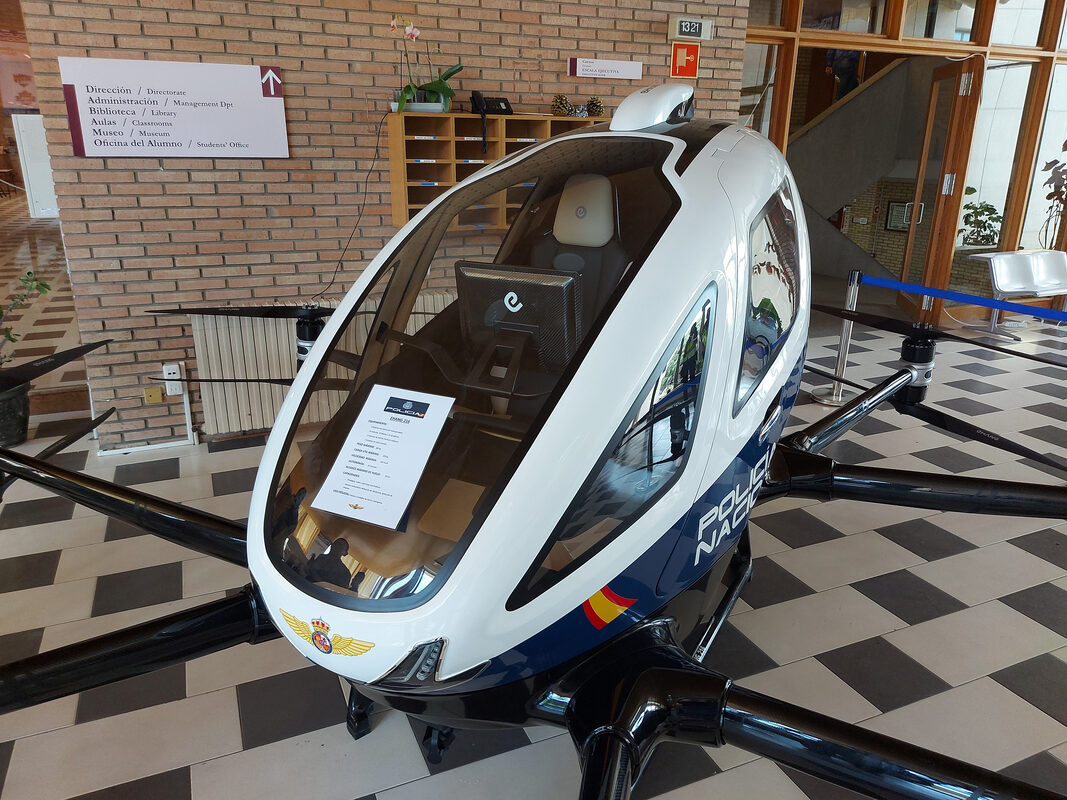
EHang has the paperwork to fly paying passengers in China but still has no permission to do it. So the company is building a business somewhere else. On Oct. 30 the Guangzhou-based maker of pilotless passenger aircraft announced an overseas regional hub in Thailand. The hub starts with a fleet of 25 EH216-S two-seat eVTOLs, and EHang laid out a calendar of sandbox flights in four Southeast Asian countries running through the end of the year.
EHang presented the hub as a base for "international eVTOL deployment" across Southeast Asia and other emerging markets. The timing matters. As Aviation Week reported a month earlier, EHang's commercial passenger service in China has stalled, and the company has withdrawn its full-year 2026 revenue guidance. The Thailand hub is one way to keep aircraft flying and agreements moving while Chinese regulators work on other priorities.
What EHang Is Putting in Thailand
The press release describes two separate drone operations at the hub.
- Passenger eVTOLs: An initial fleet of 25 EH216-S aircraft will be based in Thailand for "flight validation and project implementation." EHang has not said they will carry paying passengers there. The stated job is validation flying and project work.
- Formation drones: About 1,200 of EHang's GD4.0 light-show drones are already in Thailand, and the company plans to grow that fleet past 10,000.
The light-show business matters more than it might appear. EHang describes the show-drone business as an established operational base in Thailand, and it doesn't depend on any regulator approving people riding in autonomous aircraft. A larger show fleet could also give EHang local operating experience in the same country where it is running AAM sandbox work.
The Unmanned Airspace report on the announcement repeats the same figures: 25 EH216-S aircraft at the start, about 1,200 GD4.0 drones growing to 10,000 or more, and the hub's role in coordinating the region.
The November-December Calendar
The announcement goes beyond a single hub. EHang listed a set of near-term events in four countries, each run under its Global Fast Track Program and local advanced air mobility (AAM) sandbox arrangements:
- Sri Lanka (joined the program in August 2026): sandbox launch and validation flights at Port City Colombo in November, with commercial operations targeted by year-end.
- Vietnam (joined in September 2026): validation flights in the Hanoi sandbox in November.
- Malaysia: an EH216-S demonstration in Putrajaya in November, following sandbox cooperation with the Civil Aviation Authority of Malaysia (CAAM).
- Thailand: an EH216-S demonstration at the ICAO AAM Symposium in Bangkok in December.
EHang says every item on the list is "subject to local laws and approvals." Of the four, only Sri Lanka has a stated commercial target, and that target is year-end, two months away. The other three are validation flights or demonstrations. The Bangkok event is the most visible, since it is tied to an International Civil Aviation Organization symposium.
How the Fast Track Program Works
EHang launched the Global Fast Track Program in August, as China Daily Hong Kong reported. The idea is simple. EHang does not ask each country to certify the EH216-S from scratch. Instead, it invites foreign authorities to validate an aircraft that China's civil aviation regulator has already certified. The program has four phases:
- Framework alignment between EHang and the local authority.
- Site selection, infrastructure and ground operations.
- Validation flights.
- Commercial launch.
EHang points to safe flight records in 23 countries and regions as evidence for the case. CEO Huazhi Hu has publicly backed the program. Measured against that roadmap, the November and December events place most of the new partners in phase three. Sri Lanka is the one trying to reach phase four this year.
Vietnam shows what the paperwork looks like. Aviation Week reported that EHang signed a memorandum of understanding with HungViet Technology and Investment Trading JSC and the Hanoi Department of Science and Technology to run trials at Hoa Lac Hi-Tech Park. That is the sandbox setup EHang wants to repeat elsewhere: a local commercial partner, a local government body and a defined test area.
The Problem at Home
The odd part of this story is that EHang is not short of certificates. Aviation Week reported that the company holds all four certificates from the Civil Aviation Administration of China (CAAC) that it needs: type, production, airworthiness and air operator. Even so, it cannot yet charge passengers. EHang had told investors that commercial passenger flights would begin in March.
According to analysts at UOB Kay Hian, cited by Aviation Week, the delay is administrative, not regulatory, and the certificates themselves are not under review. Regulators moved rules for piloted aircraft to the front of the queue after a June 26 accident in which a Starair SA60L crashed into Beijing's CITIC Tower. The city's Chaoyang District Government later attributed the crash to the pilot. It involved a piloted two-seater, not an EHang aircraft, but it still changed the regulators' schedule, per UOB Kay Hian. Approval for operations in Hefei has been pushed back, and EHang withdrew its full-year 2026 revenue guidance.
That is the real background to the Thailand announcement. A company that cannot sell rides at home, and has dropped its own revenue forecast, is taking its sandbox model abroad. It is putting hardware in place and lining up public demonstration flights in countries willing to validate the Chinese certificate.
Why It Matters
For the wider UAS and AAM industry, EHang is testing whether a pilotless passenger aircraft certified in one country can win acceptance in others through validation instead of full re-certification. If Sri Lanka, Vietnam, Malaysia or Thailand moves from sandbox flights to paid service using the CAAC certificate as the starting point, that would set an early example of regulators importing autonomous passenger-aircraft approvals. The outcome would be worth watching for other developers.
The plan also limits EHang's dependence on Beijing. The light-show fleet, which EHang plans to grow past 10,000 drones, gives the company an operating presence in Thailand while passenger approvals are pending.
The caveats are real. None of the planned November-December events is a commercial passenger operation except Sri Lanka's year-end target, and every one depends on local approval. In China, the company already learned that holding all four certificates did not produce paying passengers on schedule. The next two months will show whether the Southeast Asian sandboxes move any faster, or whether the Thailand hub ends up as a well-equipped place to wait.
Sources
- EHang Establishes Overseas Regional Hub in Thailand to Support International eVTOL Deployment Across Southeast Asia and Other Emerging Markets (EHang, Oct. 30, 2026)
- EHang plans fleet of uncrewed passenger-carrying eVTOLs for Thailand (Unmanned Airspace, Oct. 30, 2026)
- EHang Exports Sandbox Model To Vietnam Amid China Delay (Aviation Week, Sept. 30, 2026)
- EHang eyes eVTOL push via fast-track program (China Daily Hong Kong, Aug. 25, 2026)
