
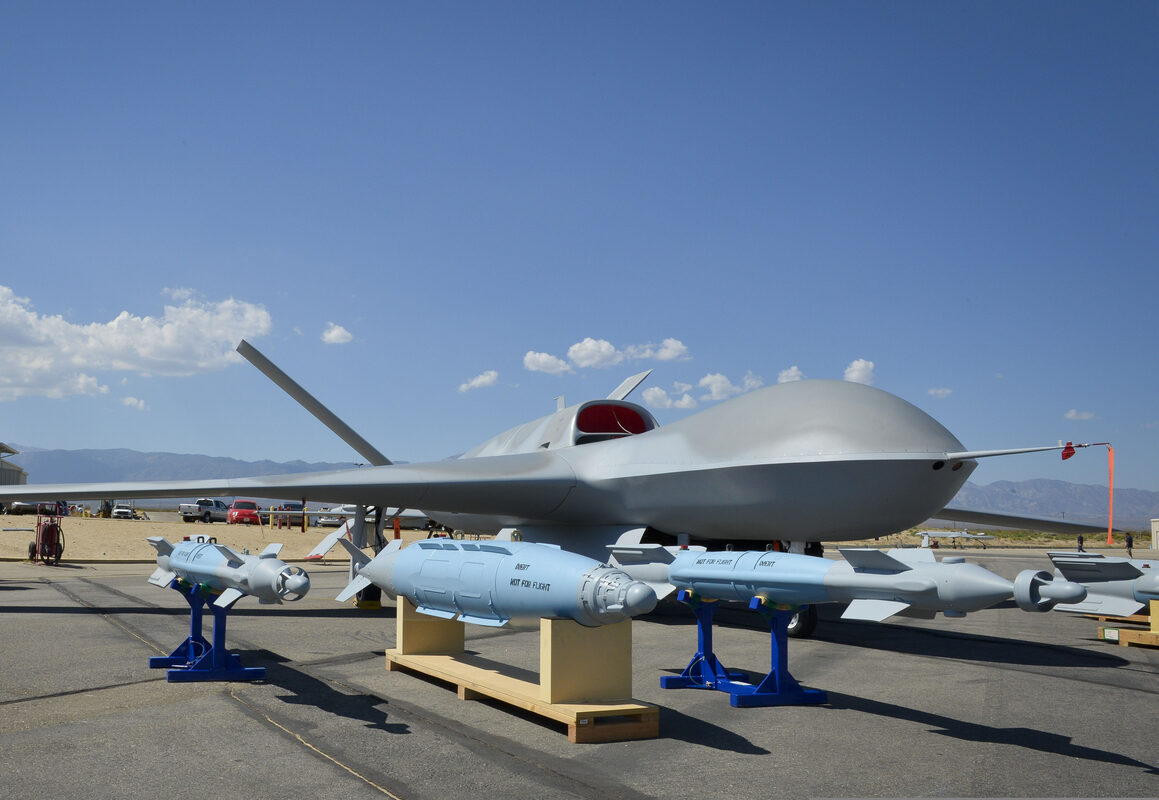
General Atomics Aeronautical Systems (GA-ASI) has confirmed that it is developing a new, much larger flying-wing drone it calls NextGen. It will carry weapons as well as sensors and use what the company calls "novel hybrid-electric propulsion." It is also not part of the Collaborative Combat Aircraft (CCA) effort that has taken up most of the company's public attention over the past two years.
The confirmation came from GA-ASI spokesperson C. Mark Brinkley in comments to The War Zone, published Oct. 30, 2026, as part of a status update on the whole Gambit family.
"General Atomics is currently working on a much larger flying wing we call NextGen. It's not a CCA. We're talking novel hybrid-electric propulsion on a fully armed, fully outfitted, ISR/Strike wing. Our engine team has promised 60+ hours unrefueled."
Note the wording at the end of that quote. The 60-plus-hour figure is something the company's engine team has promised. It has not been demonstrated, and GA-ASI has not said whether the number comes from analysis, ground testing or anything else. Until hardware flies, read it as a design goal.
What NextGen is, and what it isn't
Brinkley's statement draws three lines. NextGen is a flying wing. It is "much larger" than a typical CCA-style drone. And it is meant to be a complete combat aircraft, "fully armed, fully outfitted," for both intelligence, surveillance and reconnaissance (ISR) and strike. It is not built to be a low-cost loyal wingman flying next to a crewed fighter.
Brinkley also said the work on the NextGen flying wing "will funnel into Gambit 4," one of the six variants in GA-ASI's modular Gambit family, "so that when customers are ready for this, we're not starting from scratch." So NextGen does not look like a standalone program built from scratch. It reads more like the development path for Gambit 4, the family's flying-wing member.
The statement does not describe the hybrid-electric architecture. It doesn't say how power is split between a combustion engine and electric drive, what the energy storage is, or how propulsors are placed on the wing. It gives no size, weight, payload, weapons load or timeline either.
Where the idea comes from
The 60-hour figure is not new for General Atomics. The War Zone notes that the company has previously tied hybrid-electric propulsion to a 60-hour endurance target for an earlier stealthy flying-wing concept called MQ-Next.
The hybrid-electric part has a more concrete history. The War Zone points to an earlier Air Force Research Laboratory (AFRL) contract awarded to GA-ASI for what AFRL described as a "hybrid-electric propulsion ducted fan next-generation intelligence, surveillance, reconnaissance/strike unmanned aerial system," known as GHOST. GlobalSecurity's reference compilation on the Gambit family links Gambit 4 to GHOST.
Put together, the line appears to run like this: MQ-Next set the endurance goal, GHOST explored hybrid-electric ducted-fan propulsion for the ISR/strike mission with AFRL backing, and NextGen appears to build on both in a larger armed flying wing whose work will shape Gambit 4. That is a reasonable reading of the record, but The War Zone itself says it remains unclear how GHOST is intertwined with MQ-Next, NextGen and Gambit 4, and GA-ASI has not publicly confirmed the lineage step by step.
The Gambit family: a status check
GA-ASI first unveiled Gambit in March 2022 as a family of six variants built on a common "Gambit Core," according to GlobalSecurity. The core includes landing gear, baseline avionics and other shared hardware, with different airframes and mission equipment fitted on top. Here is where the variants stand, based on the reporting cited in this article. The sources reviewed here don't give current status for Gambit 3 or Gambit 5, so they are left out below.
Gambit 1: XQ-67A
Gambit 1 is the XQ-67A, built for AFRL's Off-Board Sensing Station (OBSS) effort. GlobalSecurity records its first flight on Feb. 28, 2024. The War Zone reports that AFRL has since announced that the XQ-67A demonstrated integration of several mission systems during a recent test flight over the Nevada Test and Training Range (NTTR) as part of a program called Demon Ape. So the jet is still being used as a testbed.
Gambit 2: FQ-42A Vengeance
Gambit 2 is GA-ASI's CCA Increment 1 aircraft, now called FQ-42A Vengeance. It is the company's most visible program. GlobalSecurity records the first YFQ-42A flight on Aug. 27, 2025, and Air & Space Forces Magazine reported that Anduril's competing YFQ-44A first flew only days before the magazine's Nov. 4, 2025 report on GA-ASI's second YFQ-42A flight, which the company disclosed in a Nov. 3, 2025 press release.
According to The War Zone, Brinkley listed the type's first missile live-fire, planned for later this year, and participation in the Emerald Flag exercise as upcoming milestones. Both move the program from flight test toward showing it can do its combat job.
Gambit 4: the NextGen connection
Gambit 4 is the variant NextGen is meant to feed. GlobalSecurity links it to GHOST and describes it as a tailless flying wing. With this week's statement, Gambit 4 now looks like the place where GA-ASI's long-endurance, hybrid-electric ISR/strike work ends up. The War Zone describes Gambit 4 as still an ambitious future concept that relies heavily on the success of NextGen and related work, and as an outlier completely different from the other concepts in the family.
Gambit 6: air-to-ground
GA-ASI announced Gambit 6 in a separate release around its Nov. 3, 2025 CCA announcement, as a variant meant for air-to-ground missions, according to Air & Space Forces Magazine. The War Zone now reports that the company is planning a company live-fire event for early 2027, using a ground-attack munition from a company-owned Gambit 6.
Why a non-CCA matters for General Atomics
The CCA program is the biggest prize in the uncrewed combat aircraft market right now. The War Zone notes that in September the Air Force announced a goal of at least 500 Increment 1 CCAs in inventory by 2032. GA-ASI's FQ-42A is one of the two aircraft the Air Force has ordered into production under Increment 1; the other is Anduril's FQ-44A Fury.
But a CCA is a specific kind of aircraft: relatively cheap, fast enough to keep up with fighters, and built to work alongside crewed jets. Brinkley's "It's not a CCA" makes clear that GA-ASI is also chasing a separate mission. That mission is long-endurance surveillance combined with the ability to strike. In the same statement, Brinkley said GA-ASI has built and delivered more than 1,600 aircraft in 34 years.
A larger flying wing with extreme endurance would be a new step for that line of work, though GA-ASI has not said which threats or environments NextGen is meant to operate in.
Why It Matters
Endurance is the main selling point of uncrewed ISR. An aircraft that can stay airborne for more than 60 hours without refueling needs fewer airframes and fewer launches to keep a sensor or weapon over an area, which affects fleet size, basing and crew workload. If GA-ASI's engine team delivers, NextGen would make that case strongly.
The caveats are just as important. NextGen's endurance is a company promise, not a flight-test result. Its hybrid-electric architecture has not been described publicly. GA-ASI has not announced a customer, a contract or a schedule. What this week did make clear is that the company is pursuing two paths at once: a CCA line with FQ-42A plus the Gambit 6 live-fire planned with a company-owned jet, and a separate long-endurance, armed flying wing developed through NextGen and Gambit 4.
The milestones to watch are concrete: FQ-42A's first missile shot and its Emerald Flag appearance, the Gambit 6 live-fire planned for early 2027, and any GA-ASI disclosure of NextGen hardware, propulsion testing or a government sponsor. Each one would show how much of the Gambit roadmap is turning into flying aircraft.
Sources
- General Atomics Developing Strike-Recon Flying Wing Called NextGen That Uses Hybrid-Electric Propulsion (The War Zone, Oct. 30, 2026)
- GA-ASI Gambit Series - Modular Collaborative Combat Aircraft Family (GlobalSecurity)
- General Atomics Flies Second CCA, Announces New Ground-Attack Drone (Air & Space Forces Magazine, Nov. 4, 2025)
