
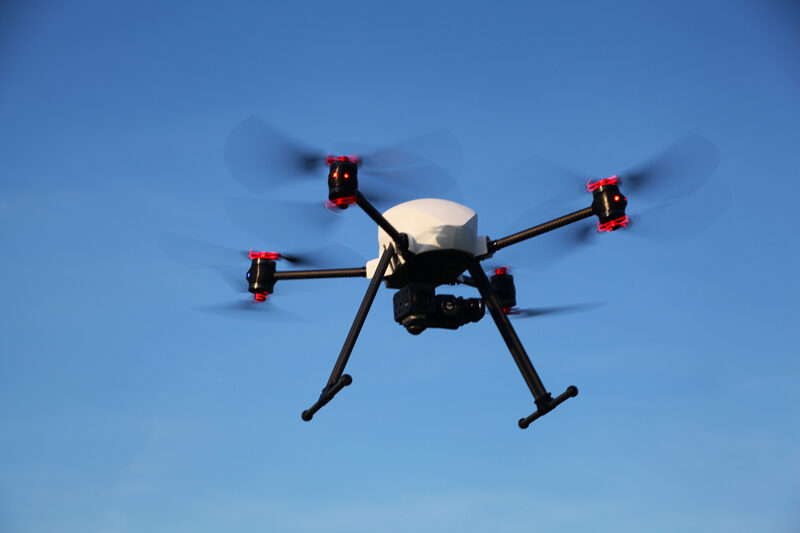
Most drone designers treat contact as failure. A rotor that touches a wall usually means a crash, so the standard answer to a tight opening is to plan a path around it or to build a smaller aircraft. A new paper on arXiv takes the opposite approach. Its authors built a quadrotor that is meant to hit the edges of a gap and uses that contact to fold itself narrow enough to get through.
The paper is titled "Task-Driven Closed-Loop Design Optimization of Passively Morphing Quadrotors for Contact-Mediated Narrow Gap Traversal" (arXiv 2611.09272). It was first submitted on November 6, 2026 and last revised on November 11. The authors are Etor Arza, Luca Girardi, Gabriel Maquignaz, Javier Paez, Stefan Leutenegger, Stefano Mintchev and Kostas Alexis. Their prototype is 31.3 centimeters wide in normal flight. When it presses into an opening, its two side arms bend and it narrows to 14.1 centimeters, about 55 percent less. That is narrow enough to clear a 15-centimeter gap, which is about 16 centimeters narrower than the drone's normal span.
IEEE Spectrum showed the work in its Video Friday roundup on November 20 and credited the work to the Autonomous Robots Lab, thanking Alexis for the tip. Below is what the paper says it shows and what is still unproven.
What does "passively morphing" mean here?
The key word is "passively." A morphing drone could carry motors or servos that fold its arms on command. That approach needs extra actuators, extra weight and a control system that knows when to fold. This design doesn't work that way. According to the abstract and Spectrum's description, the two side arms bend when they make contact. The fold is a mechanical reaction to touching the edges of the gap, not a planned maneuver.
That makes the arms' stiffness the central design problem. The paper describes it as the arms' torque-deflection response: how much an arm bends for a given amount of twisting force. The abstract says hand-made passive designs struggle to balance folding ratio, flight efficiency and control tracking performance. Arms that are too stiff would be expected to resist folding, and arms that are too compliant would be expected to flex in normal flight, so the useful range is a trade-off.
How was the design found?
The authors call their method "task-driven closed-loop design optimization." It optimizes two things together: the quadrotor's geometry and the torque-deflection behavior of its folding arms. Instead of tuning each one separately by hand, the method treats them as one design space.
The feedback is the "closed-loop" part. Each candidate design runs through simulated gap traversals, and its simulated success rate is passed back to the optimizer. The optimizer then adjusts the geometry and arm response and tries again. The objective is the task itself, getting through the gap, rather than a stand-in measure such as stiffness or mass.
This matters because contact is hard to reason about by hand. The outcome of a contact likely depends on factors such as approach speed and angle of contact. Running many simulated attempts per candidate lets the optimizer explore those interactions without building and crashing a prototype for every guess.
What did the prototype actually do?
The abstract reports several physical results:
- Width change: passive narrowing from 31.3 cm to 14.1 cm.
- Gap traversal: passage through a 15 cm opening at a reference speed of 2 m/s.
- Approach tolerance: success with approach-angle errors of up to 30 degrees.
- Confined passages: the drone folded and flew through a 40 cm long confined passage, not just a thin slot.
- Cost in normal flight: compared with a rigid twin, the folding design added only 2 mm of position RMSE and less than 1 percent more electrical power during contact-free flight.
The 30-degree tolerance may be the most useful result in practice. A gap that can only be crossed with a perfectly square approach requires precise state estimation and control right at the edge of an obstacle. A design that still works when the drone arrives well off-axis puts much of that burden on the mechanical structure. That tolerance suggests the mechanical response of the arms makes the maneuver more forgiving.
The 40 cm passage result shows something else. Getting through a thin opening only requires folding for a moment. A longer passage means the drone has to stay folded and controllable while contact continues along its length. The abstract does not give details beyond the passage length.
What is the cost of the fold?
Morphing airframes can pay for their flexibility, since a structure that bends on purpose may also bend when you don't want it to. The rigid-twin comparison addresses that concern directly. In contact-free flight, the folding version tracked position with only 2 mm more RMSE than a rigid copy and drew under 1 percent more electrical power. If those numbers hold up more widely, the passive fold costs almost nothing when it isn't being used.
Why It Matters
Small aerial robots face a basic tradeoff. A larger airframe can carry more battery, sensors and payload, but it fits through fewer openings. Most approaches pick one side: build small and accept the limits, or build large and stay out of tight spaces. A passive fold offers a third option, an airframe that is full size most of the time and narrow only when the environment forces it.
The method may matter more than this particular drone. The paper sets the design problem as an optimization loop scored on task success in simulation. That workflow could, in principle, be pointed at other targets such as different gap sizes, speeds or approach conditions without designing a new mechanism by hand from scratch. The abstract does not report such extensions, so that generality is still a claim to be tested.
The work also fits a broader idea in the field: physical contact can be designed for instead of only avoided. The Autonomous Robots Lab's homepage lists collision-tolerant aerial robots and agile and physical interaction control among its research areas, and this paper applies that view to airframe design. The drone is built to expect contact and use it.
The usual caveats apply. Every result above comes from the authors' own simulations and prototype tests, reported in a preprint. Spectrum's item is a short video feature and did no independent testing. The abstract does not establish how the design handles irregular or deformable openings, other airframe sizes, wind, or repeated contact over many flights. Those are the questions to watch as the work goes through peer review and other groups try to reproduce it.