
In August 2025 at Camp Grayling, Michigan, a U.S. Army National Guard Sergeant First Class—not a pilot—used a handheld tablet to direct a Black Hawk through a complete operational mission sequence after less than one hour of training. The aircraft autonomously delivered cargo 70 nautical miles out, completed the first autonomous airborne hookup of a 2,900-pound water tank, ran multiple precision parachute drops, and performed a simulated tail-to-tail patient transfer with a crewed Black Hawk—the first time an untrained soldier directed an autonomous medevac from inside the aircraft. Whether to call this a drone operation or a helicopter mission is the wrong question. The aircraft was an optionally piloted vehicle, and the premise of the concept is that it doesn’t force you to choose.
An optionally piloted aircraft (OPA)—or optionally piloted vehicle (OPV) in rotorcraft parlance—operates in three modes: fully manned with an onboard crew, fully autonomous without anyone aboard, and a hybrid mode in which ground operators fly while a safety pilot monitors from the cockpit and can take over if needed. The pilot is not absent. The pilot is optional. That distinction matters more in a regulatory context than in a tactical one.
The Certification Bridge
A conventional UAV must navigate a separate airworthiness pathway to operate in national airspace—a process that remains unresolved for most platforms at any meaningful scale. An OPA in manned mode retains its standard airworthiness certificate, because when a qualified pilot is aboard the aircraft simply is a standard aircraft. FAA Order 8130.34D establishes the federal framework for issuing certificates to vehicles intended to fly as either manned or unmanned, but the practical leverage of the OPA model is more direct: no novel regulatory pathway is required as long as a crew is present.
Aurora Flight Sciences’ Centaur, built on the Diamond DA42MNG twin-engine platform, demonstrated this leverage before anyone else did. The Centaur holds both FAA and EASA Normal Category Airworthiness Certification in manned mode while providing full unmanned flight capability—the first aircraft to achieve both simultaneously. Reconfiguring between modes requires approximately four hours. Endurance reaches 24 hours, range exceeds 2,000 nautical miles, and in manned configuration the aircraft carries 800 pounds of payload; unmanned, 200 pounds. The Centaur is also self-deployable, carrying its own ground control station. The operational payoff of retaining manned certification came in December 2012, when Aurora delivered a Centaur to Switzerland’s Armasuisse—the Department of Defence procurement agency—by flying it crewed from Manassas Regional Airport, Virginia, to Emmen Military Airfield. Positioning an optionally piloted asset to theater as a manned aircraft, then handing it off for unmanned operations: not a workaround, but the point.
Cargo Without Casualties
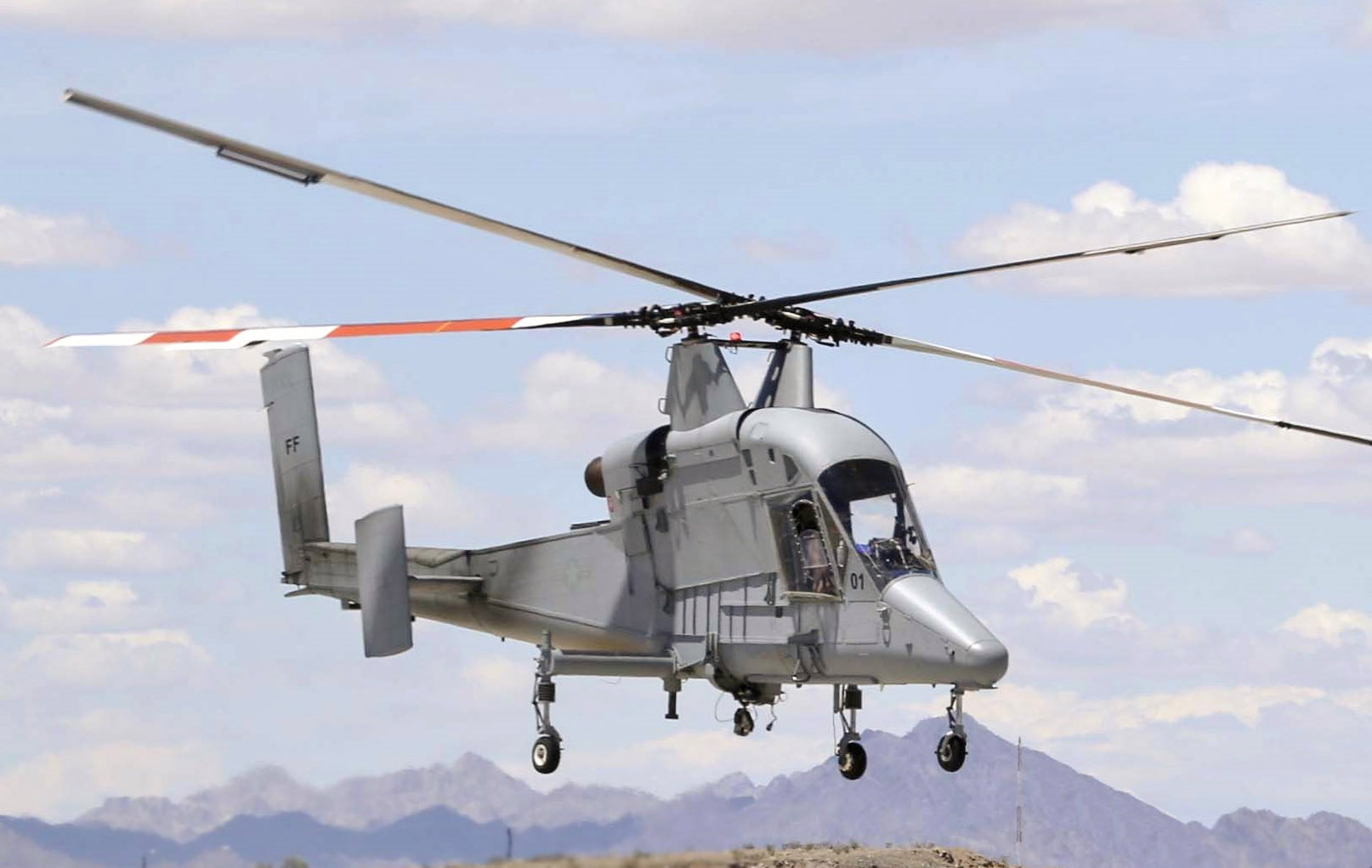
The Kaman K-MAX made the operational case in Afghanistan. Originally a manned intermeshing-rotor helicopter designed for logging and construction, the K-MAX was adapted by Kaman and Lockheed Martin—Kaman on the platform, Lockheed Martin on mission management and flight control systems—into an optionally piloted cargo system capable of lifting 2,722 kilograms at sea level, flying at up to 148.2 km/h under load, and ranging 396.3 km with an external payload. It retains an optional single-seat cockpit for ferry and manned operations, and a four-hook carousel that enables multiple external load deliveries per sortie.
In November 2011, the U.S. Marine Corps deployed two K-MAX systems to Afghanistan, using the unmanned cargo capability to sustain resupply to Marines at remote outposts and eliminating the convoy and aircrew exposure that had made resupply a recurring casualty source.
DARPA’s Drop-In Approach and the Black Hawk Pipeline
Rather than designing optionally piloted platforms from scratch, DARPA’s Aircrew Labor In-Cockpit Automation System (ALIAS) program developed a tailorable, removable automation kit that reduces onboard aircrew requirements on existing aircraft while improving mission performance and flight safety. The target was the UH-60 Black Hawk—the Army’s primary utility helicopter—enabling the fleet to acquire autonomous capability without new platforms and their attendant procurement timelines.
On February 5, 2022, a UH-60A retrofitted with Sikorsky’s MATRIX autonomy technologies completed the first uninhabited Black Hawk flight at Fort Campbell, Kentucky, lasting 30 minutes. A second uninhabited flight followed two days later. MATRIX handles contingency events including aircraft system failures and is designed for contested, congested, and degraded visual environments.
“With reduced workloads pilots can focus on mission management instead of the mechanics,” said Dr. Stuart Young, ALIAS Program Manager in DARPA’s Tactical Technology Office.
Northern Strike 25-2 put that capability in a non-pilot’s hands. The Sergeant First Class completed every assigned mission from a tablet. “With lives on the line, Sikorsky’s MATRIX flight autonomy system can transform how military operators perform their missions,” said Rich Benton, VP and General Manager, Sikorsky. On March 23, 2026, the H-60Mx—the experimental fly-by-wire Black Hawk at the center of the ALIAS program—was delivered to the Army’s Project Manager for Utility Helicopters. The Army Combat Capabilities Development Command will use it as a flying laboratory under the Strategic Autonomy Flight Enabler (SAFE) program, building a universal, scalable autonomy kit for the entire Black Hawk fleet. In October 2025 Sikorsky also debuted the S-70 UHawk, a variant with the cockpit removed entirely—an unmanned-only platform distinct from the optionally piloted H-60Mx.
The commercial fixed-wing sector is running a parallel track on the Cessna 208 Caravan. Reliable Robotics received FAA G-1 issue paper acceptance in August 2022, establishing the certification basis for a Supplemental Type Certificate covering autonomous operation across flight phases, with a single pilot aboard for abnormal procedures. “This certification basis represents a key step towards bringing advanced navigation and autoflight systems to normal category aircraft,” said Mark Mondt, Director of Certification. Xwing, competing on the same platform, received a Military Flight Release from AFWERX—the Air Force’s innovation arm—in February 2024, authorizing cargo missions in unrestricted national airspace.
Why It Matters
The OPA concept functions as a graduated entry ramp into autonomous aviation—for regulators, militaries, and commercial operators simultaneously. Retaining manned certification compresses timelines at every stage: ferry flights position aircraft to theater under existing frameworks; pilot training proceeds on the same hardware used for autonomous missions; certification cycles draw on established procedures rather than waiting for new regulatory infrastructure to solidify. For the military, the flexibility cuts in both directions—crew up when airspace complexity or mission risk demands it, go autonomous when protecting aircrew is the dominant concern.
Sikorsky’s Ramsey Bentley framed the design philosophy directly: “We are looking to extend the capability of the crewed platform through this uncrewed teaming—using platform autonomy to reduce the workload of that human crew, so that they can focus on the broader mission capability.” That logic holds across every program here. The K-MAX kept Marines out of vulnerable cargo helicopters over contested Afghan terrain. The ALIAS-equipped Black Hawk extends the operational reach of a fleet the Army cannot fully staff. The Caravan programs are laying the certification architecture that will underpin autonomous cargo aviation as pilot shortages worsen across both commercial and military sectors.
The optionally piloted aircraft is not a transitional form that will be superseded once full autonomy matures. It is a design category in its own right—one that preserves optionality in a domain where the cost of a wrong assumption is measured in mission failures, airspace incidents, or lives. The seat stays because there are still environments where someone needs to be in it. The option to leave it empty is what makes the platform genuinely new.
Sources
- DARPA — First Uninhabited Black Hawk Flight, ALIAS Program (February 2022)
- DARPA — H-60Mx Black Hawk OPV Delivered to U.S. Army (March 2026)
- Lockheed Martin Sikorsky — Soldier Plans and Executes Autonomous Black Hawk Missions, Northern Strike 25-2 (October 2025)
- Breaking Defense — Army Receives First Autonomous-Ready Optionally Piloted Black Hawk (March 2026)
- Army Technology — K-MAX Unmanned Aircraft System
- Avionics International — Reliable Robotics Receives FAA G-1 Acceptance for Autonomous Cessna Caravan (August 2022)
- Vertical Magazine — The Future of Flight: Inside Crewed and Uncrewed Aircraft Integration
- Airforce Technology — Diamond DA42 Centaur Optionally Piloted Aircraft (OPA)
- Flying Magazine — Xwing Awarded Military Airworthiness for Autonomous Cessna Caravan (February 2024)
- Defense Tech Briefs / Mobility Engineering Technology — Aurora Flight Sciences Centaur OPA
