
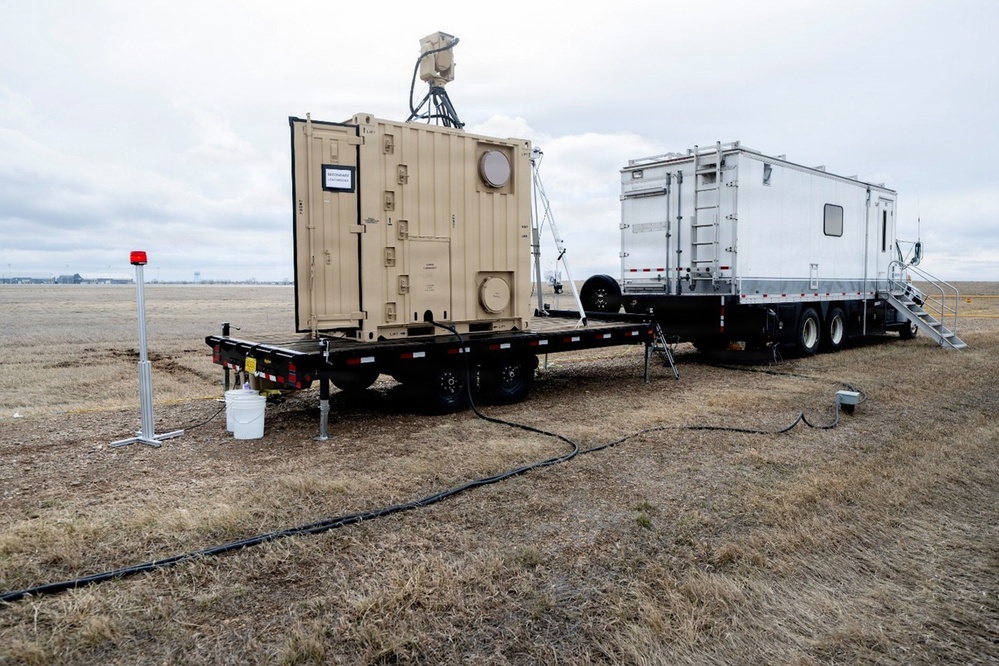
The U.S. Naval Research Laboratory has demonstrated something the directed-energy field has spent years talking about but rarely shown in the open: a single laser that does two fundamentally different jobs without changing its hardware footprint. In a recent field test, one NRL-led platform wirelessly beamed electrical power to a remote forward base, then transitioned on demand into a directed-energy weapon, intercepting a simulated drone before going back to delivering power — all without a restart.
What makes the demonstration notable is not just the dual-use trick. It is where and how NRL chose to run it. Rather than stage the test on a clean, controlled range under ideal optics, the team deliberately let conditions deteriorate. The intercept was carried out as snow accumulated and visibility collapsed toward a near-whiteout, using a Marine Corps laser. The goal was not a glossy success reel. It was data: how much an expeditionary laser degrades when the weather turns against it, and what engineering work remains before a system like this can be fielded.
What Actually Happened
According to NRL's own announcement and trade-press coverage that followed, the demonstration ran roughly in three phases within a single, continuous operation:
- Power beaming. The directed-energy platform wirelessly transmitted electrical power over a long distance to a remote forward base — the kind of austere, hard-to-resupply position where hauling fuel or stringing cable is costly and dangerous.
- Counter-UAS intercept. When a simulated drone threat appeared, the same laser rapidly transitioned from power transmission to a directed-energy defensive role and engaged the target. This happened as snow piled up and conditions slid toward whiteout, using a Marine Corps laser.
- Resume power delivery. After the engagement, the system returned to beaming power to the forward base — critically, without restarting the platform.
NRL Electrical Engineer Alex Grede, Ph.D., framed the appeal in operational terms: "the same laser used to beam power remotely can immediately transition to counter a drone threat, giving Marines and soldiers greater flexibility." That flexibility — one box, two missions, no reconfiguration — is the whole pitch.
Why Run It Into a Whiteout?
Lasers are physics-bound in ways that radar and radio-frequency systems are not. A directed-energy beam is line-of-sight only, and its energy is scattered and absorbed by anything suspended in the air between emitter and target — fog, rain, smoke, and snow all degrade it. NRL was explicit about this limitation in its announcement, which is unusual candor for a capability demonstration.
That candor is the point. Per Tech Times' reporting, the test was specifically designed to break from controlled-precedent demonstrations by running as visibility worsened, in order to quantify atmospheric interference and identify the engineering improvements needed before fielding. In other words, the team was not trying to prove the laser works in perfect conditions — everyone already knows it does. They were trying to measure how badly it falls off in the conditions Marines and soldiers actually operate in, where you do not get to schedule the weather.
UAS Vision's trade-press account echoed the same framing, emphasizing a realistic adverse-weather field environment rather than a sanitized range. For a technology that has historically been demonstrated under near-ideal optics, deliberately stress-testing it against accumulating snow is a meaningful methodological shift — and a more honest one.
The Dual-Use Logic: Expeditionary Energy Meets Defense
Strip away the directed-energy novelty and the demonstration is really about two persistent headaches for forward-deployed forces: power and air defense.
Forward bases are energy-hungry and logistically fragile. Fuel convoys are slow, expensive, and dangerous; running wire across contested terrain is often impractical. Wireless power beaming offers a way to push electricity to a position over line-of-sight without any of that physical infrastructure. At the same time, small drones have become one of the most democratized threats on the modern battlefield, and every forward position now needs some answer for cheap aerial intruders.
The dual-use laser collapses both problems into one platform. When there is no threat, it works as an energy utility, keeping a remote base powered. When a drone appears, it becomes a weapon, then returns to utility duty. Because directed energy fires at the cost of electricity rather than expendable interceptors, the per-engagement cost against a cheap drone is dramatically lower than a missile — and a system that already exists on-site to move power does not add a separate footprint to do air defense.
Who Built It
This was not a single-lab effort. NRL led the demonstration, sponsored by the Office of the Under Secretary of War for Acquisition & Sustainment (OUSW A&S) through the Operational Energy Capability Improvement Fund (OECIF) — a funding line whose name itself signals the expeditionary-energy intent behind the work.
The work was conducted with Boeing and the U.S. Army, with collaboration spanning the Navy, Marine Corps, and Army. Trade coverage and the official DoD release identify the U.S. Army's DEVCOM Ground Vehicle Systems Center (GVSC) among the partners, and DVIDS published official imagery of the demonstration corroborating the participants and the hardware involved. The cross-service makeup is itself a tell: this is being positioned as a joint expeditionary capability, not a service-specific science project.
The Caveats Worth Keeping
It is worth being precise about what this was and was not. This was a demonstration, not a fielded system. The published accounts flagged the core limitations: the beam is line-of-sight only and is degraded by fog, rain, smoke, and snow. The whiteout test was designed to find out how much — which means, by definition, that the answer is "enough to matter" and that engineering improvements are still required before anything like this reaches Marines or soldiers in the field.
The drone target was simulated, and the published accounts describe a controlled field event rather than an operational deployment. None of that diminishes the achievement; it contextualizes it. The headline capability — beam power, kill a drone, resume beaming power, all from one laser without a restart — is real and was demonstrated. The path from that to a deployed system runs straight through the atmospheric-degradation data this test was built to collect.
Why It Matters
For years, directed-energy programs have promised two transformative things separately: cheap, magazine-deep counter-drone defense, and wireless power delivery to austere positions. NRL's demonstration is significant because it fuses both into one platform and, just as importantly, because it was honest about the conditions under which lasers struggle. By deliberately running the intercept into accumulating snow toward a near-whiteout, the team traded a flawless demo reel for real-world atmospheric-degradation data — the unglamorous information that actually determines whether a system survives contact with operational weather. If the dual-use concept holds up as the engineering matures, a forward base could one day keep itself powered and defend its own airspace with the same piece of hardware, fired at the cost of electricity rather than interceptors. That is a meaningful shift in both the logistics and the economics of holding ground under drone threat — but the whiteout test is also a reminder that the weather still gets a vote.
Sources
- NRL Demonstrates Dual-Use Laser System for Power Beaming and Counter-UAS Operations (Navy.mil)
- Navy Laser Powers Remote Bases and Intercepts Drones: NRL Demo Clears Whiteout Test (Tech Times, June 25, 2026)
- US Naval Research Laboratory Demonstrates Dual-Use Laser System for Power Beaming and C-UAS Operations (UAS Vision, June 26, 2026)
- NRL Demonstrates Dual-Use Laser System for Power Beaming and Counter-UAS Operations (DVIDS)
