
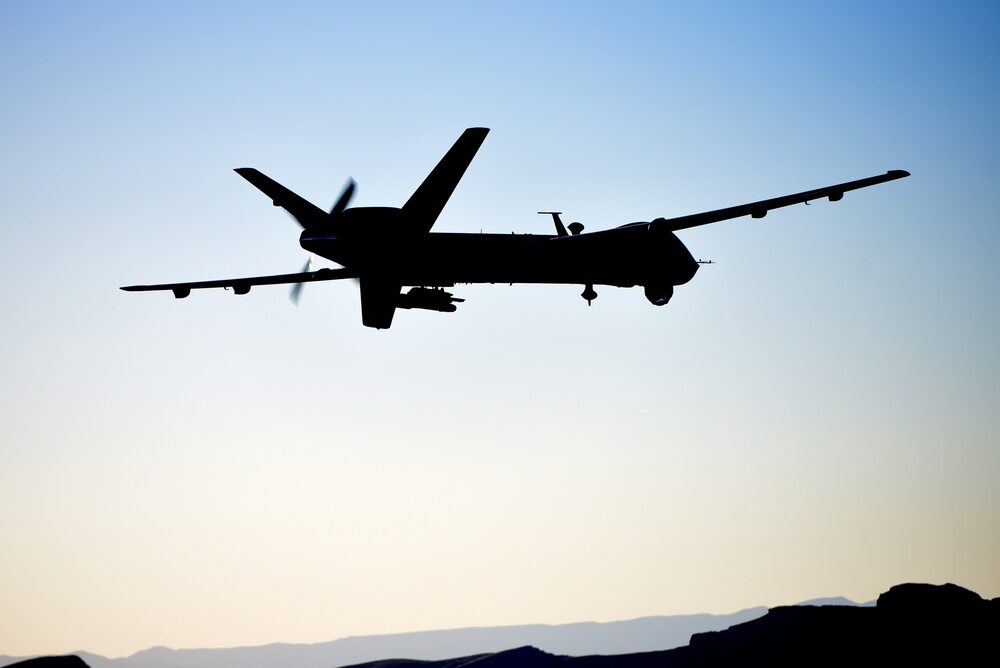
A single table underpins almost every consequential decision in U.S. military drone policy. Which office writes the contract — a battalion supply sergeant or a Pentagon acquisition executive — depends on it. Which agency owns counter-UAS authority depends on it. Whether a platform needs an FAA certificate of authorization, operates freely in Class A airspace, or is governed by Title 10's use-of-force statute depends on it. That table is the DoD Group 1–5 classification system, and understanding it is prerequisite knowledge for anyone who follows defense UAS seriously.
Where the System Came From
DoD's engagement with unmanned aircraft as a formal policy domain traces to 1988, when P.L. 100-202 directed the department's first UAS master plan. For the next two decades, each service ran its own taxonomy — the Air Force used "tiers," the Army had its own altitude-and-weight bands — creating an interoperability and acquisition coordination problem that grew worse as the post-9/11 operational tempo pushed drone inventories skyward.
In 2007, the Joint UAS Center of Excellence proposed consolidating everything into five groups. DoD adopted an amended version in 2008, and the framework was codified in the FY2009–FY2034 Unmanned Systems Integrated Roadmap. A 2011 revision unified the group system across all services, formally retiring the service-specific tier schemes. Today, the authoritative home for the classification is JP 3-30, Joint Air Operations.
The department defines an unmanned aircraft as "an aircraft that does not carry a human operator and is capable of flight with or without human remote control." The group taxonomy then sorts those aircraft by three parameters: maximum gross takeoff weight (MGTOW), operating altitude, and airspeed. One rule governs edge cases: if any single attribute places an aircraft in a higher group, the aircraft belongs to that higher group.
The Five Groups: Thresholds and Representative Platforms
The table below gives the official thresholds. Altitudes for Groups 1–3 are expressed as AGL (above ground level) or MSL (mean sea level) as specified in the framework; FL180 — the Group 4/5 dividing line — is the base of Class A airspace, a deliberate alignment with FAA airspace structure. The 55 lb boundary between Groups 2 and 3 matches the FAA's "small UAS" definition under 14 CFR Parts 1 and 107. One caveat worth knowing: the upper Group 3 weight bound varies slightly across official documents — the Army UAS Roadmap chart uses 1,320 lb, while CRS's 2024 primer describes Group 3 as spanning 55 to 1,350 pounds. The structure of the system is consistent; the exact pound figure depends on which DoD document you read.
| Group | Max Gross Takeoff Weight | Operating Altitude | Airspeed |
|---|---|---|---|
| 1 | 0–20 lb | <1,200 ft AGL | <100 kt |
| 2 | 21–55 lb | <3,500 ft AGL | <250 kt |
| 3 | <1,320 lb | <18,000 ft MSL (below FL180) | <250 kt |
| 4 | >1,320 lb | <18,000 ft MSL (below FL180) | Any |
| 5 | >1,320 lb | >18,000 ft MSL (at or above FL180) | Any |
Groups 4 and 5 share the same weight threshold — 1,320 lb. FL180 is the only thing separating a heavy tactical drone from a strategic ISR platform under this framework.
Group 1 is the infantry drone. The canonical example is the RQ-11B Raven — 4.2 lb, hand-launched, 60–90 minutes of endurance, 10 km range, fielded in May 2003. More than 19,000 Ravens have been delivered to over 40 nations. Also here: the Puma AE and WASP. Critically, commercial FPV strike drones — the kind proliferating in the Ukraine and Middle East conflicts — fall into Group 1 by weight, despite delivering effects that once required much larger platforms. That mismatch is now driving policy.
Group 2 covers small tactical persistent-ISR systems. The textbook representative is the ScanEagle/MQ-27, with a 10.2-foot wingspan, 20-plus hours of endurance, and a 19,500-foot ceiling that accumulated over 500,000 combat hours by 2011. There is a notable asterisk: the latest ScanEagle variant carries a cited MTOW of approximately 58 lb, which is technically 3 lb over the Group 2 ceiling. Under the higher-group rule, that variant would fall into Group 3. The borderline placement matters operationally — Group 3 triggers different acquisition, airspace, and C-UAS authority chains — and program offices should confirm which variant threshold governs a given procurement.
Group 3 is the battalion-to-brigade workhorse tier. The RQ-7B Shadow is the Army's long-standing example: 15 hours of endurance, organic to brigade combat teams. The RQ-21A Blackjack at 135 lb serves the Navy and Marine Corps. The Shield AI V-BAT/MQ-35 — a 161-lb ducted-fan VTOL capable of 13-plus hours and 20,000 feet — illustrates how the group now includes sophisticated vertical-lift designs. DoD's policy (DoDD 3800.01E) designates Groups 1–3 collectively as "small UAS," capping that definition at 1,320 lb.
Group 4 is the high-endurance tactical MALE tier operating below FL180. The MQ-1C Gray Eagle at 3,600 lb, 29,000-foot ceiling, 25 hours, carrying four Hellfires, is the benchmark Army system. The legacy MQ-1 Predator at 2,250 lb and the MQ-8B Fire Scout at roughly 3,150 lb (a rotary-wing variant) also live here. The weight threshold cleanly separates these from Group 3: 1,320 lb is approximately 600 kg, the same mass threshold that separates NATO Class II from Class III.
Group 5 contains strategic systems — HALE and long-endurance MALE platforms operating at or above FL180. The MQ-9 Reaper (10,500 lb, 50,000-foot ceiling, 27-plus hours, 3,800 lb of payload) is the operational workhorse. The RQ-4 Global Hawk at 32,250 lb and 60,000 feet is ISR-only with 32-plus hours of endurance. The MQ-4C Triton covers the maritime domain. At this tier, acquisition is unambiguously a Major Defense Acquisition Program.
Why the Group Number Has Real Consequences
Acquisition authority tracks groups closely, even if the correspondence is not mechanical. Group 1 systems often fall under the Simplified Acquisition Threshold — roughly $250,000 — meaning a unit can buy them with minimal oversight. Groups 4 and 5 systems routinely qualify as ACAT I MDAPs, where the thresholds are $525 million in RDT&E or $3.065 billion in procurement. The gap between those two acquisition regimes represents years of schedule and layers of bureaucracy.
Airspace integration is structurally mapped to the groups. Groups 1 and 2 operate below 3,500 feet AGL, generally below controlled airspace. Group 3 systems require FAA Certificates of Authorization and must remain out of Class A. Groups 4 and 5 operate in Class A alongside commercial and military manned aircraft. DoD's long-term airspace goal — normalized operations without exemptions or waivers, governed by a single overarching COA — effectively requires solving Groups 4 and 5 integration, which remains unresolved.
Counter-UAS authority and law follow the same lines. DoDD 3800.01E (2019) designated the Army as executive agent for countering Groups 1–3. The Joint Counter-small UAS Office was stood up under that executive-agent framework to coordinate those efforts. DoD's January 2021 Counter-Small UAS Strategy described adversary small UAS as "rapidly proliferating, low-cost, high-reward." That framing — and the investment it justified — applies specifically to Groups 1–3.
At the statutory level, 10 U.S.C. § 130i authorizes DoD personnel to "detect, identify, monitor, and track" and to "use reasonable force to disable, damage, or destroy" UAS over covered facilities — nuclear sites, missile defense installations, space operations, presidential protection details, SOF facilities, and weapons storage. That authority covers all groups and runs through December 31, 2030.
The NDAA FY2026 extended the picture. The SAFER SKIES Act provisions would allow state, local, tribal, and territorial agencies to detect, track, and mitigate UAS — but only after meeting federally established training and compliance requirements, with penalties up to $100,000 per violation for uncoordinated action. The legislation also establishes a JIATF 401 coordination role, acknowledging that the C-UAS problem has outgrown purely federal jurisdiction.
Regardless of group, DoDD 3000.09's human-judgment requirement applies to any use of lethal force. Autonomy discussions in the UAS context cannot be resolved by group classification alone.
NATO Alignment and the Mapping Gap
NATO's parallel taxonomy sorts by mass into three classes: Class I below 150 kg (approximately Groups 1–2 plus the lower end of Group 3), Class II from 150–600 kg (roughly upper Group 3), and Class III above 600 kg (Groups 4–5). The correspondence is close but not exact at the boundaries — the 600 kg NATO Class II/III line converts to approximately 1,322 lb, essentially the same as DoD's 1,320 lb Group 3/4 threshold, making coalition interoperability at that weight band relatively clean.
Where the systems diverge is at the top. NATO Class III subdivides by mission (MALE versus HALE) rather than by FL180. There is no NATO equivalent to the altitude-based Group 4/5 split — the alliance treats the heavy-tactical and strategic tiers as a single class differentiated by role, not altitude ceiling. For coalition planners, this means the Group 4/5 boundary is a U.S.-specific construct that does not map cleanly to alliance deconfliction procedures.
A Classification Under Pressure
The Group 1–5 framework was designed around purpose-built military systems with predictable signatures, cost structures, and effects. That design assumption is fraying. A 3-lb commercial FPV quadcopter modified with a shaped-charge warhead is a Group 1 system by weight, triggering the same C-UAS authority chain and acquisition treatment as a Raven — while delivering kinetic effects that once required a Group 3 or Group 4 platform.
Congress noticed. The NDAA FY2022, Section 1073, directed the Under Secretary of Defense for Acquisition and Sustainment to review whether the JP 3-30 classification "may not remain an accurate reflection of the different classes of uncrewed aircraft," in the language CRS used to summarize the congressional concern. That review is ongoing. Whether it produces a sixth group, an effects-based modifier, or a parallel taxonomy for commercial-off-the-shelf threats remains to be seen. Until then, Groups 1–5 remain the governing framework — and the table above is the starting point for understanding almost any U.S. military drone policy question.
Sources
- CRS IF12797 — "Defense Primer: Categories of Uncrewed Aircraft Systems" (2024)
- CRS IF12797 full text mirror (Oct 2024)
- 10 U.S.C. § 130i — Cornell LII
- U.S. Army — DoD Counter-Small UAS Strategy (Jan 2021)
- Penn State GEOG 892 — Army UAS Roadmap 2010–2035 (secondary)
- DroneLife — NDAA FY2026 Key Counter-UAS Provisions Explained (Dec 2025)
