Navy support ships have carried drones for years. What is unusual about a Request for Information that Naval Sea Systems Command posted on 20 July 2026 is that the drones are the point. The solicitation asks industry to describe a 300- to 400-foot "Special Mission Vessel" whose defining features are a dedicated patch of clear deck for vertical-takeoff unmanned aircraft, the ability to put small boats and unmanned surface vessels over the side without a deck crane, and enough fuel and stores to stay out for a month at a time. The RFI itself describes the ship as "an afloat forward-deployed operations and staging base for UAS, USV, small boat, and U.S. / multi-national command and control (C2) missions"; The War Zone reports the vessel is intended for US Southern Command's counternarcotics work in the Eastern Pacific and Southern Caribbean.
The notice (ID 57889edc24cd40089188290808afd5e6, solicitation number N0002426RXXXX) was posted to SAM.gov on 20 July as a Sources Sought notice, with a response deadline of 1500 EDT on 19 August 2026 and an auto-archive date of 3 September. It carries no set-aside, a primary NAICS code of 336612 — boat building — and product/service code 1940, small craft. Place of performance is the United States. SAM.gov's federal organizations data identifies the issuing office as NAVSEA HQ (AAC N00024), sitting under Department of Defense > Department of the Navy > NAVSEA; the RFI text attributes it to the Navy's Portfolio Acquisition Executive (PAE) Maritime, code PMS 300. The listed points of contact are Kirby Tucker and Anthony O'Rourke, both using ".civ" Navy addresses. The War Zone's Howard Altman published a detailed breakdown of the requirements on 22 July.
What the Navy is asking for
The hull itself is deliberately unexotic. NAVSEA wants a steel monohull or catamaran between 300 and 400 feet long, capable of a minimum sustained speed of 10 knots and a range of 9,600 nautical miles at that speed. It must be able to conduct primary operations in and survive Beaufort 6 conditions (Sea State 5) or greater, and still launch and recover boats in Beaufort 4. Minimum endurance without underway replenishment or resupply is 30 days. The RFI also asks for Panama Canal compliance, ABS classification, and SOLAS, MARPOL, COLREGS and ICLL certificates — and it explicitly invites bids to convert an existing vessel as well as to build a new one, urging respondents to use non-developmental platforms wherever possible.
Accommodation is where the mission profile starts to show through. The RFI calls for total berthing for up to 59 personnel: 20 to 25 staterooms for civilian mariners running the ship, plus 29- to 44-person open berthing for embarked crew — the aviation detachment, boat crews, unmanned-systems operators and law-enforcement teams that would actually prosecute the mission.
The aviation requirement spans both Navy and Coast Guard rotary-wing types: the Sikorsky SH-60 and MH-60 Seahawk, the MH-60T Jayhawk and the MH-65 Dolphin. That mix is a fair summary of who actually flies counter-drug interdiction sorties in the region, and it means the flight deck and its support systems have to be sized and certified for more than one service's aircraft — the RFI requires certification to NAVAIR Air Capable Ships Aviation Facilities Bulletin 1M for day and night operations.
A 20-by-20 patch of deck
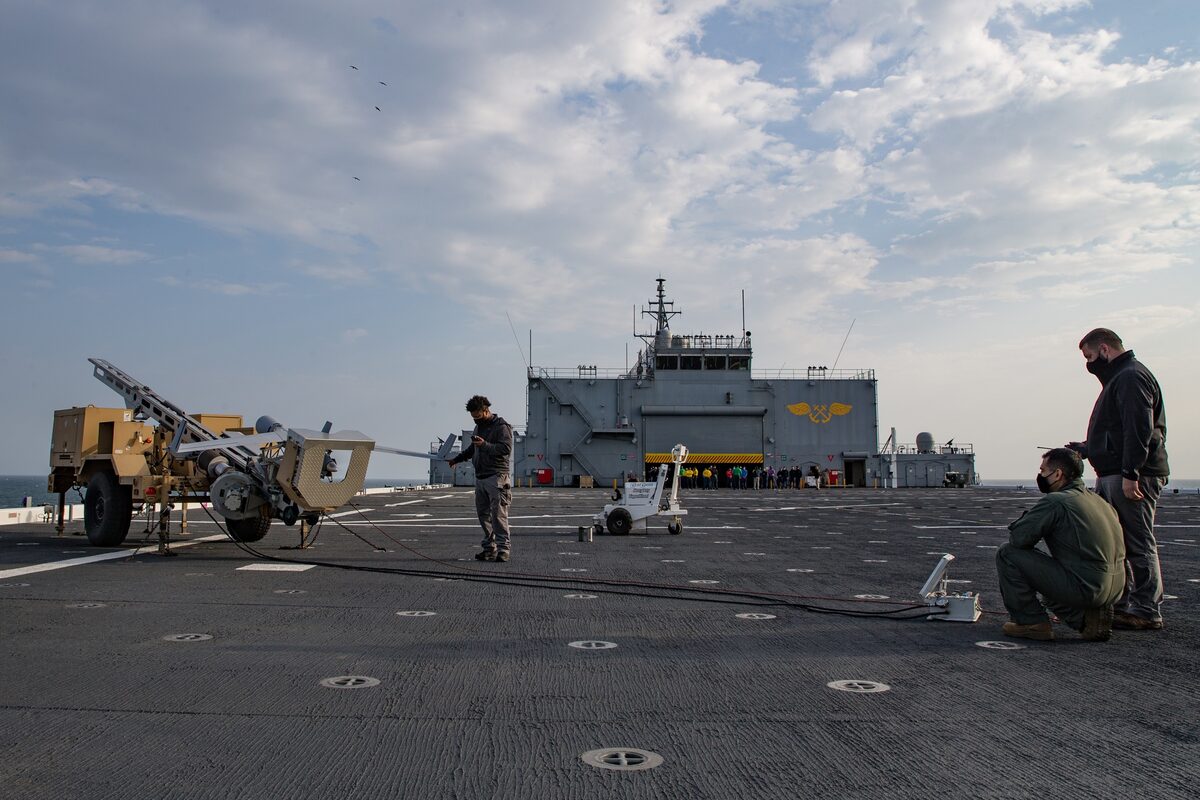
The line in the RFI that makes this a drone story rather than a shipbuilding story is the requirement for a flight deck able to launch and recover "vertical take-off Class 2/3 UAS platforms," with a minimum "20x20 ft dedicated clear deck space for UAS recovery and storage," plus sockets for a minimum of two 20-foot TEU containers "for UAS control and maintenance" sited near the flight deck.
Read that carefully and it describes a modular unmanned aviation detachment rather than a permanent installation. Twenty by twenty feet is a small footprint by flight-deck standards — it is a spot for a VTOL drone to land, not a runway — and the container sockets are the tell. Control stations and maintenance facilities ship in standard 20-foot boxes, which means the aircraft type embarked can change between deployments without cutting steel. The Navy is specifying the interface, not the aircraft. Notably, the RFI does not name a UAS; it names a class and a footprint and leaves the rest open, asking only for at least a Class 2 system with a Due Regard Alternative Means of Compliance.
The same modular logic runs through the surface side. NAVSEA wants launch and recovery of 24- to 44-foot boats weighing up to 35,000 pounds — and it wants that done without a deck crane. The RFI names three acceptable arrangements: an elevator or boat lift with a universal cradle, an integrated or deployable boat ramp, or a well deck. Crane-free launch and recovery is what makes high-tempo, repeated sorties practical in a seaway, and it applies equally to manned interceptor boats and to unmanned surface vessels in that size and weight bracket. A separate small crane — "fixed/portable or 'yellow gear'" — is required only for emergency recovery of UAS, USVs or other watercraft. A ship that can cycle 35,000-pound craft over the side in Beaufort 4 is a ship that can operate USVs as a matter of routine rather than as a demonstration.
The requirement that is not about technology
One line in the RFI has nothing to do with sensors, decks or endurance: "Secure detainee space with suitable AC / ventilation for 10 – 12 people."
It is a blunt reminder of what this vessel is for. The War Zone describes the mission as a SOUTHCOM counternarcotics sea base operating across the Eastern Pacific and Southern Caribbean in support of partner nations including Panama, Costa Rica, Colombia, El Salvador, Guatemala and Mexico. Interdiction produces prisoners, and a sea base that keeps its boats and aircraft out for 30 days at a stretch needs somewhere lawful and secure to hold people until they can be transferred. Few requirements documents state a concept of operations as plainly as that one does — the same document also asks for a 160-square-foot armory, a 100-square-foot magazine and support for .50-calibre anti-terrorism/force-protection mounts.
The clock: March 2028
This is a replacement program with a date attached. The contract for the current chartered vessel, MV Kellie Chouest, expires on 31 March 2028. The Navy has said it intends to release a formal Request for Proposals upon receipt of FY27 appropriations, and the effort appears in the President's Fiscal Year 2027 budget. An RFI with a 19 August response date and a September archive is the front end of that sequence — market research to establish whether the requirements as written are buildable, and by whom, before money is committed. The notice is explicit that it "does not constitute a Request for Proposal or a promise to issue an RFP in the future."
The NAICS and PSC codes are worth noting for anyone tracking who NAVSEA expects to answer. Code 336612 covers boat building, and PSC 1940 covers small craft — categories that point toward mid-tier commercial and workboat yards rather than the large surface combatant primes. No set-aside is applied to the RFI itself, but the notice warns that based on the responses the eventual requirement "may be set-aside for small businesses or procured through full and open competition," and asks small-business respondents to explain how they would meet the 50 percent manufacturing-cost rule under FAR 52.219-14.
Why It Matters
Unmanned systems have been hosted on Navy ships for years as passengers. This RFI inverts the relationship: the crewed vessel exists to service the unmanned ones. Every headline requirement — the dedicated VTOL deck box, the container sockets, the crane-free launch and recovery of 35,000-pound craft, the 30-day unsupported endurance — is written around sortie generation for drones and boats. Read alongside the Navy's other recent unmanned work, it is a solicitation that treats a manned support ship primarily as an unmanned-systems mothership, and it does so for a real-world, in-progress mission rather than an experimental one.
The timing sharpens the case. On 13 July, Breaking Defense reported that CENTCOM had confirmed the use of three Saronic Corsair unmanned surface vessels against Bandar Abbas Naval Base, a submarine and ship maintenance facility — "marking the first time American forces have employed sea drones in combat operations," with CENTCOM-released video showing three explosions as the craft closed on dock infrastructure. The Corsair carries up to 1,000 pounds over 1,000 nautical miles and operates under Task Force 59, the Bahrain-based unmanned operations organization; the month before the Bandar Abbas strike, a Corsair was used to locate and retrieve two AH-64 Apache crew members off Oman. Task Force 59 began fielding the Corsair in March 2026, per CENTCOM, and the Navy announced in May 2026 that Saronic was one of seven companies selected for at-sea testing under the service's MUSV Marketplace.
Those operations were mounted from an established shore infrastructure in a mature theater. SOUTHCOM's operating area offers nothing comparable across the distances involved, which is precisely the gap a 9,600-nautical-mile, 30-day sea base is meant to fill. Whether the Navy gets that ship now depends less on the technology than on the FY27 appropriations calendar and the March 2028 expiry of the charter it is trying to replace.
Sources
- Request for Information (RFI): Special Mission Vessel (SMV) - Helicopter, Unmanned Aerial System (UAS), Unmanned Surface Vehicle (USV) & Small Craft Support Vessel - SAM.gov
- Mothership Sought By Navy For Southern Command Operations - The War Zone
- In first, US uses sea drones in combat in Iran strikes: CENTCOM - Breaking Defense