
Buried in the U.S. Department of War's contract announcements for 23 July 2026 — the daily list that catalogs everything from base food service to missile buys — is a line item that tells you more about the state of the American drone industrial base than most of this year's louder news. Siemens Government Technologies of Arlington, Virginia was awarded a $79,988,134 firm-fixed-price contract "to establish a secure, government-controlled, and highly flexible advanced manufacturing capability, including an initial production capability for electric motor stator assemblies for unmanned aircraft systems."
Work will be performed in Anniston, Alabama. Estimated completion is 9 August 2027. Bids were solicited via the internet and eleven were received. Fiscal 2025 aircraft procurement (Army) funds in the full amount of $79,988,134 were obligated at the time of award. The contracting activity is Army Contracting Command, Detroit Arsenal, Michigan, under contract W911RQ-26-C-A016.
That is the entire public record of the award: five sentences. It is worth unpacking each of them, because the Army has just spent eighty million dollars on the least glamorous component in a quadcopter.
What a stator is, and why it is the choke point
A brushless DC motor — the kind that turns nearly every propeller on every small drone in service — has two functional halves. The rotor is the spinning part, a cylindrical housing carrying permanent magnets. The stator is the part that does not move: a laminated iron core wrapped in copper windings. As Tech Times described it in its 1 July 2026 explainer on domestic motor production, the stator is "a fixed set of copper-wound coils" that receives timed bursts of three-phase current from an Electronic Speed Controller, generating a rotating magnetic field that the rotor — and the propeller bolted to it — chases around.
Everything a small UAS operator cares about downstream of the airframe is decided in that copper. Winding pattern, wire gauge, fill factor, lamination stack quality and termination consistency set the motor's torque constant, its thermal ceiling, and therefore the aircraft's thrust, efficiency and endurance. Two motors with identical part numbers and different winding quality do not fly the same mission.
Stator winding is also, unglamorously, a labor-and-tooling problem rather than a materials-science one. It is precisely the kind of high-volume, tight-tolerance, low-margin manufacturing that migrated offshore decades ago and that no U.S. prime had an obvious commercial reason to repatriate. Which is why the Army is now paying for it directly rather than waiting for a market to appear.
Read the adjectives
The award text is unusually specific about what is being bought, and the qualifiers are doing real work. "Secure" and "government-controlled" signal that this is not a conventional supplier relationship in which the government buys parts and takes on faith how they were made. It is a production line whose configuration, tooling and — implicitly — data the government intends to control. "Highly flexible" suggests the line is not being optimized for a single motor size or a single program of record, which is consistent with a small-UAS fleet that changes designs faster than it changes contracts.
"Initial production capability" is the honest part. This is a first line, not a national supply. Eighty million dollars and twelve and a half months buys a factory, not a market.
Two further details deserve attention. First, the entire contract value was obligated at award using fiscal 2025 aircraft procurement funds — no incremental funding, no options held back. Combined with a completion date roughly 12.5 months out, that is a schedule-driven posture: the Army wants tooling installed and running, not a phased development program. Second, eleven bids came in. For a specialized manufacturing capability with a government-control requirement, that is a crowded field, and it implies a domestic supplier base that believes it can build this — a data point that cuts against the assumption that nobody in the United States wants to wind stators.
The Army now has two motor plays — one organic, one contracted
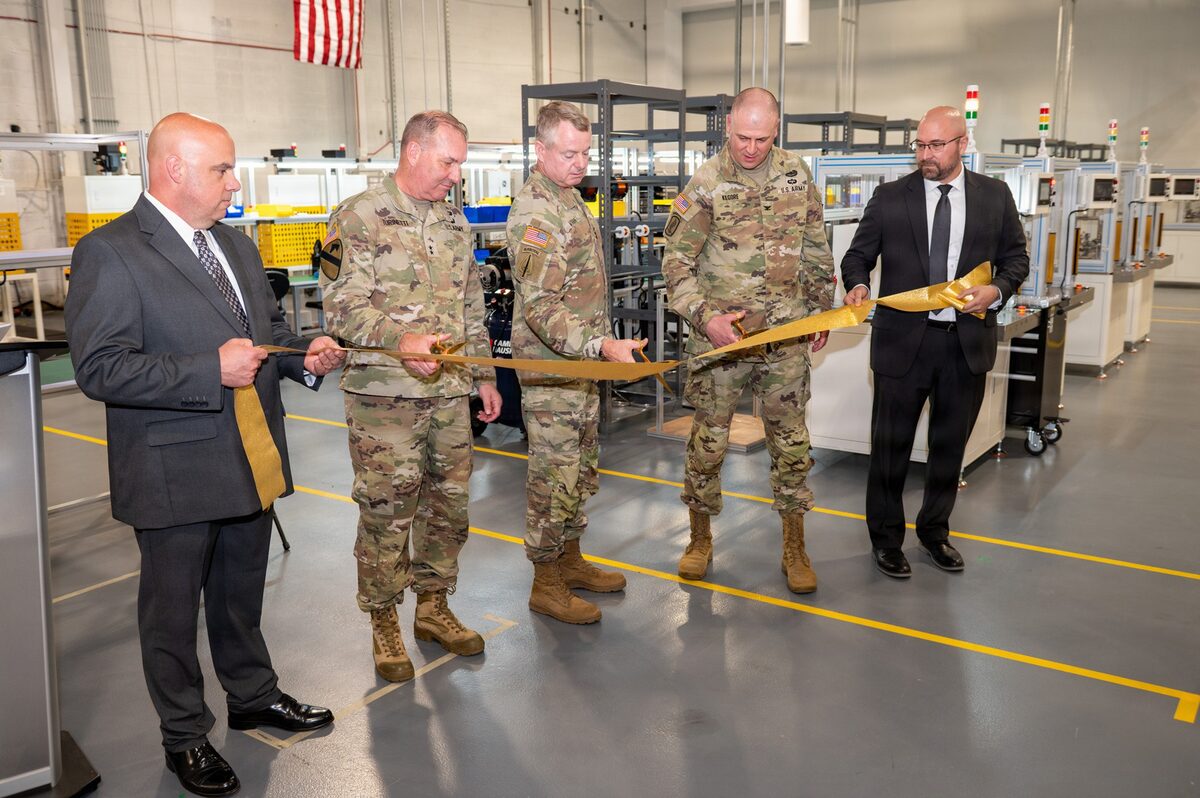
The Anniston award does not stand alone. On 30 June 2026, Tobyhanna Army Depot in Pennsylvania held a ribbon-cutting on its own advanced manufacturing facility for small unmanned aircraft systems: a brushless DC motor assembly line the Army describes as "a scalable domestic production capability for critical components of small uncrewed aircraft." Depot officials say the facility has capacity to produce "upwards of 500,000 motors annually." (Tech Times, reporting from a media tour of the same facility, cited a production target of 480,000 motors per year, or 1,500 per day — enough for 375 four-motor drones daily.)
The stated purpose, per the Army, is "building immediate security and resilience into Department of War supply chains, moving the DOW a step closer to completely eliminating reliance on foreign suppliers." Lt. Gen. Christopher O. Mohan, commanding general of Army Materiel Command, hosted the event, joined by Maj. Gen. James D. Turinetti IV, commanding general of Communications-Electronics Command; the ribbon-cutting party also included Col. Benjamin L. Kilgore, Joseph Cosimo and Jonathan Strzelec. "This is another testament to what our organic industrial base can do when they're given the proper guidance, the proper resources and a timeline," Mohan said, adding that Tobyhanna is "our most modern depot, and Team Tobyhanna is our most aggressive and forward-thinking workforce."
Tobyhanna is not a newcomer. It is the designated Center of Industrial and Technical Excellence for C4ISR, electronics, avionics and missile guidance and control; it has supported the MQ-9 Reaper since the 2010s through public-private partnerships with L3Harris and General Atomics; and it completed its first delivery of first-person-view small UAS in August 2025. The Army explicitly ties the depot line to the July 2025 Secretary of War memo "Unleashing U.S. Military Drone Dominance," in which Pete Hegseth called drones "the biggest battlefield innovation in a generation." The Anniston award carries no such stated lineage in its announcement — but it lands in the same policy weather.
So the Army is now running two parallel plays: an organic depot line it owns and staffs outright, and a contractor-operated, government-controlled line in Alabama. That is a deliberate hedge. The depot model gives the Army surge capacity it cannot be cut off from; the contractor model gives it access to industrial process engineering the depot workforce does not have on staff, plus a plausible on-ramp to commercial volume. The two are also aimed at different parts of the same assembly: Tobyhanna is assembling motors, while Anniston is being built to produce the stator assemblies that go inside them.
Does the arithmetic add up?
Tobyhanna's stated ceiling is upwards of 500,000 motors a year. Set that against the Army's own most aggressive published ambition for finished aircraft: SkyFoundry, announced in October 2025, targeted 10,000 complete FPV drones per month. At four motors apiece, that is roughly 480,000 motors a year — almost exactly the depot's nameplate, with nothing left over for spares. The capacity number is not comfortably oversized; it is sized to the goal, and only if everything runs.
Nameplate capacity also assumes a fully staffed line running a stable design with parts arriving on time — which is exactly what a single-source domestic stator supply cannot guarantee. Attrition-tolerant drone warfare is defined by consumption, not inventory: motors are expended with the aircraft. Read that way, the Anniston award is less about adding units and more about removing a single point of failure upstream of the depot.
The depot line is also not a standalone factory. Per Tech Times, it is one node in a distributed architecture across the Army's Organic Industrial Base: Tobyhanna handles brushless motors, wiring harnesses, microelectronics and four of the five circuit card assemblies in an FPV drone; Red River Army Depot in Texas is slated for battery assembly and final drone integration; Rock Island Arsenal in Illinois 3D-prints airframes and propellers. A stator line in Alabama is another node — and the gap between "a domestic supplier exists" and "a domestic supply chain exists" is the gap these investments are trying to close.
The magnet problem nobody has solved
Both lines share an unresolved dependency, and it is the one that should temper any declaration of victory. The neodymium-iron-boron permanent magnets that go into the rotor of every one of these motors are approximately 90% manufactured in China. A domestic stator line and a domestic motor assembly line change where the copper is wound and where the parts are bolted together. They do not change where the magnets come from. The same holds one layer over: Tech Times puts China's share of the lithium-ion cells used in commercial and military drones at roughly 99%.
This is the recurring pattern in drone-supply-chain onshoring: the assembly step is the visible one, the ribbon-cutting one, the one with a contract number. The materials step underneath it — magnets, battery cells, certain semiconductors — is slower, more capital-intensive and harder to photograph. The Army's stated goal, per its own Tobyhanna release, is "completely eliminating reliance on foreign suppliers." On motors specifically, the stator award moves that goal meaningfully closer without reaching it.
Why It Matters
Eighty million dollars is a rounding error against Army aviation procurement, and a stator assembly is not a weapon. But this award is a clean look at how the Pentagon has decided to fix its drone-component problem: not by writing requirements and hoping industry responds, but by directly buying the production capability and keeping control of it. The phrase "secure, government-controlled" in a firm-fixed-price manufacturing award is the tell — the Army is treating small-UAS motor production as infrastructure it must own the way it owns an arsenal, not as a commodity it can competitively source.
The full obligation of FY2025 funds at award and a 9 August 2027 completion date say the schedule is not negotiable. The eleven bids say the domestic industrial base is more willing than the conventional wisdom holds. The pairing with Tobyhanna's organic line says the Army wants redundancy across two different ownership models rather than betting on either. And the roughly 90% China share of neodymium magnets says the hardest part of this problem is still ahead. If the Anniston line hits its date and the depot line hits anything close to its stated capacity, the United States will have solved the copper half of drone propulsion within about two years. The magnet half remains a policy problem with no contract number attached to it yet.
