
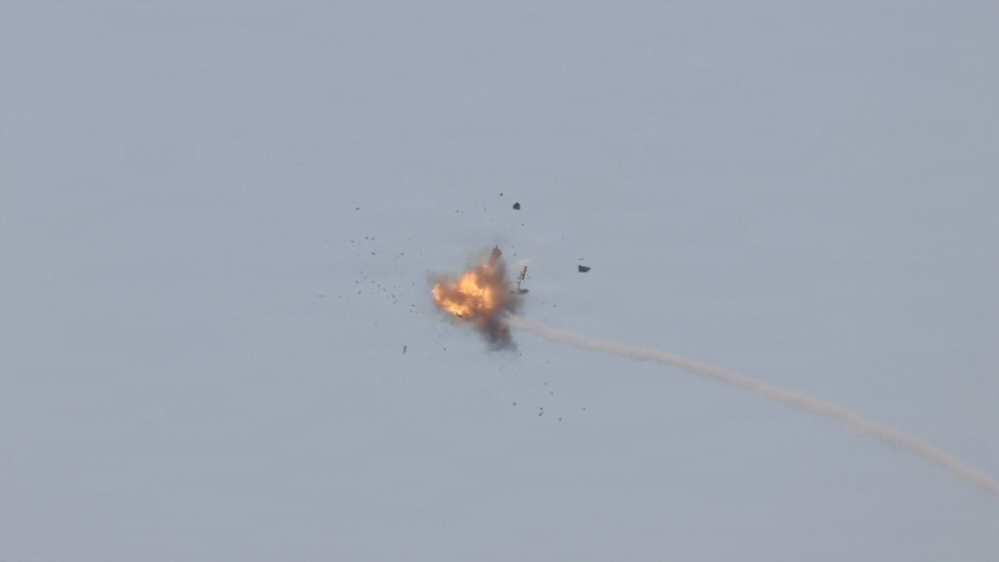
On Nov. 24, Kongsberg announced that it has delivered the DESNA air defence system to Ukraine. DESNA connects Ukrainian-made air defence missiles and launcher units to Kongsberg's fire command and control centre. The Norwegian company says its purpose is to protect people and critical infrastructure against drones and other aerial threats. The system is not a prototype. Kongsberg says DESNA systems are already in operation, and Norway's defence minister, Tore O. Sandvik, said Oslo has been buying them and handing them over in recent months.
"In recent months, Norway has acquired and donated several such systems to Ukraine," Sandvik said in the Kongsberg announcement. The announcement does not say how many systems have been delivered or what they cost.
What DESNA Is
Kongsberg describes DESNA as developed together with Norwegian and Ukrainian authorities and Ukrainian industry, in collaboration with a Ukrainian partner. The system takes its name from a river in Ukraine. The work is split between the two countries:
- Ukraine supplies the missiles and launchers. Unmanned Airspace, citing a Norwegian Ministry of Defence statement issued the same day, reports that an unnamed Ukrainian defence partner provides the missiles and launch units.
- Norway supplies command and control. Kongsberg provides the fire command and control centre, which the launchers are connected to.
Kongsberg says the Ukrainian missiles can be produced in large quantities at a lower unit cost. That claim explains why the system exists. DESNA is not meant to replace NASAMS, the Kongsberg/RTX system that has been operational in Ukraine since 2022. Kongsberg says DESNA complements NASAMS, and that both systems are based on Kongsberg's command and control solutions.
The Kongsberg announcement gives no specifications. It says nothing about the missile's range, guidance, warhead or sensors, or about how many launchers one fire centre can control. What is public is the system's design: a Kongsberg command and control layer, already used with NASAMS, paired with Ukrainian interceptors that can be built in volume.
The Cost-Exchange Problem DESNA Targets
The logic behind DESNA starts from a familiar problem in Ukraine's air war. A defender firing its best surface-to-air missiles at large salvos of attack drones spends scarce, expensive interceptors on cheap targets. Even when every drone is shot down, the defender can lose on stocks. The approach Norway and Ukraine have chosen appears to separate the command and control layer of an air defence system from the part that gets used up.
The fire command and control centre is the part Kongsberg already supplies for NASAMS. The interceptor is the part that gets fired and has to be replaced. If the interceptor is a Ukrainian missile that can be produced in large quantities at a lower unit cost, as Kongsberg says, the cost of each engagement should fall, while the targeting and coordination rest on Kongsberg's existing systems.
This approach may also keep production closer to the front. Building the consumable part in Ukraine would make the supply of rounds depend less on Western export queues, and Kongsberg's role would lean toward integration rather than manufacturing every part of the system. That is an inference from the system's design, not something the sources state.
Part of a Layered Norwegian Package
DESNA arrives alongside a much larger Norwegian effort. On the same day, Ukraine's Ministry of Defence published an overview of Norwegian support. According to that account:
- Norway provided $7 billion in security assistance to Ukraine in 2026 and has planned another $7 billion for 2027.
- Norwegian support over the past five years has reached $16.7 billion.
- Norway topped the list of the largest partners in supplying Ukrainian unmanned aerial vehicles and is the largest contributor to the Prioritised Ukraine Requirements List (PURL).
- Norway supplies automated turrets to counter jet-powered Shahed drones.
- Norway is jointly developing interceptors with Ukraine, and together with Germany it is integrating IRIS-T into NASAMS.
- The first Norwegian-supplied F-16 is carrying out missions to defend Ukraine's airspace.
Ukraine's ministry also notes that Norway takes part in four capability coalitions and that the two countries signed a Security Agreement on May 31, 2024.
Taken together, this suggests a layered structure. NASAMS, with IRIS-T integration under way, covers one tier. DESNA adds mass-producible missile capacity alongside it. Automated turrets address the jet-powered Shahed variants, and jointly developed interceptors add another layer. Unmanned Airspace reports that Ukraine's Minister of Defence, Evgeniy Khmara, met Norway's Minister of Finance, Jens Stoltenberg, earlier this month, and that they discussed how Norwegian support is helping Ukraine scale up counter-UAS capabilities including turrets and interceptor drones.
A Separate NOK 22 Billion Missile Buy
Unmanned Airspace also reports, in a separate announcement by the Norwegian government, a purchase of air defence missiles for approximately 22 billion kroner. The missiles can be used in NASAMS ground-based launchers and are designed to shoot down, among other things, enemy attack and surveillance drones. The report presents this as distinct from DESNA, and it says the missiles are meant to protect combat air bases and critical infrastructure. Even so, it fits a broader pattern of Norwegian investment in air defence against drones.
Why It Matters
DESNA is an example of a model worth watching: pair a missile that can be produced in large quantities at lower unit cost with command and control that already exists, instead of trying to make a high-end missile cheap. If it works at scale, it could give Ukraine a way to answer drone salvos without draining NASAMS inventory meant for more dangerous targets. It could also give Kongsberg a template for integration work with partners' munitions, though no source says so.
Important questions remain open. The Kongsberg announcement discloses no unit counts, no prices, no performance data and no name for the Ukrainian manufacturer. Without those figures, outside observers cannot check whether DESNA actually improves the cost exchange against drones or only promises to. "Lower unit cost" is a comparison, not a number. Until Norway or Ukraine publishes combat results or procurement figures, DESNA is best read as a strong signal of direction, a fielded system that Norway says it has acquired and donated, rather than proof that the cost-exchange problem has been solved.
Its context also matters. With $7 billion planned for 2027 and a ranking at the top of partners supplying Ukrainian-made UAVs, Norway is buying air defence for Ukraine and also supporting Ukraine's own defence industry. DESNA, built with Ukrainian missiles and Norwegian command and control, reflects both aims.
Sources
- KONGSBERG delivers the DESNA air defence system to Ukraine (Kongsberg, Nov. 24, 2026)
- Drones, missiles, and air defence: how Norway became a key defender of Ukraine's skies (Ministry of Defence of Ukraine, Nov. 24, 2026)
- Ukraine and Norway boost air defence against attack drones (Unmanned Airspace, Nov. 24, 2026)
