
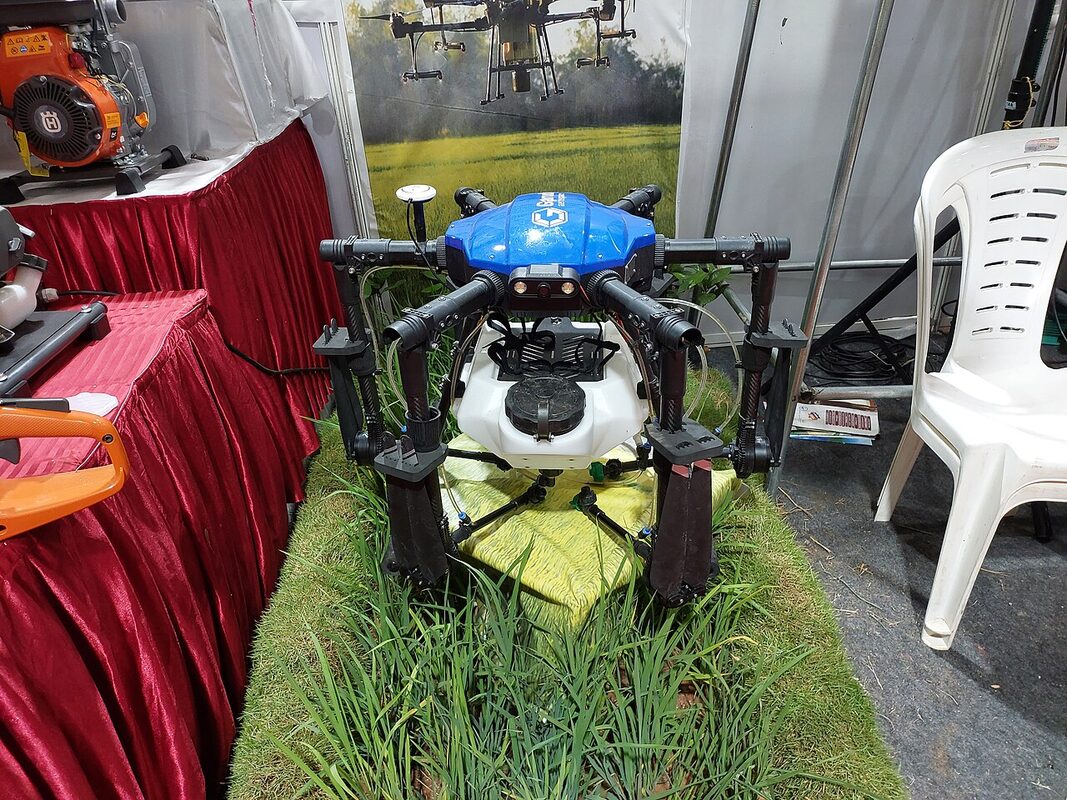
About 600 days before the 2028 Summer Games open, the head of the Los Angeles Police Department is naming the drone threats he is preparing for, and they are not hobbyist quadcopters drifting over a stadium. LAPD Chief Jim McDonnell told ABC7 Los Angeles that planners are thinking about agricultural spray drones from California's Central Valley and drones fitted with ordnance.
"Drone crop dusters in the Central Valley that could be weaponized for other materials or whether it's somebody putting ordinance on a drone," McDonnell said. "All of these threats today are very real." The job now, he said, is to "get our technology, our training, and our authorizations up to the speed it needs to be. That's going to be a challenge."
That challenge has a price tag and a timeline. Los Angeles already owns a counter-drone network, paid for with $9,770,209 in federal money and bought for the 2026 FIFA World Cup. Local police only gained legal authority to take drones down on July 1. The Olympics will test both at a scale neither was built for.
The Scale Problem
The U.S. Secret Service leads security planning for the Games. Jeff Stohler, acting special agent in charge of its Los Angeles field office, explained to ABC7 why the Olympics are different. A typical National Special Security Event covers one to three venues over a couple of days. The Olympics, he said, means 20 security footprints over more than 40 days.
The staffing numbers show the same thing. ABC7 reported that roughly 9,400 officers will be needed at venues alone, which is more than the entire LAPD. The California Highway Patrol, which has about 750 officers assigned to Los Angeles County, is expected to grow to more than 2,000 during the Games, and one of its biggest responsibilities will be patrolling the 369-mile games route network. More than 50 agencies share responsibility. Officer.com, carrying a Los Angeles Times report, said officials expect to deploy up to 16,000 officers at a time.
For counter-UAS, this means coverage across many sites at once, for weeks, along routes as well as at venues. That is a very different job from protecting one stadium on match day.
What Los Angeles Already Owns
The City Council voted 13-0 on April 21 to accept the $9,770,209 FEMA counter-drone grant, DroneXL reported. The money pays for:
- Radio-frequency detection sensors at 24 fixed locations
- Two fixed mitigation sites, at the Police Administration Building and the Mt. Lee communications tower
- Three tactical kits
- Three trailer-mounted radar and camera units
- A handheld mitigation device
- A command-and-control tracking system and a response van
The mitigation is electronic, not kinetic. According to DroneXL, citing the city administrative officer's report, the tools work through signal interruption and control override, used remotely. They do not shoot drones down.
DroneXL also reported that LAPD personnel had completed the FBI's counter-drone training. But compare the package with the Olympic picture. It was bought for one tournament, while the Olympics means 20 security footprints over more than 40 days and a 369-mile route network. The three tactical kits, three trailer units and handheld device are the mobile pieces, and the two fixed mitigation sites cover two places. Stretching that across the Games will depend on more money, more equipment and more trained operators. DroneXL's editor made a similar point, saying the chief should tell the council which parts of the Olympic job the network cannot cover.
The Funding Gap
More federal counter-drone money is coming, but less than before. DroneXL reported that California's share of FEMA's second round is $18.7 million, 46% less than the state got in the World Cup round. FEMA expects to issue those awards on December 10. The state decides how the money is divided among its agencies, so that pot covers the whole state, not just Los Angeles.
The total security budget has the same problem. McDonnell estimates that securing the Games could cost $3.5 billion to $4 billion, against the $1 billion Congress has approved, Officer.com reported. Los Angeles alone accounts for about $1.3 billion of that estimate. Officer.com said leaders continue seeking additional funding for counterterrorism, drone threats and other public-safety needs.
A gap of $2.5 billion or more means trade-offs. Counter-drone systems compete with overtime, transportation, intelligence and every other line in an NSSE budget.
The Authority Question
For local police, the question is not only equipment. It is also the law, and that changed this summer.
An interim final rule from the Justice Department and the Department of Homeland Security, published in the Federal Register on July 6 and effective July 1, 2026, implements the SAFER SKIES Act. It authorizes state, local, tribal and territorial law enforcement and correctional agencies to conduct counter-UAS operations. The rule sets a two-tiered structure for training and certification, one for detection and warning and one for mitigation. It also covers authorized technologies, spectrum coordination, airspace approval, real-time notification to air traffic control, mitigation reporting, privacy protections, and compliance.
In practice, DroneXL noted, takedown authority requires certified officers, a written agency policy, and FAA airspace coordination for each operation. This is the "authorizations" part of McDonnell's list. Having the legal authority is different from having enough certified people, approved policies and pre-arranged FAA coordination to use it across dozens of sites at once.
Why Spray Drones?
McDonnell's mention of Central Valley crop dusters is deliberate. DroneXL describes a spray drone as built to lift a heavy tank of liquid and release it, and says such drones are farm equipment, not exotic military hardware.
They can also go missing. DroneXL pointed to the theft of 15 Ceres Air C31 spray drones from a warehouse in Harrison, New Jersey, on March 24, using a forged bill of lading. Warehouse workers found all 15 about a month later, roughly 30 miles away. The FBI treated the theft as possibly coordinated, but ABC7's report names no specific plot against the Games, and DroneXL called it the nearest case on record rather than evidence of one. It does show that a batch of spray drones can disappear from a commercial site and stay missing for weeks.
McDonnell's second example, someone attaching ordnance to a drone, is the more familiar worry. He pointed to large drone strikes elsewhere in the world as the reason his department is preparing. Planners have to be ready for both ends of that range.
Why It Matters
The 2028 Games will be the biggest test yet of the new model, in which local agencies, not just federal teams, detect and defeat drones. The legal framework is only months old. The main local equipment was bought for a shorter, smaller event. The next round of federal grants is smaller than the last one. And the chief of the host city's police department says openly that technology, training and authorizations all have to speed up.
Three things to watch over the next 600 days:
- The FEMA second-round awards, expected December 10. They will show how much of California's $18.7 million goes to Olympic counter-drone coverage.
- Certification numbers. The SLTT rule's two-tier training system decides how many officers can legally run mitigation equipment. That number may limit coverage more than the hardware does.
- The security funding gap. Whether Congress moves toward McDonnell's $3.5 billion to $4 billion estimate will shape how much drone defense planners can afford around 20 footprints and 369 miles of routes.
For other cities, Los Angeles is a preview of how local counter-UAS will work under the SAFER SKIES Act, where the equipment is bought one event at a time and the threats are anything that can fly.
Sources
- LAPD, other agencies preparing to respond to possible drone activity, protests during 2028 Olympics (ABC7 Los Angeles)
- LAPD Chief Warns of Weaponized Spray Drones at the 2028 Olympics (DroneXL)
- Los Angeles Police Chief Estimates 2028 Olympic Security Costs at Up to $4 Billion (Officer.com)
- Counter-UAS Authority for State, Local, Tribal, and Territorial Law Enforcement and Correctional Agencies, DOJ/DHS interim final rule (Federal Register 2026-13609)
