
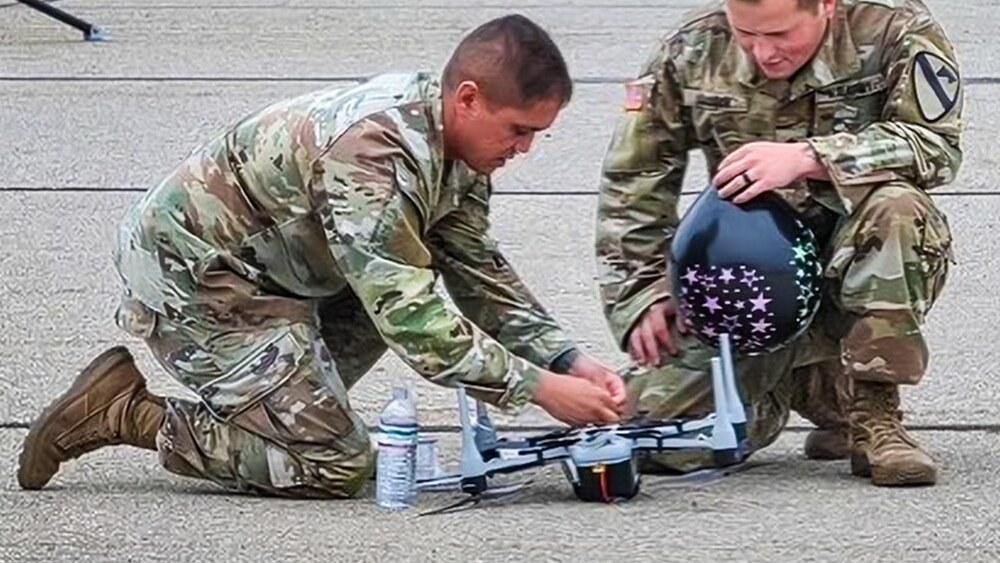
The Army's ramming interceptor has a new unit training on it. Joint Interagency Task Force 401 (JIATF-401) has run training at Fort Hood, Texas, for soldiers of 1st Cavalry Division Artillery on the Bumblebee V2. The task force describes the small drone as a dual-use aircraft: an intelligence, surveillance and reconnaissance (ISR) platform that can also destroy a hostile drone by flying straight into it. The task force announced the event on Nov. 18 and tied it to Project Agincourt, the Pentagon effort meant to build a path toward an Autonomous Warfare Command.
The trainees came from the division artillery's Target Acquisition Battery, specifically its sensor platoon, according to DroneXL. That choice matters. DroneXL reports the Army says the soldiers are fitting the drone into the defense of artillery positions and brigade support areas. Giving a drone that can both look and strike to a sensor platoon moves a counter-drone tool into a formation that is not an air defense unit.
As with the earlier Bumblebee training accounts, the announcement leaves out the numbers that would show whether the system works: how many aircraft were used, whether live intercepts were flown, and how many succeeded.
What happened at Fort Hood, and when
The dates in the public record do not fully agree. DroneXL reports that the 1st Cavalry soldiers trained from Nov. 2 to Nov. 13 and that JIATF-401 announced it on Nov. 18. A DVIDS photo caption, however, describes a 1st Cavalry Division Artillery soldier testing a Bumblebee V2 alongside a JIATF-401 member "during a training session at Fort Hood, Texas, on November 18, 2026."
The two accounts may not conflict: the caption may have used the release date as the session date, or a further session may have taken place on the announcement date. UASFeed could not settle the question. The Army's own pages on the event could not be reached directly, so the DVIDS caption is the closest primary source we were able to read. Readers should treat the exact dates as unconfirmed.
The caption does say what the event was for. The training was meant to evaluate the Bumblebee V2's "ability to strengthen the installation's drone layered defense and establish a foundation for future implementation across the U.S. Army." That wording points two ways. It names a near-term job, protecting Fort Hood itself, and a longer goal of fielding the system across the Army. It does not describe the training as an acceptance test, and it gives no performance threshold. DroneXL adds that the task force bought the systems and that the Army's release says the training was meant to build operator proficiency and assess how the drone is used tactically.
What the Bumblebee V2 actually is
Public descriptions are thin but consistent. Unmanned Airspace describes the V2 as a first-person-view (FPV), multirotor drone. DroneXL reports that JIATF-401 calls it a dual-use aircraft: an ISR drone in one mode and a kinetic interceptor in the other, one that defeats other drones by direct collision.
The most consequential claim about the system concerns autonomy. At the first Army training event in April, Sgt. Maj. Kellen Rowley, JIATF-401's senior enlisted advisor to the director, said the V2 "doesn't rely solely on the skill of the drone operator," and that its automated target recognition "allows the drone to lock on and engage an adversary drone autonomously." That point carries weight. Hitting a small, maneuvering quadcopter with another quadcopter by hand is very hard, and a hit rate that depends on elite FPV pilots would not scale to an artillery battery. If the terminal guidance works as described, the operator mostly cues the interceptor and the airframe does the hard part.
What the record does not show is how well that terminal guidance performs. None of the sources we read gives detection-to-intercept times, engagement envelopes, or results against different target types or in difficult conditions.
A road show, not a fielding (yet)
Fort Hood is the latest stop in a training circuit that JIATF-401 has run since spring:
- April 22, Fort Bragg: Paratroopers from the 82nd Airborne Division took part in what Unmanned Airspace called the inaugural Bumblebee V2 training event, with 20 paratroopers taking part. It was the first operational test of prototypes bought by JIATF-401.
- Oct. 8–9, MacDill Air Force Base: The 6th Security Forces Squadron tested the V2 alongside U.S. Secret Service personnel, DroneXL reports. A Paladin net-launching counter-drone system was also shown at the same event.
- November, Fort Hood: 1st Cavalry Division Artillery's Target Acquisition Battery sensor platoon.
The progression runs from an airborne infantry division to an Air Force base-defense squadron with a federal agency alongside, and now to a division artillery sensor unit. That spread is the most telling thing in the announcements. JIATF-401 appears to be testing the same airframe against different problems: a light force defending itself in the field, a fixed installation defending its perimeter, and a fires formation protecting its own positions.
Chief Warrant Officer 2 Andrew Westerberg, quoted by DroneXL, described the V2 as "a practical, dual-purpose capability they can integrate immediately into the fight." Brig. Gen. Matthew Ross, the JIATF-401 director, said the work lets the task force "refine emerging technology in operationally relevant conditions." Both statements describe the system as usable now. Neither gives evidence of how well it performs.
JIATF-401 has also run training outside the Bumblebee-only events. A separate DVIDS release covers counter-UAS training with Joint Task Force National Capital Region. Taken together, the releases show a task force that brings systems into units by training soldiers on them, rather than by publishing test reports.
Follow the money
The funding history is short, and the reports differ on one detail. DroneXL says JIATF-401 awarded manufacturer Perennial Autonomy a $5.2 million contract for the V2 on Jan. 30. Unmanned Airspace describes a $5.2 million investment "in February," with the system first deployed in March. The two accounts are most likely describing the same buy, recorded at different points.
The bigger number came in May. DroneXL reports the task force folded the Bumblebee into a three-year contract with Perennial worth up to $500 million, alongside the company's Merops interceptor and Hornet strike drone. "Up to" is a ceiling, not money spent, and the reporting does not split the figure among the three systems. DroneXL also notes that in May Perennial would not tell reporters how many aircraft the ceiling buys. The contract suggests the V2 is not a one-off science project, and sits inside a vehicle that could support real production if the Army orders it.
DroneXL also notes that the Fort Hood release did not name the manufacturer. Military releases often omit vendor names, but here the omission makes it harder to trace the system from a training photo back to a contract line.
The Agincourt frame
The Fort Hood announcement is tied to Project Agincourt, which DroneXL reports Defense Secretary Pete Hegseth ordered on Sept. 30. DroneXL describes it as the interim program meant to build the path to a four-star Autonomous Warfare Command by Oct. 1, 2027, and says its memo calls for systems to be tested with operators in exercises. Placed in that context, the Bumblebee training events serve a second purpose. Besides counter-drone tests, they fit the case that autonomous systems should be organized, resourced and commanded differently. An interceptor that relies on onboard target recognition rather than pilot skill is the kind of system that case depends on.
Why It Matters
Low-cost drone interceptors are attractive because they could flip the cost math that makes small-drone defense so hard. Spending an expensive missile on a cheap quadcopter is unsustainable. A cheap interceptor that rams the threat would not be, if it actually hits. That condition is the whole question, and nothing JIATF-401 has released about the Bumblebee V2 answers it.
Across Fort Bragg, MacDill and Fort Hood, the public record we read contains quotes, photos and contract figures. It contains no intercept counts, no hit percentages, and no statement of the number of aircraft used at Fort Hood. For a system an Army warrant officer calls ready to "integrate immediately into the fight," and that sits under a contract ceiling of up to $500 million, those numbers are the basic evidence needed to judge the claim.
The choice of unit is also significant. Moving the V2 into an artillery Target Acquisition Battery suggests the Army sees it as more than a point-defense tool. It could become a sensor-platoon asset that scouts, helps protect the battery's positions, and kills incoming drones with the same airframe. If that concept holds, the interceptor becomes standard equipment for units that have never owned air defense. Whether it should be depends on performance data the services have not yet released.
Sources
- 1st Cavalry Division conducts C-UAS training with JIATF 401 (DVIDS image)
- Army Trains 1st Cavalry Artillery To Ram Drones With Bumblebee V2 (DroneXL)
- Bumblebee V2 interceptor tested in inaugural US Army training event (Unmanned Airspace)
- JIATF-401, JTF-NCR Strengthen Homeland Defense with Counter-UAS Training in National Capital Region (DVIDS)
