
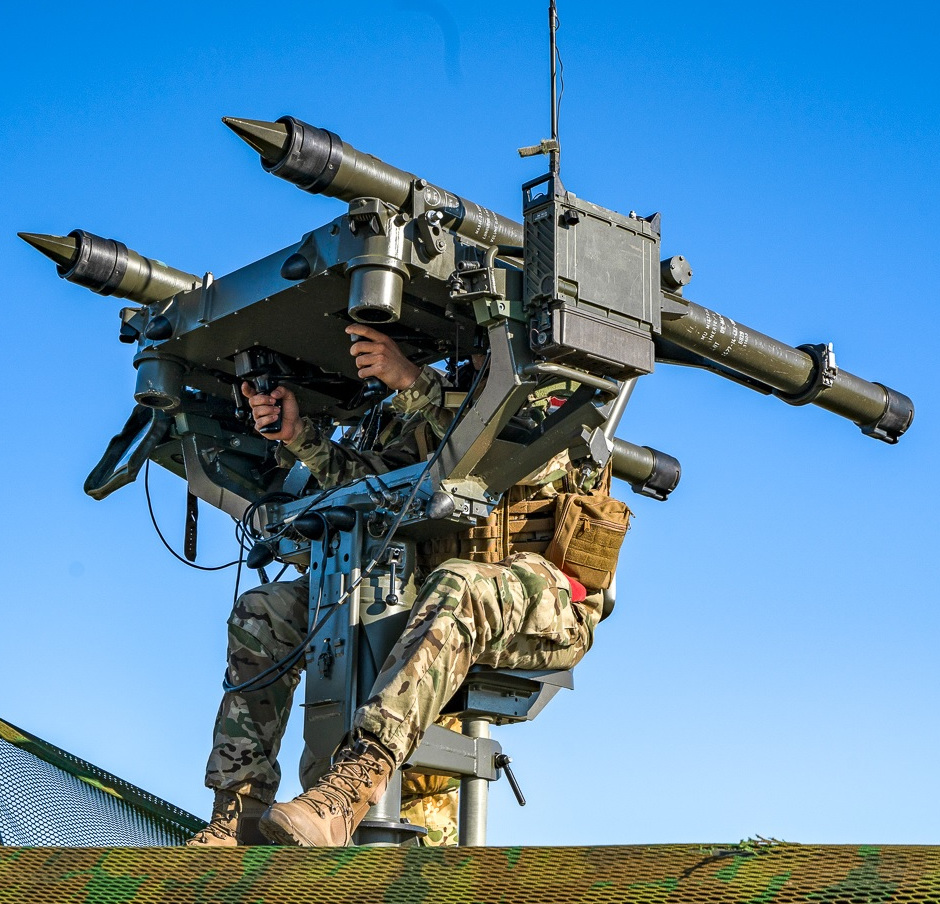
MBDA first marketed SPIMM in early 2019. The idea was a short-range missile system that fits in a shipping container and can be put on vessels that lack their own combat systems. Seven years later, with one-way attack drones and explosive-laden boats prominent in naval combat, the European missile maker is trying again with a new partner. At Euronaval 2026, MBDA and Denmark's Terma showed the Self-Protection Integrated Mistral 3 Module. It is a self-contained air and surface defense system built around the Mistral 3 missile, and it needs only an electrical power connection from whatever it is mounted on.
The two companies are not presenting it as a finished product. According to Janes, they are still working to turn the concept into a fully developed product. EDR Magazine quotes an MBDA representative saying the team is working on a demonstrator to show to customers and expects a fully developed product by 2030. No customer or price has been announced in the sources reviewed.
What is in the box
SPIMM is built into a standard 10-foot ISO container. On top is MBDA's SIMBAD-RC4, a remote-controlled turret that carries four Mistral 3 missiles ready to fire. Inside the container there is a locker for up to eight more missiles, so a module holds twelve rounds in total. Two operators work from a shelter inside the module.
The sensors are a mix of the two companies' equipment. Naval News reports that the module combines optical sensors with a Terma radar. EDR's account of the MBDA briefing is slightly different: it describes the surveillance radar as a Saab Sea Giraffe 1X or a Terma equivalent, optionally with EO/IR systems. Command and control comes from a Terma C2 system inherited from C-FLEX. According to the companies' joint announcement, the C2 layer brings sensor and track data into one tactical picture so that a limited crew can run the system with less reliance on the host platform's own systems. Naval News adds that C-Flex lets the container be networked into wider air defense systems to receive external target designation.
The defining design choice is independence. According to MBDA, as relayed by Naval News, the module operates independently of the host vessel's architecture and requires only an electrical power connection. EDR notes that communication interfaces are also needed, including an audio link to the bridge. The companies call it a "plug and play" solution that can be deployed on vessels without pre-existing combat systems and moved between vessels and land sites as needs change.
The missile
Mistral 3 is the latest version of MBDA's very short-range missile. EDR lists these figures:
- Length: 1.88 m
- Weight: under 20 kg
- Warhead: 3 kg
- Manoeuvrability: up to 30 g
- Interception range: 8,000 m
- Interception altitude: 6,000 m
- Minimum interception range: 500 m
The feature that matters most for counter-UAS work is the seeker. According to EDR, Mistral 3 is the first VSHORAD missile fitted with an infrared matrix imager, developed by Safran, and MBDA says its image processing allows engagement of low-thermal-signature targets such as small UAVs and turbojet-powered missiles. Naval News describes the missile's target set as running from cruise missiles to high-speed turbojet drones.
EDR says MBDA has run fire trials against low-signature targets, namely UAVs and small, fast boats, in 2024 and 2025 respectively. Naval News reports that the counter-USV capability was validated in live-fire testing in Spain last year, building on advances in the missile's flight control, guidance and image processing. That is why the SPIMM pitch lists uncrewed surface vessels and fast inshore attack craft next to aerial threats.
The missile also has wide adoption behind it. EDR reports that Mistral 3 has more than 50 customers worldwide and has been selected and procured by 25 of them, and that MBDA has increased its production rate. A container that uses an already-fielded missile is arguably an easier sale than one that needs a new weapon qualified.
What it is meant to defend against
Janes lists the threat set as missiles, UAVs, aircraft, helicopters, unmanned surface vehicles, fast inshore attack craft and one-way attack boats. The companies' announcement adds RHIBs to the surface list. Naval News ties the revival to recent conflicts and urgent operational requirements in the Middle East and the Black Sea.
The intended hosts reflect this. Naval News says the target platforms are corvettes, logistics ships and landing craft, as well as shore installations and offshore oil platforms. The companies say the module is deployable at sea and on land, and the announcement names ports, naval bases and industrial sites as land uses. EDR quotes MBDA describing the module as a way to protect military support ships without a self-protection system or combat management system, merchant ships and critical infrastructure at sea. Most of these are not front-line warships with full air defense suites, and a container that can be placed on board and powered up offers a route to missile-armed point defense without complex shipboard modifications.
Why Terma, and why now
The partnership sits within a cooperation agreement signed at Eurosatory in June 2026. Janes and the companies' announcement both describe SPIMM as developed under that agreement. Naval News notes that the effort is backed by Danish industrial cooperation initiatives. MBDA CEO Jean-Brice Dumont framed the partnership around European cooperation, saying it was developed within MBDA's industrial cooperation initiative in Denmark.
The division of labor is fairly clear. MBDA supplies the effector, meaning the turret and missile, and the operator consoles reuse SIMBAD-RC ones. Terma provides the C2 and the sensor suite, according to EDR. Both pieces have to work for a self-contained module to make sense, because a turret without its own fire control would need integration with the host's systems, which is what SPIMM is supposed to avoid.
Why It Matters
The spread of drones and drone boats has widened the defensive problem from protecting high-value warships to protecting everything else. Auxiliaries, landing craft and fixed offshore infrastructure are named as intended hosts for SPIMM, and the pitch rests on the idea that such assets need a dedicated point-defense capability. Containerized weapons are one response: capability that can be added to a platform when the threat requires it and moved when it does not.
SPIMM brings a widely used missile with an imaging seeker and claimed counter-UAS and counter-USV trial results. It also puts its own sensors, C2 and crew space in the box, which is more than a bare launcher offers. Its limits should be stated plainly. Twelve rounds of a missile with a 500-meter minimum interception range is a point-defense answer, and the sources give no indication it is meant to defeat large drone swarms. None of the sources gives a cost per engagement, and a guided missile is an expensive way to counter the cheapest drones. The system is also still a concept being developed into a product, with no customer named.
The most important development may be the timing. MBDA unveiled the idea in 2019, and it is now back with a radar and C2 partner, Danish industrial backing and a pitch built around drones and drone boats. That suggests how much the market for small-platform self-defense has changed since then.
Sources
- MBDA, Terma teaming puts new life into SPIMM containerised self-protection system (Janes)
- Mistral in a Box: MBDA Revives SPIMM Concept Against Drones (Naval News)
- MBDA and Terma Join Forces to Develop Innovative, Flexible Air and Surface Defence Solutions (ASDNews)
- MBDA new SIMBAD-RCs on schedule, more Mistral 3 worldwide and SPIMM for everyone (EDR Magazine)
