DroneShield says a layered counter-drone system installed at a fixed site for the Pentagon's Joint Interagency Task Force 401 (JIATF-401) has reached Initial Operational Capability (IOC). The system combines the company's radio-frequency sensing and electronic countermeasures with EchoShield radar from Echodyne. DroneShield trades on the ASX as DRO. It released the news on Nov. 23, 2026, under a Warrenton, Virginia dateline.
The announcement says little. It names no installation and gives no count of sites. It includes no timeline beyond the release date and no detection ranges, engagement results or test data. What it does show is that a two-vendor sensor-and-effector stack has moved from delivery to a stage the company calls operational readiness. Both vendors also hold large JIATF-401 contract vehicles awarded two months earlier.
What DroneShield actually announced
According to DroneShield's press release, the IOC covers a "layered" fixed-site counter-UAS (C-UAS) solution that supports JIATF-401. The release describes the milestone as a step past equipment delivery and installation to operational readiness. It does not say who certified that readiness or which criteria they used.
The architecture described has two layers. DroneShield supplies RF sensing and electronic countermeasures. Echodyne supplies EchoShield, a radar. The release does not explain how the two are integrated or which command-and-control software ties them together.
Chief executive Angus Bean framed the milestone as an argument for multi-sensor defense. He said effective counter-UAS "demands specialized capabilities working together." That is the standard pitch for layered C-UAS. Here it also shows DroneShield's own RF-based portfolio being paired with another vendor's radar, not offered alone.
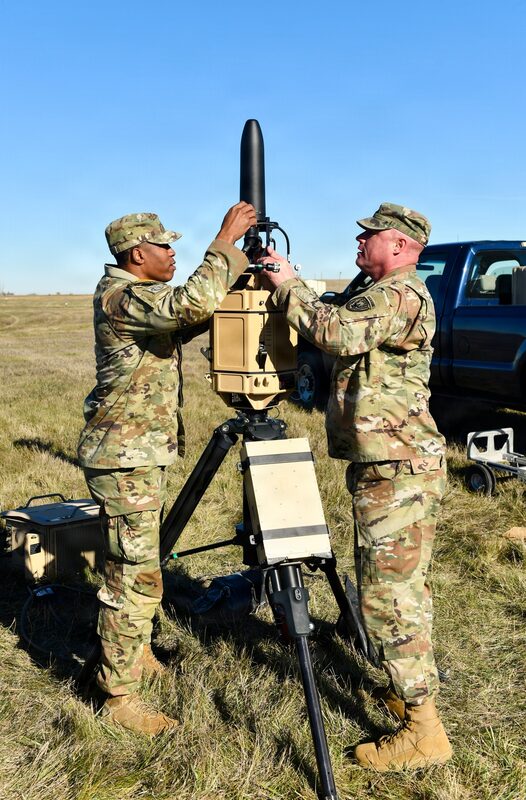
The company also says the fixed-site capability complements "previously announced vehicle-based deployments." Unmanned Airspace confirmed the IOC announcement the same day. It reported that DroneShield had already deployed mobile C-UAS units with JIATF-401 and takes part in the task force's C-UAS marketplace. DroneXL republished the release on its wire service. Its summary describes the deployment as pairing RF sensing and electronic countermeasures with Echodyne's EchoShield radar.
What the release leaves out
The gaps say as much as the claims. Neither the release nor the coverage built on it discloses:
- Where the system sits. No base, facility or region is named. "Fixed-site" could mean one installation or several.
- How many systems were fielded. The release gives no unit or site count.
- When it was installed or accepted. The only date is the announcement itself.
- How well it performs. The release gives no detection, tracking or defeat metrics and no results from any evaluation.
- Who declared IOC. The release does not say whether the government or the company made the determination, or against what standard.
None of this is unusual for a defense-adjacent vendor release, especially for sites guarding sensitive installations. But it means the announcement establishes that a milestone was claimed, not what the system can do.
The contract backdrop
The announcement makes more sense next to JIATF-401's acquisition approach. On Sept. 29, 2026, U.S. Army Public Affairs reported that the task force had awarded several multiple-award indefinite-delivery/indefinite-quantity (IDIQ) contracts supporting Domestic Shield and the C-UAS Marketplace (Army release, via Wayback Machine snapshot). The Army's list of the latest awards included these base IDIQ amounts:
- Allen Control Systems: $500 million
- Digital Force Technologies: $500 million
- DroneShield: $500 million
- Echodyne: $250 million
- Napatree Technology: $500 million
- PVP Advanced EO Systems: $250 million
- RADA Technologies: $500 million
The Army's list also named SmartShooter ($150 million), SRC Inc. ($500 million) and L3Harris WESCAM ($500 million). Both halves of the newly announced fixed-site pairing are on that list: DroneShield with a $500 million vehicle and Echodyne with $250 million. As with any IDIQ, these figures are ceilings on orders that may be placed, not money obligated. The Army release did not tie any amount to the deployment DroneShield described this week, and the DroneShield release cites no contract value.
The Army said the technology covered by the awards spans smart optical scopes, robotic weapon stations, compact radars and long-range tracking cameras. That range points to a marketplace meant to let the government combine sensors and effectors from different suppliers. It does not suggest a buy of a single turnkey system. Brent G. Ingraham, Assistant Secretary of the Army for Acquisition, Logistics and Technology, said the marketplace enforces strict open-architecture standards. The Army identified Brig. Gen. Matt Ross as JIATF-401's director.
Reading the milestone
Taken together, the sources describe a familiar pattern for the task force's marketplace. Vendors with separate specialties, here RF sensing and electronic countermeasures on one side and radar on the other, are put together into one site-level defense. That is the kind of open, multi-vendor arrangement the Army says its contract structure is built to support. Neither the release nor the Army has said whether the fixed site was bought through the marketplace contracts, so that link is an inference from the overlap in vendors.
The milestone also shows how DroneShield is positioning itself. The company already has mobile systems with the task force, according to Unmanned Airspace. A fixed-site IOC lets it claim a role in both vehicle-based and fixed-location defense with the same task force. For an exchange-listed company, that narrative has obvious value to investors. That is one more reason to separate the stated facts from the framing.
Why It Matters
DroneShield's own release says the requirement now extends beyond individual platforms to protecting operational locations, personnel and critical military assets, and the Army's description of JIATF-401's work centers on Domestic Shield. The milestone matters less for what this one system does, which is undisclosed, than for what it may say about how the task force is buying. Two vendors that both appear on the Army's list of IDIQ awardees have been combined into one layered defense and declared operationally ready. That is consistent with the open-architecture marketplace producing integrated, multi-vendor deployments, though the sources do not confirm that connection.
The limits matter too. With no named site, no performance data and no public statement on who validated the IOC, outside observers cannot yet judge how well the layered approach works. Until JIATF-401 or the Army releases its own account of the deployment, the clearest evidence is the contract record. That record shows both DroneShield and Echodyne holding substantial headroom to sell more under their IDIQ awards.
Sources
- DroneShield Achieves Initial Operational Capability for Layered Counter-UAS Solution Supporting JIATF-401 (DroneShield press release, Nov. 23, 2026)
- DroneShield achieves JIATF 401 IOC for layered, fixed-site C-UAS (Unmanned Airspace)
- DroneShield Layered Counter-Drone Site Operational For JIATF-401 (DroneXL Wire)
- JIATF-401 advances Domestic Shield with counter-UAS contract awards (U.S. Army Public Affairs, Sept. 29, 2026, via Wayback Machine snapshot)