
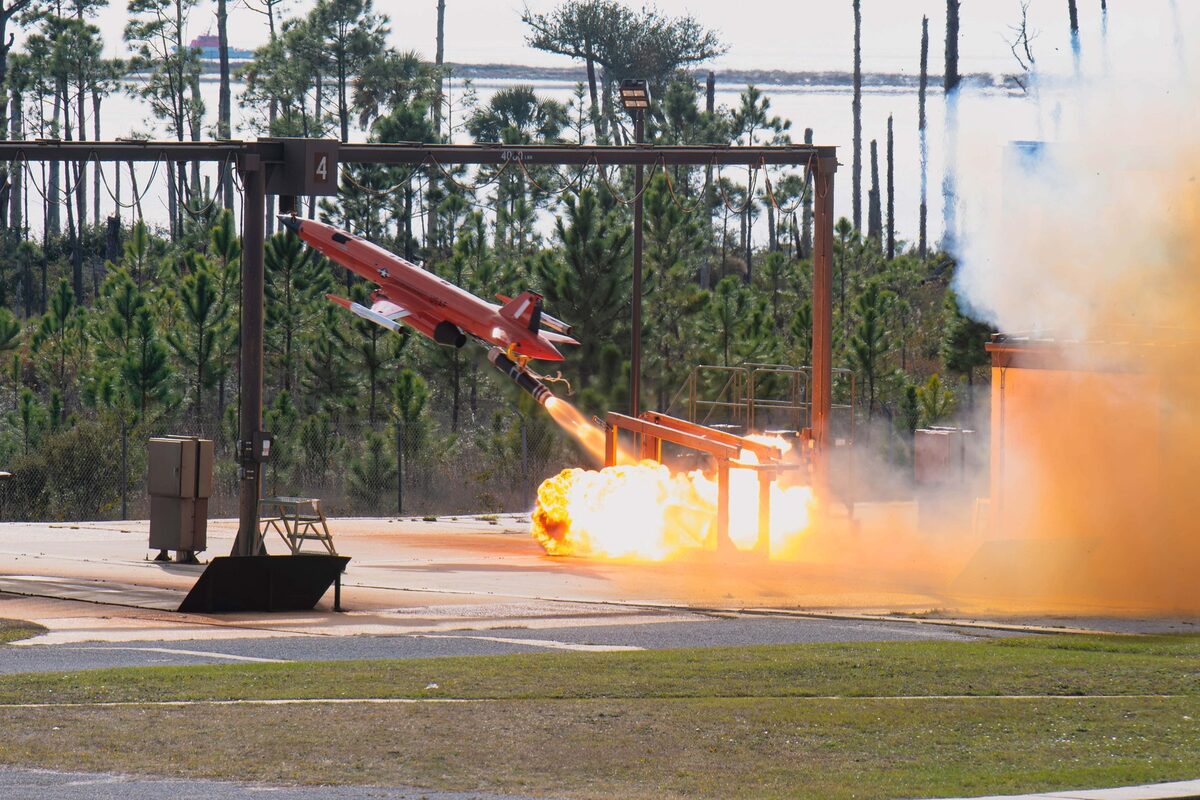
GKN Aerospace has publicly rolled out a full-scale uncrewed aircraft demonstrator built for Sweden's Defence Materiel Administration (FMV), presenting the airframe mock-up on August 21, 2026 — roughly nine months after the underlying contract was signed. The pace is the headline: a program that in most defense-aerospace circles would still be in early design review has already produced hardware, and the company says turbojet engine testing is running in parallel with the airframe work rather than trailing behind it.
FMV and GKN Aerospace announced the collaborative program in November 2025. Less than a year later, the UK-headquartered aerostructures and engine-components manufacturer put a physical demonstrator in front of an audience — a milestone GKN and outside observers alike are framing less as a finished weapons system and more as proof of an accelerated development model for uncrewed aviation programs.
What Was Shown
The reveal centered on an integrated platform combining an airframe, a dedicated turbojet powerplant, and onboard systems — described by GKN as a testbed rather than an operational drone. GKN Aerospace characterized the demonstrator as "a flexible platform for testing and evaluation, supporting the exploration of future uncrewed aviation technologies while providing valuable experience in how complex aerospace systems can be developed, integrated and manufactured on accelerated timelines," according to reporting from Janes. Russ Dunn, GKN Aerospace's chief technology officer, had separately outlined the company's work on the demonstrator to Janes and other defense media in April 2026, four months before the public reveal. Together, that framing suggests FMV's interest is less about fielding a specific airframe immediately and more about having a working platform on which Sweden and its partners can iterate propulsion, systems integration, and mission-equipment concepts without starting each cycle from a clean sheet.
The program brings together propulsion, aerostructures, and systems integration expertise from Sweden, the Netherlands, and the United Kingdom, according to Janes' account of the demonstrator's reveal — a trilateral arrangement that fits a broader pattern of European states pooling uncrewed-systems development rather than running fully national efforts, particularly for the kind of turbojet-powered, higher-performance UAV class this demonstrator represents rather than smaller electric or piston-engine platforms.
The Timeline, in Context
GKN's own numbers are the story here:
- November 2025 — Contract/collaborative program announced with FMV.
- August 21, 2026 — Full-scale mock-up publicly revealed, roughly nine months later.
- 18 months — GKN's stated goal for completing both the demonstrator airframe and its purpose-built turbojet engine, meaning the program is roughly halfway to that internal deadline at the point of this reveal.
UAS Vision's coverage of the same event called it "a major milestone for the programme" and noted it arrived "less than a year after launching a collaborative programme" and "within 18 months" of GKN's original target — language GKN itself is leaning into as evidence that complex aerospace programs, which have historically been measured in years between contract signature and metal-cutting, can be compressed when a company builds around an integrated demonstrator strategy rather than a traditional linear design-freeze-build sequence.
Shephard Media's reporting adds a detail the other two outlets frame differently but converge on: engine testing has already begun. That the turbojet — a purpose-built engine rather than an adapted off-the-shelf unit — is undergoing tests concurrently with the airframe reveal indicates GKN is running propulsion and airframe development as parallel tracks rather than sequential ones, which is itself part of how the company is compressing the schedule.
Why a Turbojet, and Why GKN
GKN Aerospace's involvement is notable less for the airframe than for what the company brings on the propulsion side. GKN has a long history as a Tier 1 supplier of aerostructures and engine components to established manufacturers, but a dedicated turbojet engine developed specifically for a UAV demonstrator — rather than components supplied into someone else's engine program — represents a more vertically integrated role than the company typically plays. Turbojets, as opposed to turbofans, favor smaller frontal area and higher speed at some cost to fuel efficiency, a trade that tends to suit higher-speed or expendable/attritable UAV concepts over long-endurance intelligence, surveillance, and reconnaissance platforms.
Why It Matters
Defense procurement in Europe has spent much of the past decade being criticized — fairly, in many well-documented cases — for slow movement between political commitment and fielded capability, especially in emerging categories like uncrewed systems where commercial and adversary development cycles move in months rather than years. A contract-to-hardware timeline under a year for an integrated airframe-and-engine demonstrator, even one explicitly built as a testbed rather than a production system, is a data point in a debate that has mostly run on the other side of the ledger.
It also matters for what it signals about propulsion sourcing for higher-end European UAVs. Turbojet- and turbofan-powered uncrewed platforms — the class that includes loyal-wingman and attritable strike concepts now in development across several NATO states — have historically depended on adapted engines from established manufacturers or on relatively limited domestic options. A Tier 1 supplier standing up a purpose-built turbojet on an accelerated schedule, backed by a trilateral Sweden-Netherlands-UK arrangement, points toward more European sourcing options for that engine class and a template — demonstrator-first, propulsion and airframe developed in parallel — that other national procurement offices may look to copy. Whether GKN's 18-month target holds for the completed demonstrator and engine, and whether the platform ultimately feeds into a fielded FMV program rather than remaining a pure testbed, are the questions that will determine how much this milestone is worth beyond the schedule itself.