
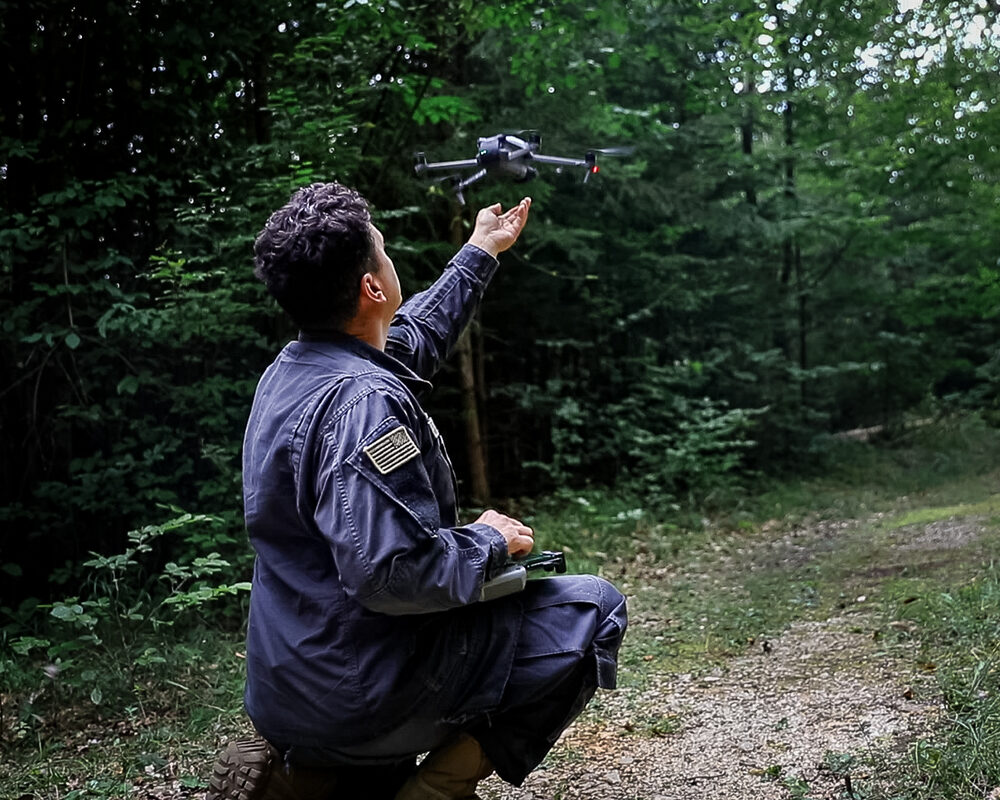
Germany is buying drones that catch other drones in nets. On Oct. 14, 2026, the Bundestag's budget committee (Haushaltsausschuss) approved a procurement of net-launching drone systems to protect Bundeswehr properties against small and micro unmanned aircraft. The same session approved three other proposals: replacement Patriot firing units, Patriot repair containers and encrypted radios for the NH90 helicopter fleet. The Federal Ministry of Defence (BMVg) announced the four approvals in a press release the same day.
The package is mostly about air defence and helicopter communications, with the counter-drone item as the one aimed at base protection. The ministry's description of it is direct. Small and micro drones are a growing threat, it says, including for spying and sabotage attempts, and it says unauthorised overflights of military sites are "no minor offence" (kein Kavaliersdelikt).
What the committee approved
The BMVg release groups the four items as "25-million-euro" proposals (25-Millionen-Euro-Vorlagen). According to the ministry and Janes' report on the approvals, the committee cleared:
- Net-launching drone systems to protect Bundeswehr properties against mini and micro UAVs, including those used for reconnaissance and sabotage.
- Patriot firing-unit replacement through the US Foreign Military Sales (FMS) programme, replacing units Germany transferred to Ukraine in 2025.
- Patriot repair containers to support maintenance of the system.
- Encrypted radios for the NH90 helicopter, called off from an existing contract.
The sources reviewed for this article do not give contract values, quantities or delivery schedules for any of the four items.
A drone that throws a net
The interceptor concept is simple. Instead of jamming a hostile drone or shooting it down, a friendly drone gets close and fires a net to entangle it. According to the BMVg release, the drones are caught or fended off with an interception net, which makes their use possible even in urban terrain. Janes reports that the ministry describes net-launching UAVs as proven effective in protecting property "even in urban areas."
The ministry does not present the net drones as a standalone answer. Both the BMVg release and Janes say they are used together with other systems, namely jammers and detection radars. In such a setup, radar can find and track an intruder, jamming can interfere with its control links, and the interceptor drone provides a physical option for removing it.
Who builds it
The BMVg release does not name a manufacturer in the text reviewed for this article. CPM Defence Network identifies the system as the A1 Falke from ARGUS Interception and says it will be delivered to the Bundeswehr under a framework contract. A framework contract usually lets the buyer place repeat orders over time instead of committing to one fixed quantity up front, but the sources reviewed here do not give its size or duration.
The threat picture behind the buy
The ministry describes the threat in specific terms: small and micro drones, including for spying and sabotage attempts, against which the Bundeswehr needs effective defences for its properties at home and abroad. Defence Network places the approval against a background of spying, sabotage and attacks, and cites Leipzig as an example of the attacks behind the growing small-drone threat. Its report does not give further operational detail about that case.
The release also says the Bundeswehr has already built up organisation for this mission. Highly mobile rapid reaction elements for drone defence, which the ministry calls SRE (Schnelle Reaktionselemente), have been set up in all branches of the armed forces. According to both the BMVg and Janes, these units have already supported Belgium and Denmark in countering drones. That puts German counter-drone teams to work in support of neighbouring partners.
The ministry also says new countermeasures have already been implemented, or testing and procurement is under way, for all relevant ranges and target classes, including the short and very short range. The net-launcher purchase therefore adds equipment to a structure that already exists.
Why It Matters
In the ministry's own framing, an unauthorised drone over a military site is not a nuisance to be tolerated. The release calls such overflights "no minor offence" and says they are treated as part of hybrid threat scenarios and are consistently prosecuted and punished. That is a notable statement from a defence ministry: it ties low-end drone incursions over Bundeswehr properties to hybrid threats and to spying and sabotage risk.
The choice of effector also says something. The ministry points to the net approach as workable in urban terrain, and says such systems are normally used together with jammers and detection radars rather than relying on any single layer.
The other items in the package show how Germany's air defence priorities overlap. The Patriot replacement restores firing units Germany handed to Ukraine in 2025, and the repair containers, per the ministry, are meant to secure the repair capability and operational readiness of the Patriot air-defence missile groups in mobile operations. The net-launcher addresses a different problem: small and micro drones over Bundeswehr properties. Approving the items in the same session shows the ministry funding air defence, base protection and secure communications together.
Several questions remain open: how many A1 Falke systems will be ordered under the framework contract, how quickly they will reach units, and how they will fit with the existing rapid reaction elements. The sources reviewed for this article do not answer any of them.
