
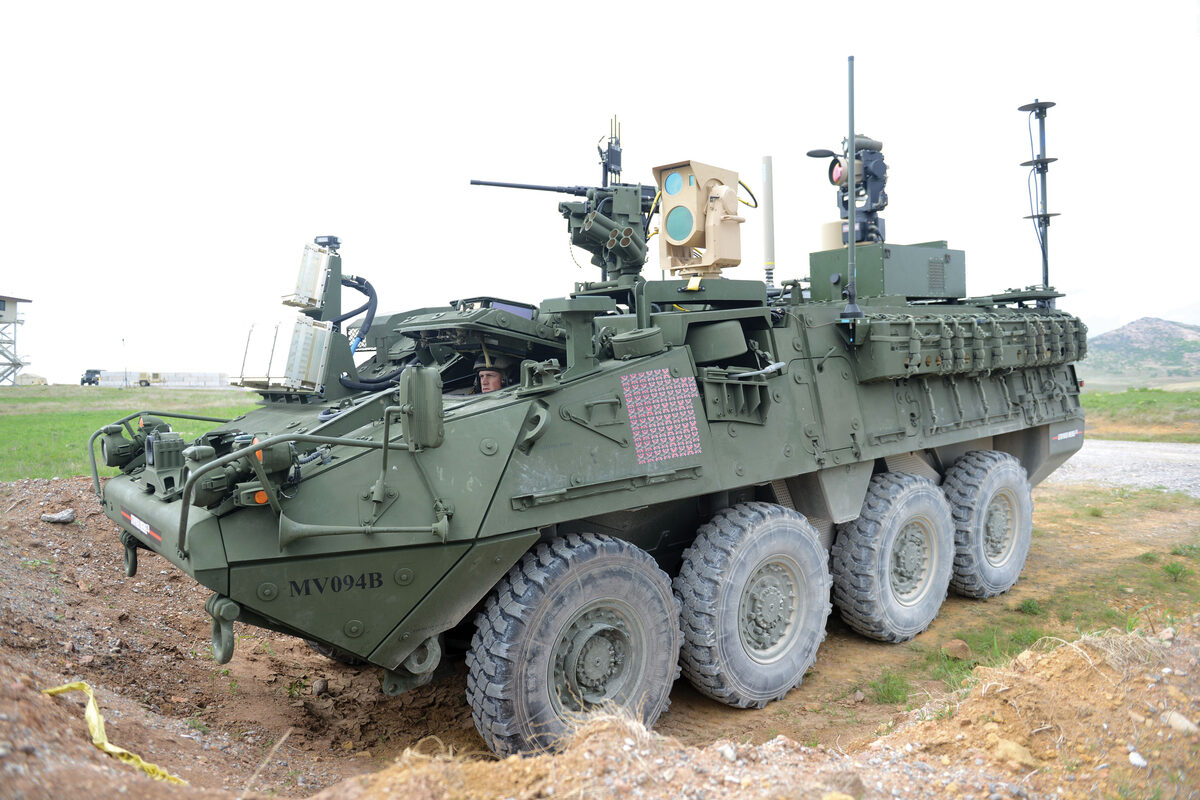
The US Army now has a date in mind for putting production high-energy lasers in soldiers' hands to shoot down drones. At the Association of the US Army (AUSA) conference this week, Army officials, as reported by Defense News, said the first weapons from the Enduring-High Energy Laser (E-HEL) program could be out of testing and ready for counter-drone operations by early 2028. The hardware is AeroVironment's LOCUST X3, a modular, palletized laser system. The Army awarded the $464.8 million contract in September.
Army leaders have talked about directed-energy counter-drone weapons for years. E-HEL differs because, per AeroVironment, the Army is now buying production units rather than prototypes. Here is what is confirmed, what is still a goal, and where the information comes from.
What did the Army actually buy?
On September 2, AeroVironment (AV) announced that the Army's Portfolio Acquisition Executive for Fires (PAE Fires) had awarded it a $464.8 million Other Transaction Agreement (OTA) for the E-HEL program. The company describes the system as a 30-kilowatt, platform-agnostic laser weapon meant to defeat Group 1 through Group 3 unmanned aircraft systems.
AV says the award covers "dozens" of LOCUST X3 systems to be delivered over the next few years. At AUSA, AV's John Garrity gave a more specific number, according to Defense News: the contract is for more than 26 laser weapon units in total.
AV calls the deal the "first-ever production contract for high energy laser weapon systems in United States history." That is the company's own claim. It appears again in AV's investor presentation filed with the SEC on September 9, where the award is listed as "$464M" and described as "marking first-ever directed energy production contract." The Army has not published its own statement that UASFeed could read, so AV's press release and SEC filing are the main documentary record of the award for now.
When will soldiers get it?
The schedule has two layers. The first is a delivery milestone: according to Defense News, the first LOCUST X3 is slated for delivery by the fourth quarter of fiscal 2027, mounted on a Joint Light Tactical Vehicle (JLTV). AV's release says JLTV integration is the baseline and that the company is analyzing the Infantry Squad Vehicle (ISV) as a possible host.
The second layer is fielding, meaning the point when a unit actually has the weapon. Brig. Gen. Guy Yelverton, Capability Program Executive for Defensive Fires, gave a range. He said "my far-down point would be spring" of 2028 and that getting it done in the December-January timeframe "would be awesome." Defense News reported that it is unclear where the first weapons will be deployed, and that Yelverton suggested the 7th Infantry Division could be a potential partner. The Army has not announced a first receiving unit.
Kirk Williams, chief engineer at the Army's Directed Energy Project Office, said the Army would like to keep the first unit off the line for testing and training. But, he said, "with the environment as it is, everything that we produce as a capable counter-UAS system tends to get deployed somewhere."
Where does LOCUST X3 come from?
LOCUST is not new to the Army. AV says E-HEL builds on its work for the Army Multi-Purpose High Energy Laser (AMP-HEL) prototypes. Defense News, citing AeroVironment, reported that earlier generations of LOCUST are actively fielded in operational environments, including at the US southern border.
According to AV, testing at White Sands Missile Range, led by Joint Interagency Task Force 401 (JIATF-401) and PAE Fires, demonstrated counter-drone operations in US airspace and directly enabled a DOW-FAA safety agreement validating the system for domestic use. Defense News also reported that the Army demonstrated eight kills with the directed-energy prototype platform during Army Modernization Day in October. The article does not make clear exactly when that demonstration happened.
On the industrial side, AV said production ramp-up will be supported by a $30 million investment in its Albuquerque, New Mexico facility, announced in March 2026.
Why It Matters
Cost is a central reason the Army is pursuing directed energy. Defense News reported that directed energy weapons are one of the capabilities the Army is pursuing at speed to counter the growing threat of low-cost unmanned aircraft, and that Army Secretary Adam Telle highlighted the need to field low-cost interceptors to shoot down missiles and drones at AUSA.
AV describes the award as a "historic transition from prototype to production" for laser weapon systems. A production OTA with a unit count reported by Defense News, a delivery quarter and a named host vehicle is a firmer commitment than a prototype program, though the "first-ever" label is AV's.
Three things are worth watching:
- Schedule. First delivery is slated by Q4 FY2027, and fielding is targeted for the December-January timeframe at best, with spring 2028 as the outer limit Yelverton named. A slip in either milestone would show quickly.
- Quantity. AV says "dozens" and Garrity says more than 26 units. Neither the Army nor AV has given an exact number of systems or how deliveries will be paced.
- Sourcing. The contract details come from AeroVironment's press release and SEC filing, plus Army officials quoted by Defense News. Until the Army publishes its own record of the award, the "first-ever production contract" label should be read as AV's claim.
The E-HEL award is also only one part of AV's counter-drone business. The same SEC presentation lists a $52 million first international commercial order for LOCUST. It also lists a $500 million selection by JIATF-401 of AV's Titan MS (Multi-Sensor) system in support of Domestic Shield, with an initial task order of $80 million. Taken together, these show AV positioning itself as a counter-UAS supplier across several programs, not just as a laser vendor.
Sources
- US Army targets 2028 for first high-energy laser counter-drone weapons (Defense News, Oct. 13, 2026)
- AV's LOCUST Selected for Nearly $500 million Army Counter-UAS Contract for E-HEL (AeroVironment, Sept. 2, 2026)
- AeroVironment Form 8-K Exhibit 99.2, investor presentation (SEC EDGAR, filed Sept. 9, 2026)
