
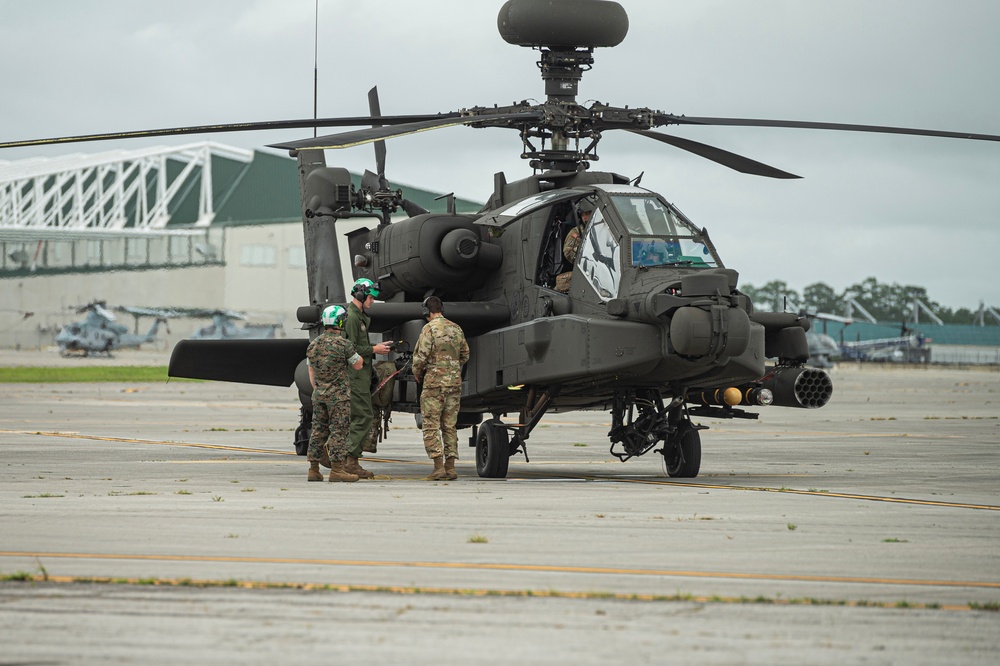
In March, Army aviators in Germany showed that an AH-64E Apache could shoot a drone out of the sky. On Oct. 6 they took the next step. At Grafenwoehr Training Area, a ground-based air defense radar found the targets and passed the tracks to Apache crews, who then destroyed three target drones.
The event was called Operation Skyfall II. It paired the 5th Battalion, 4th Air Defense Artillery Regiment (52nd Air Defense Artillery Brigade) with the 2nd Battalion, 159th Aviation Regiment (12th Combat Aviation Brigade). According to a 10th Army Air and Missile Defense Command release, "The Apache crews successfully engaged three Outlaw drones, destroying each one."
From "can it shoot?" to "can it be cued?"
The two Skyfall events tested two different questions. Stars and Stripes reported that the first Skyfall, held in the spring, tested whether the Apache could shoot drones at all. Skyfall II tested whether targeting data could be sent from the ground to the aircraft.
The first event took place at Grafenwoehr on March 18, 2026. It was run by 2-159th Aviation under the Eastern Flank Deterrence Initiative. The Army's release on it was confident: "For the first time in the European theater, the AH-64E Apache proved itself as a viable counter-unmanned aerial system platform, using its existing weapon systems to engage and destroy drones in air-to-air combat." The 10th AAMDC account of Skyfall II says the March event showed the Apache could track and engage unmanned aircraft using data from ground-based air defense sensors. Skyfall II built on that result.
According to Stars and Stripes, both events grew out of Project Flytrap, an Army modernization initiative.
The sensor-to-shooter chain
The ground side of the setup was an AN/MPQ-64 Sentinel radar used on the SGT STOUT air defense system. Stars and Stripes identified the radar as a Sentinel A4. The 10th AAMDC release says the Sentinel provides low-altitude alerting, tracking and cueing. It extends the detection range and warning time available to the aircraft, which the release says helps the Apache survive.
Lt. Col. John Verwiel, who commands 5-4 ADAR, described the air defenders' role as sending the track's location in time and space so the Apache pilot knows exactly where it is. According to the release, the air defenders relayed the data to the Apache pilots through the battalion's tactical operations center, which could also track the engagement and confirm the drone's elimination. In practice, the radar searches the low-altitude airspace and the helicopter receives a track to fly toward.
The targets were Griffon Aerospace MQM-170 Outlaw drones, which the Army describes as low-cost target drones. Stars and Stripes reported that Griffon contractors launched them during the exercise.
Inside the cockpit
Stars and Stripes reporter Matthew M. Burke described one engagement. Chief Warrant Officer 4 Jarrad Walter, the pilot, and Chief Warrant Officer 4 Cody Schoonover, the gunner, fired the Apache's 30 mm cannon in 20-round bursts. The drone "fluttered" after being hit, and the crew circled back to finish it off.
Walter said the unit had room to experiment: "We don't have to follow a black-and-white doctrine." Lt. Col. Comador Ferguson III, of 2-159th, put the test plainly. The question, he told Stars and Stripes, is whether the Apache is "a relevant platform" for countering drones. He said Ukraine is "on everybody's mind."
Doctrine still in draft
Neither unit claimed the work was finished. The 10th AAMDC release says the official tactics, techniques and procedures are "still being refined with every iteration." Maj. Tyler Jamison, operations officer for 2-159th, gave the aviation view: working with air defense "has helped us operationalize what it means to destroy a drone."
After the March event, Maj. Daniel Murphy, the battalion's operations officer, said air-to-air engagement was "a new engagement profile for us that we have to develop tactics, techniques, and procedures for." Skyfall I showed that the weapons could do the job. Skyfall II tested whether air defense and aviation units can pass a target between them, with the air defenders tracking the drone and the aviators engaging it.
Why It Matters
The Apache is a fast, armed platform that can reach a threat; the Army's March release puts its top speed at over 180 mph. If ground radars can reliably cue helicopters onto small drones, units may be able to use aircraft they already own and weapons already installed on them.
The European setting also matters. The Army release on Skyfall I notes that the 12th CAB trains with the United Kingdom, the Netherlands and Poland, and that Poland is set to become the world's second-largest Apache operator. The release calls the work a blueprint for Allied aviation units across the continent, so procedures developed at Grafenwoehr could apply well beyond one U.S. brigade.
Some caveats apply. The targets were contractor-launched target drones on a training range. Neither account reports how the method would hold up against large numbers of drones, against drones designed to evade, or in a contested electronic environment. Both units say the procedures are still being written. What Skyfall II did show is that an air defense radar can hand a drone track to an Apache crew and the crew can destroy the target, three times out of three.
