
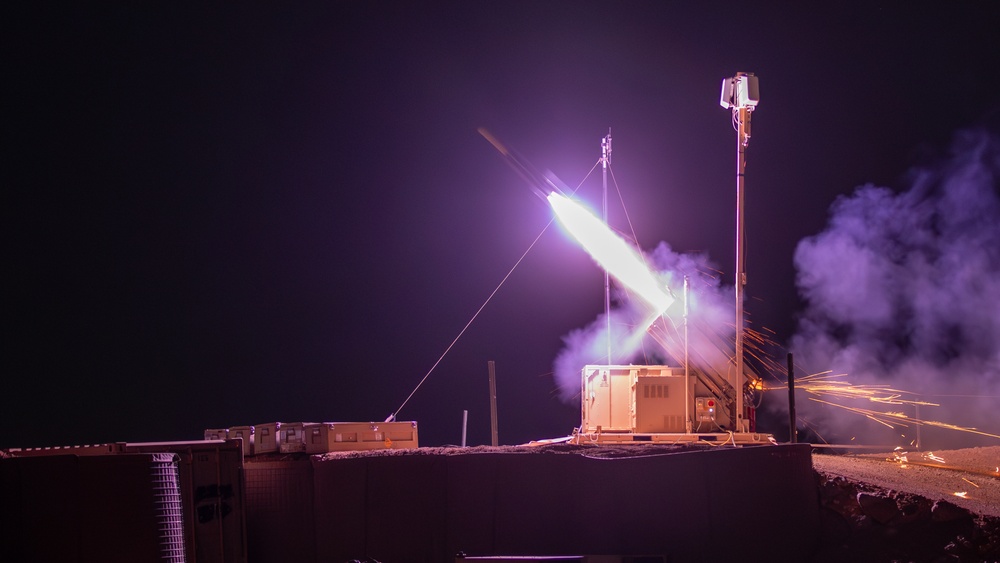
For most of its service life, the Coyote has worked like a small drone built to hunt other drones. A turbojet carries it to the target, and a radio-frequency seeker and blast-fragmentation warhead finish the job. Raytheon is now changing the first part of that formula. On Oct. 12, around the start of the Association of the U.S. Army (AUSA) annual meeting, the RTX business disclosed a new variant called Coyote Block 2C+RM. It drops the jet engine for a solid rocket motor and adds a new seeker and warhead.
According to Raytheon's announcement, datelined Tucson, the company has completed three developmental tests that it paid for itself. It says the program went from concept to test in 15 months. The announcement describes the goal as integrating "a rocket motor for faster launch and flight, along with a new seeker and warhead."
What Raytheon Has Actually Shown
The disclosure is short on numbers. According to the company, the first test series confirmed initial integration with the current counter-drone architecture. It also included the first launches of a Coyote effector with a tactical rocket motor, which Raytheon says is meant "to improve threat engagement times and faster successive shots."
The War Zone reported that the three live launches came after static fires of the motor. It also reported that the motor comes from a subcontractor that is unnamed. A photo caption in Janes' coverage cites a July 2026 test flight at Dugway Proving Ground in Utah.
Tom Laliberty, president of Land & Air Defense Systems at Raytheon, briefed reporters on Oct. 8, according to Janes. He confirmed that the solid rocket motor replaces the jet engine and that the change brings a faster launch and higher flight speed. He would not give figures. He said only that the change is "significant in terms of the range difference, and ... endgame capabilities," Janes reported.
The Raytheon statement says the new seeker and warhead are "designed to defeat all classes of current and emerging drone threats." The company has not said what the seeker is. For comparison, the existing Block 2 uses an RF seeker and a blast-fragmentation warhead, according to The War Zone.
The Target: Faster Jet-Powered Drones
Laliberty said the intention is to cover "all types of Class 3 drones," The War Zone reported. The U.S. military defines Group 3 drones as aircraft weighing roughly 56 to 1,320 pounds that fly up to 18,000 feet at no more than 250 knots. Laliberty noted that the Class 3 spectrum overlaps with the capabilities of cruise missiles.
The War Zone says Laliberty was asked whether faster jet-powered one-way-attack drones, such as Iran's Shahed 238 and Russia's Geran-4 and Geran-5 derivatives, had prompted the development. He declined to discuss specific threats. The War Zone cites claimed speeds of roughly 270 to 320 knots for those jet-powered drones, which it says push the upper boundaries of the Group 3 category. That is above the 250-knot ceiling of the definition. It is reasonable to infer that an interceptor built around slower, propeller-driven loitering munitions has less margin against such targets, but Raytheon has not said so.
From Drone-Killer to Something Closer to a Missile
This is the most interesting part of the announcement. The jet-powered Coyote has been something like a drone flown once and expended. With a solid rocket motor, a new seeker, a new warhead and a stated aim of covering a drone class that overlaps with cruise missiles, the Block 2C+RM looks much more like a short-range surface-to-air missile. The War Zone makes the same point, saying the variant pushes the Coyote into the surface-to-air missile side of the interceptor spectrum.
Raytheon's own wording points the same way. Its emphasis on "engagement times" and "faster successive shots" is how a missile maker describes a weapon. A faster interceptor shortens the time between detection and kill. That leaves more time for a second shot if the first one misses, or for engaging the next target in a salvo.
There is a cost side to this. The original reason for drone interceptors like the Coyote was to avoid firing expensive missiles at cheap drones. The War Zone notes that the Coyote's unit cost has been reported in the past at around $100,000, and puts the estimated cost of a Shahed 236 at roughly $50,000. How the rocket-powered version will compare on price is unclear. Each step toward missile-class performance, with a new propulsion system, a new seeker and a new warhead, risks pushing the unit price up. Until Raytheon discloses what Block 2C+RM costs, any claim about cost per kill is speculation. The question is still the right one to ask.
Built to Fit What Already Exists
Raytheon is stressing compatibility. Janes quotes Laliberty saying the upgrades are compatible with existing infrastructure, including launch cells, the guidance radar, and the command-and-control system. The War Zone adds that the new round works with all existing four-cell and eight-cell launchers, whether mounted on vehicles, static ground positions or ships.
That matters because the Coyote Block 2 is already in service. The Army uses it in vehicle-based and palletized versions of the Low, Slow, Unmanned Aircraft Integrated Defeat System (LIDS), and the Navy has integrated launchers on several Arleigh Burke-class destroyers, The War Zone reported. If the new round fits those cells without changes, it can be fielded without replacing the launchers.
Janes quotes Laliberty calling Block 2C "the workhorse of the US Army's counter-UAS capability." He said that variant has defeated more than 600 attack drones. The RTX press release says only that current Coyote variants "have intercepted hundreds of drones."
The Contract Question
It is not clear who will buy this variant. The War Zone reports that it is unclear whether any formal US military contracts cover Block 2C+RM, and Raytheon calls the three tests company-funded. The War Zone also quotes Laliberty saying Raytheon has "now essentially received some government sponsorship" as the effort transitions toward a program of record, with more tests scheduled into the first half of next year. The Army is the largest known operator of Coyote Block 2-series interceptors and has previously stated plans to buy at least 6,000 between fiscal years 2025 and 2029.
That purchase plan is the background to the whole announcement. Laliberty told reporters that the new round could be cut into follow-on Coyote contracts. If the Army decides it needs the faster round, Raytheon has a large existing order to migrate. If the Army stays with the jet-powered round for slower drones, the rocket variant could end up as a niche weapon. Another possibility is a mix of both rounds in the same launchers, chosen according to the threat. Raytheon told The War Zone it has no plans to stop producing the jet-powered Block 2 for now.
Why It Matters
The counter-drone market has leaned on cheap interceptors for cheap threats. Faster jet-powered one-way-attack drones, with claimed speeds above the Group 3 ceiling, put pressure on that approach. Raytheon's answer is to make the Coyote faster, with a new seeker and warhead, while keeping it compatible with the launchers, radar and command-and-control network already in use.
That is a pragmatic engineering choice, but it moves the Coyote toward the surface-to-air missile category. The unanswered questions are what the new round costs, how much the government will commit, and how it will fit alongside the at least 6,000 Coyote Block 2 rounds the Army has said it plans to buy. Raytheon has demonstrated three test launches. Formal procurement contracts have not been announced.
