
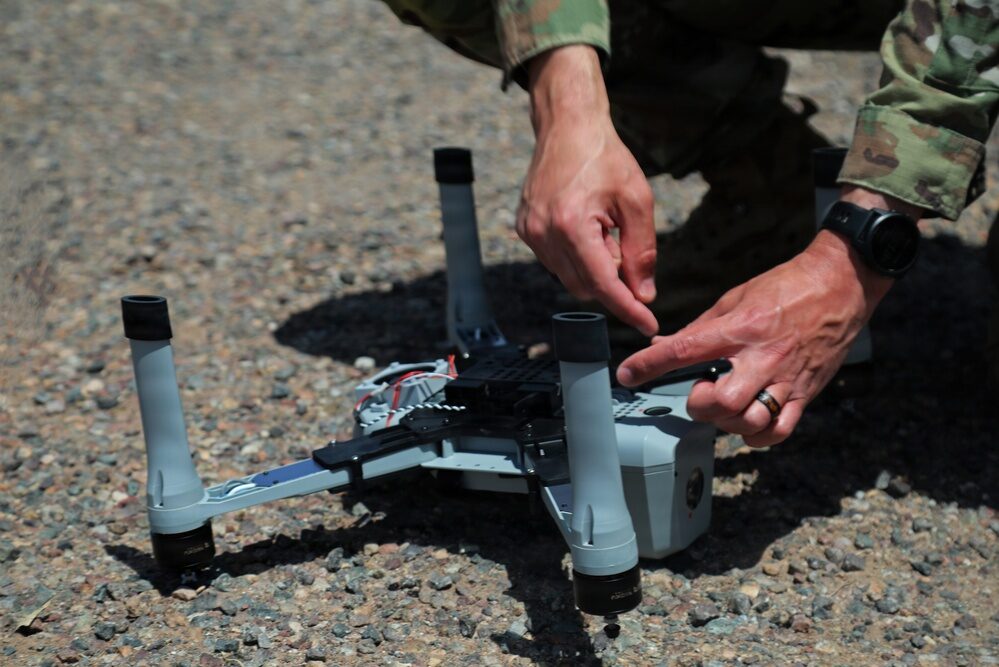
U.S. Army Southern European Task Force, Africa (SETAF-AF) is partnering with the Global Tactical Edge Acquisition Directorate (G-TEAD) on what DVIDS describes as the command's first accelerated capability event, or ACE. The event focuses on counter-UAS and force protection, and it will run in spring 2027 in Tan-Tan, Morocco. The goal is to test new systems and deliver them to Soldiers within 180 days, according to an Oct. 15 DVIDS release by Capt. Tucker Chase.
The problem it targets is specific: protecting early-entry command posts against Group 1 through Group 3 small unmanned aircraft systems (sUAS). Those are small and mid-sized drones, and the event targets capability gaps in protecting early-entry command posts and operating locations against them.
How the Event Is Structured
According to DVIDS, the event includes a Soldier-led demonstration and an operational assessment tied to an existing exercise (DVIDS describes the ACE model generally as three phases: submission and preparation, Soldier-led demonstrations, and follow-on operational evaluation):
- February–March 2027: a Soldier-led demonstration of candidate systems.
- April–May 2027: an operational assessment during African Lion 2027, U.S. Africa Command's largest joint military exercise in Africa.
G-TEAD will validate up to 15 solutions, with PAE Fires named as the transition partner.
Submissions are sorted into five categories:
- an integrated fly-away kit
- sUAS detection
- kinetic defeat
- nonkinetic defeat
- passive protection
Per DVIDS, solutions will integrate into the Army's C-UAS command and control, the Integrated Battle Command System-Maneuver (IBCS-M). That requirement suggests the Army wants components that work as part of a defended command post rather than as standalone gadgets.
DVIDS reports that a G-TEAD team was assigned to SETAF-AF in summer 2026, and Maj. Katlin VanWye serves as the embedded G-TEAD representative. Col. Christopher Hill is G-TEAD's director.
G-TEAD's Track Record: The Eastern Flank Buy
The 180-day goal is ambitious, but G-TEAD has moved quickly before. In March 2026, Army.mil described how the directorate delivered counter-drone capability to NATO's eastern flank. G-TEAD bought 50 Merops systems, made by Perennial Autonomy, through a contracting vehicle held by the 409th Contracting Support Brigade.
The same account describes a bailment of about $6 million across the Merops, Hornet and Bumblebee systems, arranged within 48 hours of a demonstration. Separately, JIATF-401 awarded a $5.2 million prototype OTA for more Bumblebee systems for the southern border. Army.mil also identified Merops as a transition candidate for a Program of Record, which is the step that turns a quick buy into a sustained, budgeted capability.
That sequence is roughly what the Morocco event is built to repeat: demonstrate, decide fast, get hardware to units, and identify which systems deserve a longer-term program.
The Institutional Context
The ACE fits a broader Army push to compress the path from prototype to field. In February 2026, Army.mil described the Pathway for Innovation and Technology (PIT), which it called a "Plus One" to the Army's six PAEs. Col. Shermoan Daiyaan is PIT's director.
Chris Manning, Deputy Assistant Secretary of the Army for Research and Technology, laid out three principles for the effort: speed over perfection, early Soldier feedback, and proving a demand signal before committing big dollars. The SETAF-AF event reflects all three. Soldiers lead the demonstrations, the assessment happens in an operational exercise rather than a lab, and validated solutions go to a named transition partner.
Why It Matters
Early-entry command posts are the stated focus, and a counter-drone kit that takes years to field risks meeting a threat that has already changed. The SETAF-AF and G-TEAD approach tries to close that gap by making the theater command the test venue, putting Soldiers in charge of the evaluation, and attaching a named transition partner and a 180-day delivery goal to the outcome.
The five-category structure is also telling. Including passive protection and a fly-away kit alongside detection and defeat suggests the Army is treating command-post defense as a system problem, not just a hunt for a better jammer or interceptor. The IBCS-M integration requirement points the same way.
Whether the 180-day target holds is the real test. G-TEAD's eastern-flank buy shows the directorate can contract and move hardware fast. The Morocco event will show whether that speed carries over to a competitive, multi-category evaluation of up to 15 solutions tied to a major exercise schedule.
Sources
- DVIDS: SETAF-AF, G-TEAD partner to accelerate counter-drone tech in Africa (Capt. Tucker Chase, Oct. 15, 2026)
- Army.mil: G-TEAD Delivers Rapid Counter-Drone Capability to NATO's Eastern Flank (Mar. 26, 2026, via mirror)
- Army.mil: Army's 'Pathway for Innovation' fast-tracks testing and scaling of new capabilities (Feb. 25, 2026, via mirror)
