
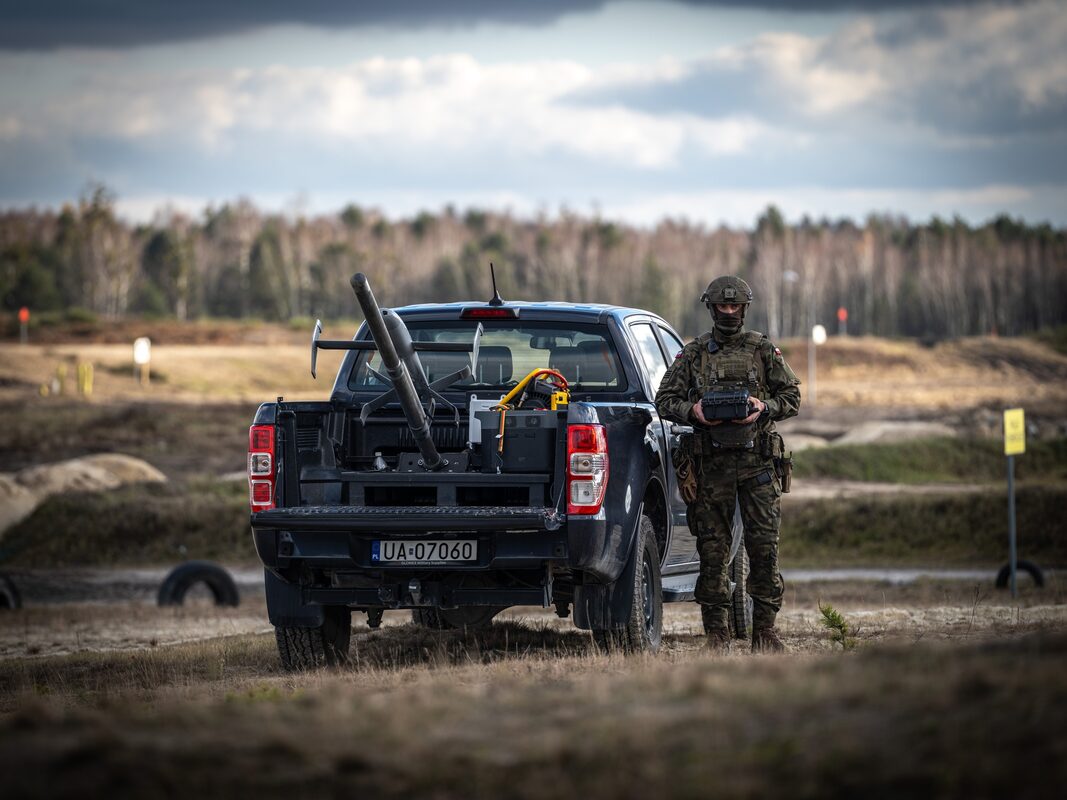
The Army has a new benchmark for how fast it can turn a battlefield stopgap into a formal program. Speaking at the Association of the U.S. Army (AUSA) annual meeting, Col. Christopher Hill, director of the Army's Global Tactical Edge Acquisition Directorate (G-TEAD), said the Merops interceptor drone became a formal Army program in 142 days, according to TWZ. G-TEAD's standard process targets 180 days.
That number caps a fast run for a system the Army was buying by the thousands only months ago. Below is what is known about Merops, how the Army moved it so quickly, and where the official account comes with caveats.
What is Merops?
Merops is a counter-drone system that launches small interceptor drones at incoming one-way attack drones such as Iran's Shahed family. According to TWZ, the interceptors use Surveyor drones that kill their target either by direct impact or with a proximity-detonated warhead. The system was developed under Project Eagle with Swift Beat.
Military Times reported in April that Merops is built by Perennial Autonomy, the company formerly known as Project Eagle. Citing industry data, it gave a range of roughly 5 to 20 kilometers, a top speed of up to 280 km/h, and a 2-kilogram fragmentation warhead. Ukraine first used it in June 2024, and Poland and Romania have also fielded it.
How did the Army get to 142 days?
Hill's figure is the time Merops took to become a formal Army program. TWZ calls it a program of record, while C4ISRNET reported in May that Merops had been flagged as a transition candidate for a program of record under Project Manager Close Combat Systems. G-TEAD's standard process is a 180-day effort to reach a decision on whether a capability becomes an Army program, which TWZ says Merops beat at 142 days. That is 38 days, or more than a month, ahead of the target.
Not every deadline was met, though. Hill said a senior commander demanded that the capability reach partners "within 14 days." According to TWZ, the first delivery took approximately 21 or 22 days. That missed the demand, but by about a week, not by months or years.
How many did the Army buy, and how fast?
The scale came before the program. Testifying at an April budget hearing, former Army Secretary Driscoll said: "within about eight days, we were able to purchase ... 13,000 Merops," according to Military Times. C4ISRNET reported that the purchase followed Iran's start of drone launches in late February, citing Driscoll's April 16 testimony. TWZ says the 13,000 interceptors were procured through the Joint Interagency Task Force.
TWZ also reports that mobile Merops firing teams were sent to a second theater, which the outlet presumes is U.S. Central Command. Separately, C4ISRNET cited a Business Insider report of roughly 20 Merops complexes at a single Middle East site.
What does it cost, and why does that matter?
Cost explains most of the urgency. Driscoll put the Merops unit cost at about $15,000, and said it could fall below $10,000 at scale. According to TWZ, he went further in a Bloomberg interview and suggested $3,000 to $5,000 with larger orders. Military Times put a Shahed at roughly $30,000 to $50,000.
The usual alternative costs far more. C4ISRNET reported that the Pentagon has used up hundreds of Patriot interceptors that cost more than $3 million each. Using a multimillion-dollar missile against a drone that costs tens of thousands of dollars is a losing trade, both in money and in the size of the stockpile. At about $15,000 a shot, Merops costs less than the drones it is meant to destroy.
Low cost also brings competition. C4ISRNET reported that Lithuania bought 48 Merops from Perennial Autonomy on April 22 without competitive bidding, calling Merops a $15,000 per-shot system. It also noted that Ukrainian-made interceptors are cheaper, typically $1,000 to $3,000 a unit. C4ISRNET described the interceptor-drone market as a "bazaar" where low price is everything.
Does it actually work?
Merops' combat record mostly comes from Ukraine. C4ISRNET reported, citing the Ukrainian outlet Militarnyi, that Merops has logged more than 1,000 Shahed-type intercepts in Ukraine since combat testing began in mid-2024. That figure comes from a single outlet, and C4ISRNET noted the Pentagon has yet to disclose a Middle East engagement count or per-target success rate.
Hill was careful not to overstate it. He said that success in Ukraine does not automatically mean a system will perform equally well in every operational environment, and that effectiveness will vary depending on where it is used, including differences between desert environments and the urban areas where it has operated in Ukraine. His stated aim is to get the capability into the Army's inventory so commanders can decide how and where to use it.
Why It Matters
Merops tests two things at once. The first is whether cheap interceptor drones can take a meaningful share of the counter-drone mission away from expensive missiles like the Patriot. TWZ notes that inexpensive drones can improve the economics of air defense while preserving more sophisticated interceptors for threats that require them. The price gap is large, but it only matters if the drones hit reliably.
The second is the acquisition model. Hill said G-TEAD's process brings program acquisition executives, testers and soldiers in early so that a transition partner is identified up front. Moving Merops in 142 days, against a 180-day target, is a strong data point for that approach. The 21-to-22-day fielding against a 14-day demand shows where the process still fell short when a commander wanted equipment within weeks.
Both questions will depend on how Merops performs outside Ukraine, the caution Hill himself raised. With 13,000 interceptors bought and firing teams sent to a second theater, the Army is positioned to gather that evidence, though neither source reports Middle East performance figures.
