
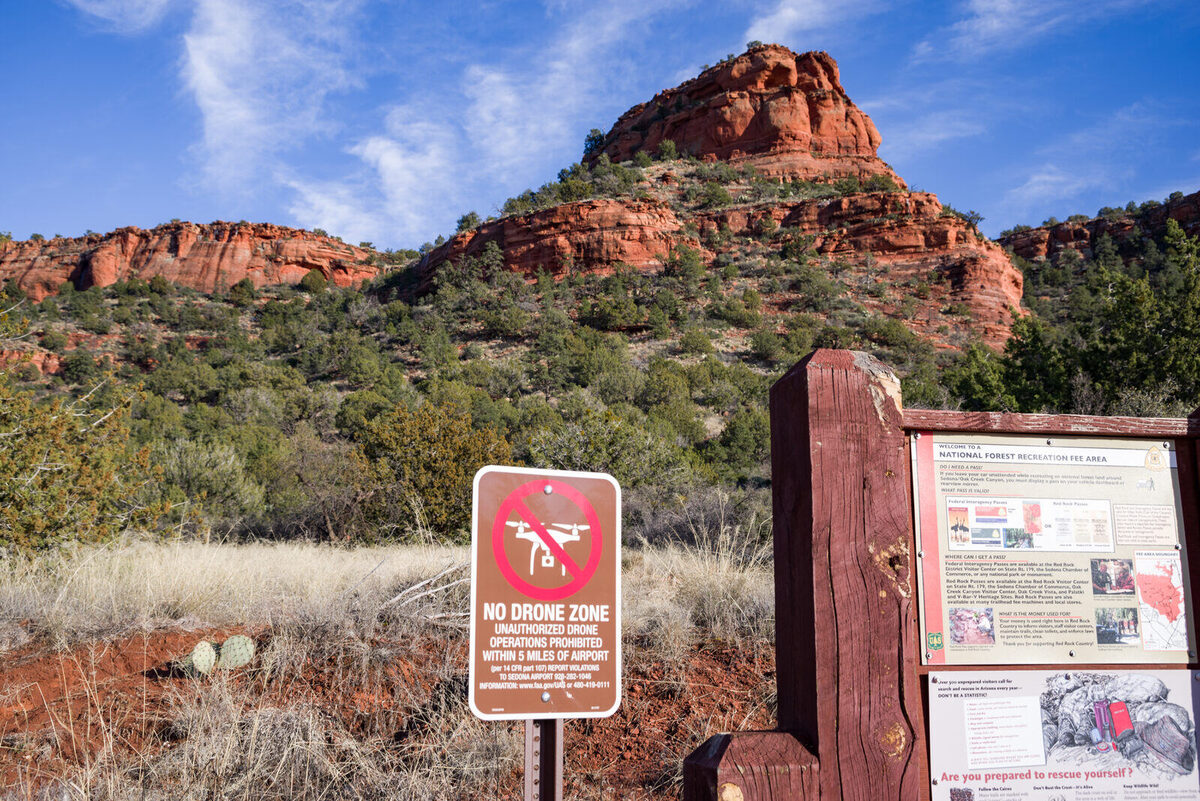
On January 13, 2025, DJI—the company whose aircraft dominate consumer and commercial drone operations across the United States—stopped preventing its drones from flying into restricted airspace. Areas that had carried hard firmware takeoff blocks under the company’s proprietary GEO system were reclassified as “Enhanced Warning Zones”: instead of a lock, pilots receive a dismissable in-app alert.
“Areas previously defined as Restricted Zones (also known as No-Fly Zones) will be displayed as Enhanced Warning Zones, aligning with the FAA’s designated areas.” —DJI official statement
The practical implication: the last widespread barrier between an uninformed consumer drone operator and a runway incursion is now a notification popup. This change surfaced a tension the industry had been deferring—what role should manufacturers play in enforcing airspace rules, and what replaces that enforcement once the dominant manufacturer steps back?
How Manufacturer Geofencing Worked—and What It Just Became
DJI introduced its GEO geofencing system in 2013 as a voluntary measure to restrict operations near sensitive US and European airspace. For over a decade, the architecture organized airspace into six zone types: Warning (alert only), Enhanced Warning (acknowledge to proceed), Restricted (formerly hard block), Authorization, Altitude Zones (enforced height ceilings), and Regulatory Restricted Zones—hardcoded firmware prohibitions covering prisons, border areas, and national security sites. Only two categories retain hard blocks today: Altitude Zones still cap height and cannot be user-overridden, and Regulatory Restricted Zones stay locked in firmware. Everything else is now an advisory.
The updated system ingests live FAA airspace data directly. The company’s global policy head framed the philosophical shift plainly: “This GEO update aligns with the principle advanced by aviation regulators around the globe—including the FAA—that the operator is responsible for complying with rules.”
The European transition preceded the US rollout by a year: Belgium, Germany, and France converted in January 2024, with Estonia, Finland, and Luxembourg following by June 2024. A second US update in November 2025 extended the advisory-only model to additional consumer and enterprise platforms; agricultural drones followed in December 2025. The GEO Unlock Request service—which had allowed pilots to petition for manufacturer pre-authorization in restricted zones—is being retired in early 2026.
Brendan Schulman, DJI’s former policy head, did not soften his assessment: “This is a remarkable shift in drone safety strategy with a potentially enormous impact, especially among drone pilots who are less aware of airspace restrictions and high-risk areas.” The company’s response: “Politics does not drive safety decisions at DJI. For over a decade, DJI has led the drone industry in safety.”
The FAA Airspace Stack Drones Must Navigate
Manufacturer geofencing was never the legal mechanism governing drone operations—it was a supplement to the actual regulatory framework. Understanding what remains requires knowing three distinct systems: UAS Facility Maps, LAANC, and Temporary Flight Restrictions.
UAS Facility Maps (UASFMs) form the quantitative foundation. The FAA divides controlled airspace around airports into grid cells, each assigned a maximum operational altitude ceiling—400, 300, 200, 100, 50, or 0 feet AGL. A “0 ft” cell means no automated authorization is available; pilots must pursue manual review through FAA DroneZone instead.
LAANC—the Low Altitude Authorization and Notification Capability—is the mechanism that made this operational. Launched in 2017, LAANC transformed a weeks-long paper authorization process into near-real-time approvals, typically in seconds to minutes. It covers approximately 740 FAA air traffic facilities—effectively the vast majority of US controlled airspace—administered through 10 FAA-approved UAS Service Suppliers including Aloft, Airspace Link, and Wing. Authorization is free. Part 107 pilots can request authorizations up to 90 days in advance and petition for above-ceiling altitudes through “further coordination”; recreational flyers access near real-time authorization only.
LAANC cross-references UAS Facility Maps, Special Use Airspace, airport data, active TFRs, and NOTAMs. The critical constraint: an active Temporary Flight Restriction blocks authorization regardless of altitude compliance. A pilot holding valid standing authorization can find themselves flying illegally if a TFR is issued after the fact.
TFRs cover VIP movements, natural disaster zones, special events, and some permanent designations. The penalties for violations are not administrative—security TFRs carry Class A misdemeanor exposure, with six to twelve months imprisonment and fines up to $100,000 without fatalities, $250,000 if deaths result. Recreational pilots face up to $1,414 per TFR violation. Current TFRs are checked via tfr.faa.gov, the FAA ArcGIS UAS map, or the FAA B4UFLY app.
Certain airspace carries absolute prohibitions. Washington DC’s Special Flight Rules Area extends 30 miles from Reagan National Airport; the inner 15-mile Flight Restricted Zone bars all drone activity without specific FAA clearance. DOE nuclear facilities prohibit all UAS flight outright. National landmarks—the Statue of Liberty, Mount Rushmore, Hoover Dam—carry a 400-foot radius prohibition. Coast Guard and naval sites require 3,000 feet of lateral separation and 1,000 feet vertical.
Remote ID—The Digital License Plate
Remote ID is the FAA’s identified replacement for mandatory geofencing enforcement. Full enforcement began March 16, 2024. Standard Remote ID—built into drones manufactured after September 2022—broadcasts via Wi-Fi or Bluetooth: unique drone ID and serial number, GPS location, altitude, speed, control station location, timestamp, and emergency status. The general public sees only location and a non-identifying serial; only the FAA and authorized law enforcement can correlate a Session ID to a registered owner.
Older aircraft can add a Broadcast Module retrofit, though these do not transmit emergency status or control station location. Sub-250-gram drones used exclusively for recreation are exempt from Remote ID—an exemption that disappears the moment the same aircraft is used commercially.
The FAA’s position is that Remote ID gives authorities sufficient tools to enforce airspace compliance after the fact, making mandatory geofencing legally unnecessary. That argument depends on law enforcement actually knowing how to use Remote ID data. GAO-24-106158, published June 2024, found the enforcement chain has documented gaps at every link. Contacted local law enforcement agencies “had little knowledge of Remote ID or how it could be used in their investigations.” The FAA initially had no plan or timeline for releasing its Remote ID interface to law enforcement; DHS likewise had no timeline for its law enforcement app. GAO issued four recommendations; two have since been implemented—FAA released law enforcement resources in April 2026 and a deployment plan in January 2026—while the DHS app timeline and a path to networked Remote ID remain open.
Where the System Breaks Down
The layered architecture—manufacturer advisories, LAANC authorization, TFR awareness, Remote ID broadcast—functions for operators who intend to comply. For anyone else, it is advisory-only from end to end.
Firmware downgrade tools such as No Limit Dronez (NLD) allow DJI operators to revert to pre-geofencing firmware versions using a USB connection and under $50 in software, with no technical expertise required. Yuneec aircraft allow no-fly zone disabling directly through their GUI. Some Parrot Anafi models offer an in-app toggle. Real-world monitoring near Las Vegas’s McCarran Airport documented drones operating routinely inside geofenced areas and above altitude limits. Separately, Airsight’s platform-wide data found close to 1% of tracked drones had no city or state metadata, consistent with Remote ID manipulation.
The GAO’s airport proximity data frames the cumulative pattern: more than 2,000 drone sightings near airports since 2021, occurring “almost daily” at major facilities; approximately 60 prompted evasive pilot actions; four involved commercial aircraft. In July 2022, Reagan Washington National Airport halted operations due to unauthorized drone activity. In June 2023, Pittsburgh International Airport experienced a 30-minute ground stop.
Enforcement exists, but operates well downstream of prevention. The 2024 FAA Reauthorization Act set a civil penalty ceiling of $75,000 per violation, with each separate infraction on a single flight generating its own penalty. In 2025, FAA issued civil penalties against 18 operations ranging from $1,771 to $36,770; eight certified remote pilots had licenses suspended or revoked. The largest 2025 fine—$36,770—was for interfering with wildfire emergency response in Maryland.
Why It Matters
The geofencing debate is a proxy for a deeper policy question: what does a layered airspace management system owe the flying public, and who bears responsibility when the layers fail sequentially?
DJI’s 2025 shift to pure advisories aligns with FAA’s regulatory philosophy but eliminates the last widespread automated barrier between a careless operator and a controlled airspace incursion. Remote ID was the named replacement mechanism—the theory being that post-hoc identification enables enforcement. GAO’s findings confirm the enforcement chain has weaknesses at every link simultaneously: manufacturers have opted out of active enforcement, local law enforcement agencies lack training and tools, and federal agencies responsible for delivering those tools missed their own timelines.
As Airsight’s industry analysis put it: “It is illegal for cars to go over the speed limit in almost anywhere in the U.S and abroad, but most cars can still go over 130 MPH. Car manufacturers aren’t disabling cars from speeding, so why are drone manufacturers disabling drones from flying?” The analogy is imperfect—speeding doesn’t threaten 150-seat airliners—but it captures the philosophical posture now prevailing across the industry.
For the compliant pilot, the existing stack—LAANC authorizations, TFR pre-flight checks, Remote ID broadcast—is functional and increasingly well-integrated. For the non-compliant actor, $50 in firmware tools, a sub-250g airframe, or a non-compliant manufacturer bypass every layer. Counter-UAS detection and interdiction technology is the logical next layer—the one designed for actors who have already decided the advisory system doesn’t apply to them. The geofencing argument was always about buying time—which is running out.
Sources
- U.S. Government Accountability Office — GAO-24-106158: Unmanned Aircraft Systems (June 2024)
- U.S. Government Accountability Office — Drones Take Flight, So Do Concerns About Safety
- DJI Viewpoints — GEO System Update (January 2025)
- IDGA — DJI Removes Key Flight Restriction Software in US
- DroneXL — DJI Geofencing Shifts to FAA Data Integration (January 2025)
- DroneDJ — DJI GEO Geofencing Update (November 2025)
- UAV Coach — DJI FlySafe and GEO Zone Types
- Drone Pilot Ground School — DJI Geofence Unlocking
- The Droning Company — DJI Removes No-Fly Zones
- The Drone U — LAANC Authorization Explained
- Rotate Pilot — LAANC Guide
- Dronedesk — FAA UAS Facility Map Explained
- DroneBundle — Airspace for Drones
- Pilot Institute — TFRs and Drones
- Pilot Institute — No-Drone Zones Explained
- Dronefly — Understanding the FAA’s Remote ID Rule
- Drone as a Service — FAA Remote ID Rule
- Airsight — How to Unlock Your Drone and Why We Should Not Rely on UAS Manufacturers for Safety
- DroneXL — FAA Drone Enforcement 2025: Fines and Suspensions
