
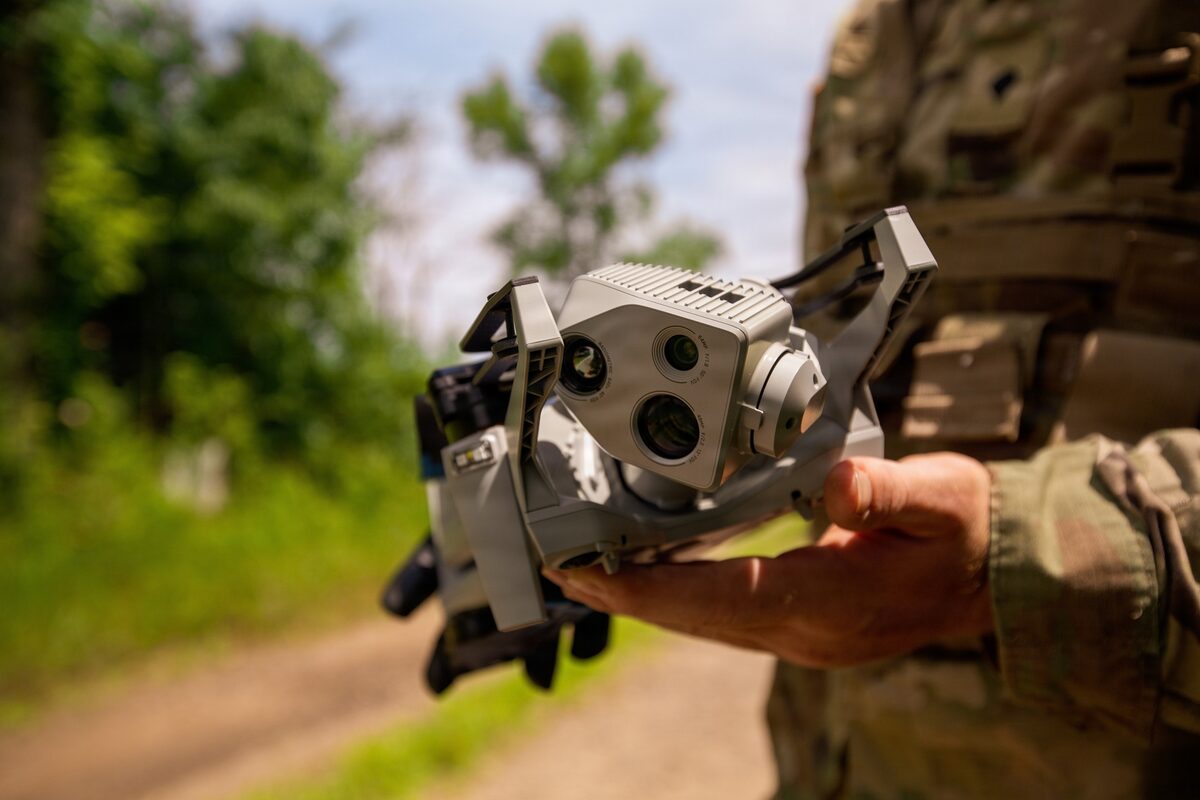
AeroVironment and Teledyne FLIR Defense on July 29, 2026, unveiled ARGUS-XL, a multi-sensor counter-drone platform designed to give US military installations round-the-clock detection and tracking of hostile small and micro drones. The system is being fielded under Joint Interagency Task Force 401's Domestic Shield Program, an Air Force-led effort backed by a three-year, $500 million indefinite-delivery/indefinite-quantity (IDIQ) contract.
ARGUS-XL is built around sensor fusion rather than any single detection method. The platform combines radar, electro-optical/infrared (EO/IR) imaging, and command-and-control (C2) data-fusion software into what the companies describe as hemispherical coverage — a continuous dome of surveillance rather than a fixed sector — aimed at spotting, identifying and following small unmanned aircraft before they can reach a protected site.
The $500 million IDIQ figure was first disclosed by AeroVironment in a company announcement on July 6, 2026, confirming the firm's award to support JIATF-401's Domestic Shield program. That figure and contract vehicle were corroborated in the July 29 rollout coverage of ARGUS-XL itself, which ties the new hardware directly to the task force's mission.
What JIATF-401 and Domestic Shield Actually Cover
Joint Interagency Task Force 401 is the Air Force-led organization responsible for the Domestic Shield Program, which is charged with protecting military installations and critical infrastructure inside the United States from unmanned aerial threats. The contract structure — an IDIQ rather than a single fixed-price buy — gives the government flexibility to issue task orders for additional ARGUS-XL units or related services over the three-year period as needs evolve, rather than committing to a single upfront purchase.
That distinction matters for how the program will likely unfold: IDIQ vehicles are typically used when the government expects recurring, variable demand — in this case, presumably as more installations are added to the counter-drone umbrella or as sensor requirements change with the threat picture.
The Sensor Fusion Approach
ARGUS-XL's design leans on combining sensor types precisely because no single sensor reliably solves the small-drone detection problem on its own. Radar is effective at detecting moving objects at range but can struggle to distinguish a small drone from birds or clutter. EO/IR cameras allow visual confirmation and classification — telling operators whether a radar track is actually a hostile quadcopter, a bird, or something else — but have a narrower field of view and are more limited at night or in poor weather without infrared. Layering the two, and feeding both into a common C2 and data-fusion software layer, is intended to produce a single, higher-confidence operating picture for the humans (or automated systems) making engagement decisions.
Dr. JihFen Lei, discussing the collaboration with AeroVironment, framed the goal as the ability to "detect, classify, track, and respond to increasingly complex unmanned aerial threats" — language that signals the platform is meant to support the full engagement sequence, not just initial detection.
Why It Matters
The $500 million Domestic Shield contract is a significant marker of how seriously the Pentagon now treats the threat of small drones over US soil, not just overseas. Homeland-based military installations have historically been designed around perimeter fencing, guard posts and airspace restrictions that assume threats arrive by land, sea or crewed aircraft — not a small hobbyist-grade quadcopter flown from a parking lot outside the fence line. The broader proliferation of small, commercially available drones has made counter-drone detection a homeland-defense priority rather than solely a deployed-forces one, a shift reflected in JIATF-401's existence as a dedicated, well-funded task force focused specifically on domestic installation protection.
ARGUS-XL's emphasis on 24/7, multi-sensor coverage also reflects a broader industry and Pentagon recognition that counter-UAS is not a problem solved by any single piece of hardware. As Janes.com's July 20, 2026 analysis of the unmanned systems market notes, counter-UAS technologies must continuously adapt to increasingly sophisticated threats — a dynamic that aligns with Domestic Shield's bet on layered, multi-sensor detection rather than a single radar or camera system that could be defeated or outdated by the next generation of drones. Programs like Domestic Shield are, in effect, a wager that fusing multiple sensor modalities into a common software layer is the most durable way to keep pace with a threat that is getting cheaper and more accessible every year.
The scale of the award — three years, $500 million, IDIQ structure — also signals that the Air Force expects this to be a sustained, expanding requirement rather than a one-time installation. That has implications for the broader counter-UAS industrial base: AeroVironment and Teledyne FLIR Defense's win establishes a template that other sensor and drone-defense manufacturers will likely compete to replicate as more task orders under Domestic Shield, and potentially other installation-protection programs, come up for bid.
What's Still Unclear
The available disclosures confirm the contract value, vehicle, program sponsor and the platform's core sensor architecture, but do not specify which installations will receive ARGUS-XL first, how many units are planned under the IDIQ, what "respond" capability the system includes beyond detection and tracking (i.e., whether it integrates with kinetic or electronic countermeasures), or a fielding timeline beyond the initial July 2026 unveiling. Those details would typically emerge as individual task orders are issued under the IDIQ vehicle.
Sources
- US Air Force expands $500M counter-drone shield with 24/7 multi-sensor threat tracking — Interesting Engineering
- AV Awarded $500 million IDIQ for Support of JIATF-401 Domestic Shield Program — AeroVironment
- The evolution of unmanned systems: Use, counters, future capabilities, and market dynamics — Janes.com