
In the spring of 2022, Iranian-designed Shahed-136 loitering munitions began striking targets across Ukraine. The weapons share a critical characteristic with the cheap commercial quadcopters saturating that same conflict: they navigate via pre-loaded GPS waypoints and emit no radio-frequency signal during flight. When a drone goes dark — no pilot datalink, no active uplink — electronic warfare systems have nothing to intercept. A jammer that cannot find the signal cannot stop the drone.
Fortem Technologies anticipated that problem before the war made it famous. The Utah-based airspace security company had been developing a radar-guided autonomous interceptor since a 2017 Air Force Research Laboratory SBIR contract formalized the concept. The system it built — the DroneHunter F700 — does not jam or spoof. It pursues a hostile drone, fires an expanding tethered net, and tows the capture to a forensics recovery point or lowers it under a parachute. As of early 2026, the F700 has completed more than 4,500 drone captures across deployments on three continents. Strategic investors include Boeing, Toshiba, and, as of April 2026, Lockheed Martin.
An Autonomous Interceptor Guided by Its Own Radar
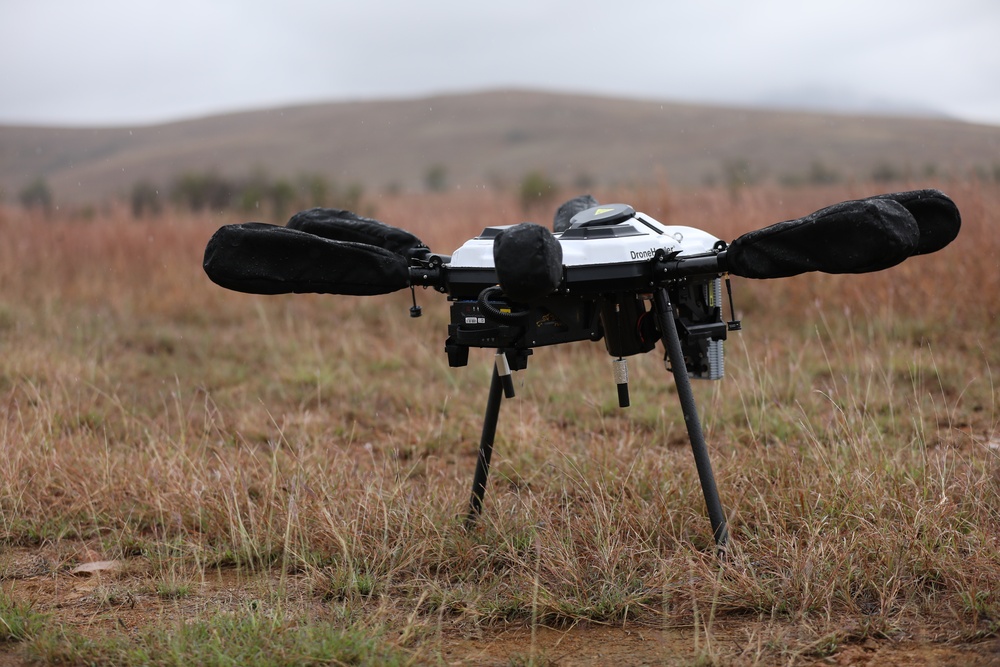
The F700 is itself a drone — a fully autonomous interceptor guided by an onboard TrueView R20 active electronically scanned array (AESA) radar that handles detection, tracking, and terminal engagement without a ground-based cue. It achieves 50 mph within seconds of launch and operates day and night through rain, snow, and fog. Three net variants match the interceptor to the target: a Small Tether Net for Group-1 quadcopters, a Medium Tether Net for small commercial platforms, and a DrogueNet with an integrated parachute for larger Group-2 drones, allowing controlled descent to a designated safe zone rather than a ballistic drop.
Four autonomous modes govern each mission. Pursue mode conducts optical investigation before committing to an intercept. Attack mode fires the net and initiates a tether tow toward a forensics staging area. Defense mode deploys net entanglement against faster or larger threats requiring a different approach vector. Tow-Away mode completes transport of the neutralized drone to a recovery point for intelligence exploitation. First-shot capture success rate stands at 85 percent; reload time for back-to-back sorties is under three minutes. The F700 has demonstrated engagements against platforms larger than itself, including the Russian Orlan-10 ISR drone and the Iranian Shahed-136 loitering munition.
The interceptor sits inside a wider architecture Fortem calls SkyDome. Ground-based TrueView AESA radars network with the F700's onboard R20 to form a continuous 3D detection dome over a protected zone. A command layer, SkyDome Manager, fuses radar data with long-range cameras and RF sensors through a ThreatAware AI risk-assessment engine, then routes cueing to interceptors and to third-party C2 platforms — including Northrop Grumman's FAAD C2 — via open API.
Why Jammers, Spoofers, and Missiles Fall Short
Electronic warfare dominates counter-UAS procurement because it is cheap and leaves no debris. The problem is structural: GPS-waypoint drones carry their mission profile onboard and transmit nothing during flight. There is no pilot datalink to sever, no uplink frequency to overpower. That gap played out visibly across the Ukraine conflict, where both sides adapted commercial drones to operate RF-silent.
GPS spoofing — feeding false position data to redirect a drone mid-flight — carries its own failure profile. State-level adversaries implement spoofing countermeasures as a matter of routine; effective redirection also requires proximity to the target that modern stand-off threats deny.
Kinetic defeat with explosives, directed energy, or interceptor missiles runs into collateral damage calculations that disqualify it over urban centers, stadiums, and critical infrastructure. Directed energy carries high per-shot cost and is range-limited by atmospheric conditions. Explosive intercepts over occupied venues frequently produce worse outcomes than the drone itself. Fortem's net-capture approach costs approximately 80 percent less than explosive kinetic interceptors, a figure Lockheed Martin cited when announcing its $25 million Series B investment in April 2026. The intelligence dimension compounds the cost argument: a captured drone is recoverable evidence. Intact electronics, onboard storage, and payload configurations yield analytic value that detonation permanently destroys.
From Ukraine to the Pentagon's Fast-Track Procurement
Operational validation at scale began in May 2022, when Fortem delivered a man-portable SkyDome package with DroneHunter interceptors to the Ukrainian Ministry of Defense. The package required no generator or fixed power network and used low-power sensors configured to minimize electromagnetic signature — constraints the forward-deployed environment demanded. "It's evident that the new weapon of war is drones, and countries must be prepared to protect their people and infrastructure from such attacks," said a senior Ukrainian Ministry of Defense official at the time. Subsequent operational deployments have validated the system in the Middle East and East Asia.
On the domestic side, Fortem holds FAA and DoD authorization to operate a kinetic drone interceptor in U.S. domestic airspace. That authorization became contract-relevant on January 11, 2026, when Joint Interagency Task Force 401 (JIATF-401) — the Pentagon unit created to fast-track homeland counter-small-UAS capability under the Replicator 2 program — announced its first acquisition: two DroneHunter F700 systems, with delivery expected April 2026. "We're designed to move at the speed of relevance, cutting through red tape, consolidating resources, and engaging venture capitalists," said Brig. Gen. Matt Ross, JIATF-401 Director.
Lockheed Martin's $25 million investment integrates the F700 into the Sanctum C-UAS ecosystem, with manufacturing capacity expanding at Fortem's Lindon, Utah facility.
Why It Matters
"Low-cost, increasingly autonomous drone threats are scaling faster than traditional defenses were designed to handle." — Jon Gruen, CEO, Fortem Technologies
Fortem's position — a 4,500-capture operational record, FAA and DoD authorization to operate kinetic intercepts, and an anchor contract from DoD — places it near the center of that contest. The deeper forcing function is what GPS-waypoint proliferation has made structurally unavoidable: no single mitigation layer is sufficient. SkyDome's detect-assess-intercept-recover loop closes the gap that EW-only approaches cannot address, while net capture preserves the threat for intelligence exploitation rather than destroying it. As drone threats scale from commercial quadcopters to Shahed-class munitions to coordinated swarms, physically intercepting and recovering a hostile platform intact is shifting from engineering curiosity to doctrinal requirement.
Sources
- Fortem Technologies — DroneHunter F700 product page
- U.S. Army (army.mil) — JIATF-401 announces first Replicator 2 purchase to counter homeland drone threats
- PR Newswire / Fortem Technologies — Fortem deploys man-portable counter-UAS solution in Ukraine
- Lockheed Martin newsroom — Lockheed Martin invests $25M in Fortem Technologies
- National Defense Magazine — Hunting Drones with Drones
- Fortem Technologies blog — Building the world's best drone interceptor
- C4ISRNET — Pentagon picks finalists for Replicator 2 counter-drone demo
