
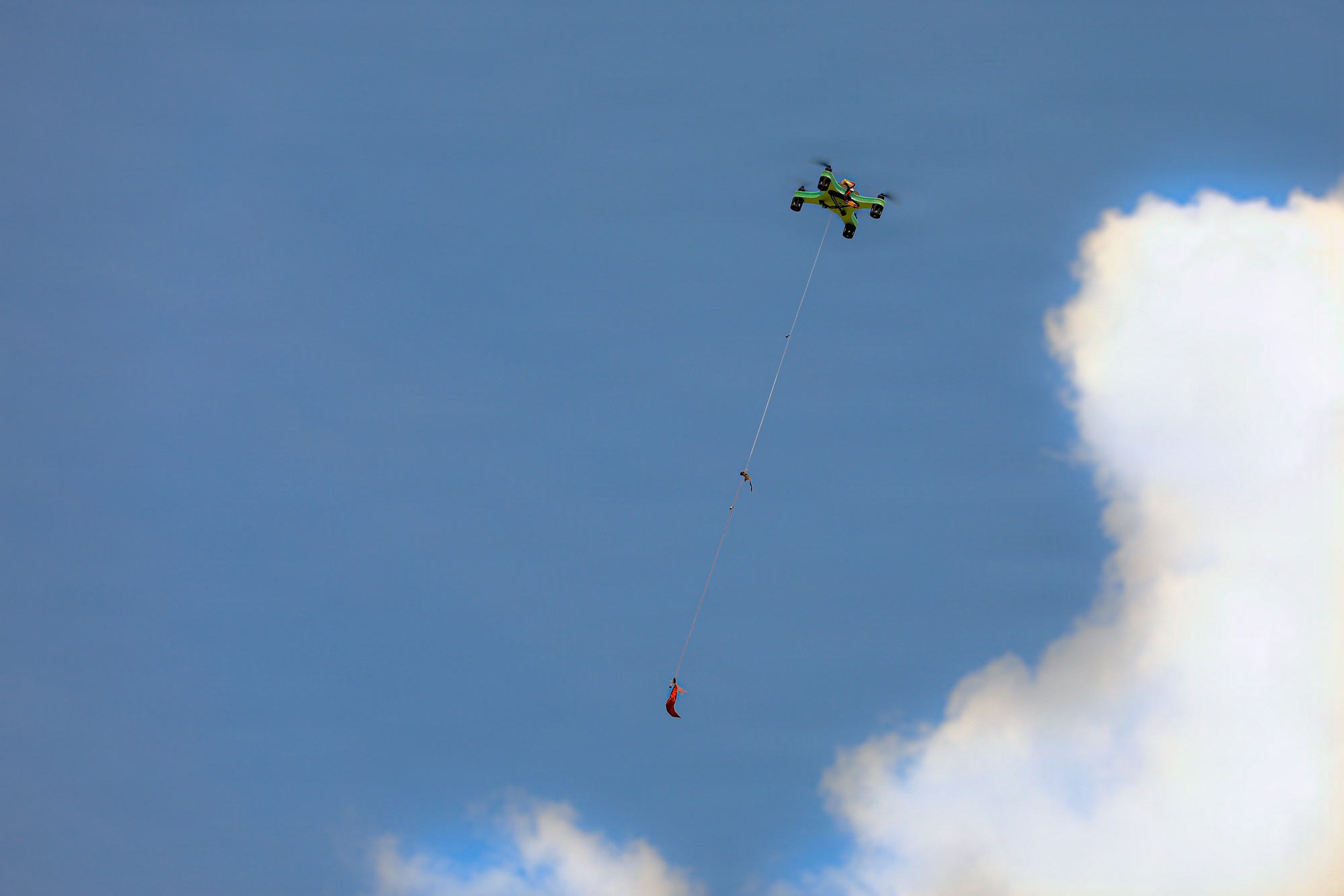
Hong Kong got its first public look at a pilotless passenger-grade aircraft this week, as Chinese manufacturer EHang flew its EH216-S electric vertical takeoff and landing (eVTOL) aircraft over Cyberport, the city's technology and innovation hub, from August 28 through August 30. The flights mark the first time the fully autonomous air taxi has operated in front of the public in Hong Kong, and they double as a live test of the regulatory machinery the city hopes to sell to the rest of the world.
During the public runs, the EH216-S carried out multiple sorties along pre-programmed routes with no pilot aboard — and in one flight, a robot rode along as a passenger stand-in, per reporting from the South China Morning Post.
A Government-Run Sandbox, Not a Free-for-All
The flights did not happen in open airspace on EHang's own initiative. They took place under Regulatory Sandbox X, a program run by Hong Kong's Transport and Logistics Bureau (TLB) specifically to let low-altitude economy operators fly real hardware in controlled conditions while regulators watch and build rules around what they observe. The TLB's own program page frames Sandbox X as the mechanism through which trials like EHang's Cyberport flights are authorized, and confirms the government's broader policy intent to develop a low-altitude economy framework rather than let individual operators seek one-off approvals.
That framing matters. Hong Kong Secretary for Transport and Logistics Mable Chan said the flights are meant to generate templates — regulatory language, safety procedures, and operational data — that could be adapted and exported elsewhere, according to the South China Morning Post. In other words, the point of the exercise is not just to prove the EH216-S can fly a route autonomously; it's to produce a paper trail of rules that other jurisdictions can borrow when they eventually license similar aircraft.
Deputy Financial Secretary Michael Wong attended the demonstration, a sign the government is treating the trial as economic policy as much as aviation policy. Hong Kong has been positioning itself as a low-altitude economy hub, a push that puts it alongside mainland Chinese cities that are also developing eVTOL certification and pilot programs of their own.
Who's Actually Buying the Aircraft
The commercial side of the story is arguably more concrete than the flight demonstration itself. Kwoon Chung Bus Holdings — a Hong Kong transport operator that partnered with EHang on the Cyberport trial — has committed to purchasing 30 EH216-S aircraft for roughly HK$70 million, or approximately US$9 million, according to the South China Morning Post. That works out to a per-unit price in the neighborhood of US$300,000, which lines up with EHang's positioning of the EH216-S as a mass-producible short-hop aircraft rather than a bespoke prototype.
What Comes Next — and What's Still Missing
Hong Kong's Transport and Logistics Bureau is aiming to complete drafting the legislation that would actually govern commercial eVTOL operations in the city by 2027, per the South China Morning Post's reporting. That timeline places the current Cyberport flights more than a year ahead of any formal legal framework — the sandbox flights are explicitly meant to inform that legislation, not operate under it.
None of the available reporting specifies passenger-carrying certification status, insurance frameworks, or air traffic integration details for the Hong Kong trial specifically. The flights described so far are demonstration and validation runs along pre-set routes, not revenue passenger service.
A separate roundup from KR Droneworks corroborates the basic shape of the story — public EHang demonstrations at Cyberport during the week of August 23-30, described as validating passenger-carrying autonomous flight paths in coastal urban airspace — while also noting that Hong Kong's sandbox effort is unfolding alongside parallel regulatory movement elsewhere: the U.S. FAA's Part 108 rulemaking for beyond-visual-line-of-sight drone operations is reportedly in final Office of Management and Budget review, and the European Union Aviation Safety Agency has been advancing regional U-Space deployments alongside an expanded rollout of its SORA 2.5 risk-assessment framework. The comparison underscores that Hong Kong is one of several jurisdictions racing to write rules for low-altitude autonomous aircraft simultaneously, rather than operating in isolation.
Why It Matters
EHang has been pursuing eVTOL certification and commercial partnerships beyond its home market of mainland China, and the Hong Kong sandbox trial is part of that broader push. What makes the Hong Kong flights notable is not the airframe — it's the regulatory container around it. Hong Kong's Transport and Logistics Bureau is explicit that the goal is exportable rules, not just a working aircraft, and a deputy financial secretary showing up to watch a drone flight signals that officials are treating pilotless air taxis as an economic development lever, not merely a novelty.
The Kwoon Chung order also matters more than most eVTOL purchase announcements, because it comes from an existing transport operator with real routes and real customers, rather than from a leasing shell or an airline exploring diversification. A transport operator committing roughly US$9 million to 30 aircraft is a bet that autonomous short-hop air travel has a place in Hong Kong's existing transit mix — inter-island hops, harbor crossings, or connections to outlying areas underserved by road and rail.
For the broader UAS and advanced air mobility industry, Hong Kong's approach is a data point in an ongoing debate over how autonomous passenger aircraft get certified at all: through incremental sandbox trials that generate regulatory templates as they go, versus the more traditional path of comprehensive certification before any public flight. With the FAA's Part 108 rule advancing in Washington and EASA refining U-Space in Europe at the same time, Hong Kong's sandbox — and whatever legislation it produces by 2027 — will be watched as one more model regulators elsewhere can copy, adapt, or reject.
Sources
- South China Morning Post — Unmanned electric aircraft makes maiden flight in Hong Kong
- GlobeNewswire — EHang EH216-S Completes First Public Flight in Hong Kong
- KR Droneworks — What Happened in the Drone Universe: Week Ending August 30, 2026
- Hong Kong Transport and Logistics Bureau — Low-altitude Economy Regulatory Sandbox X
