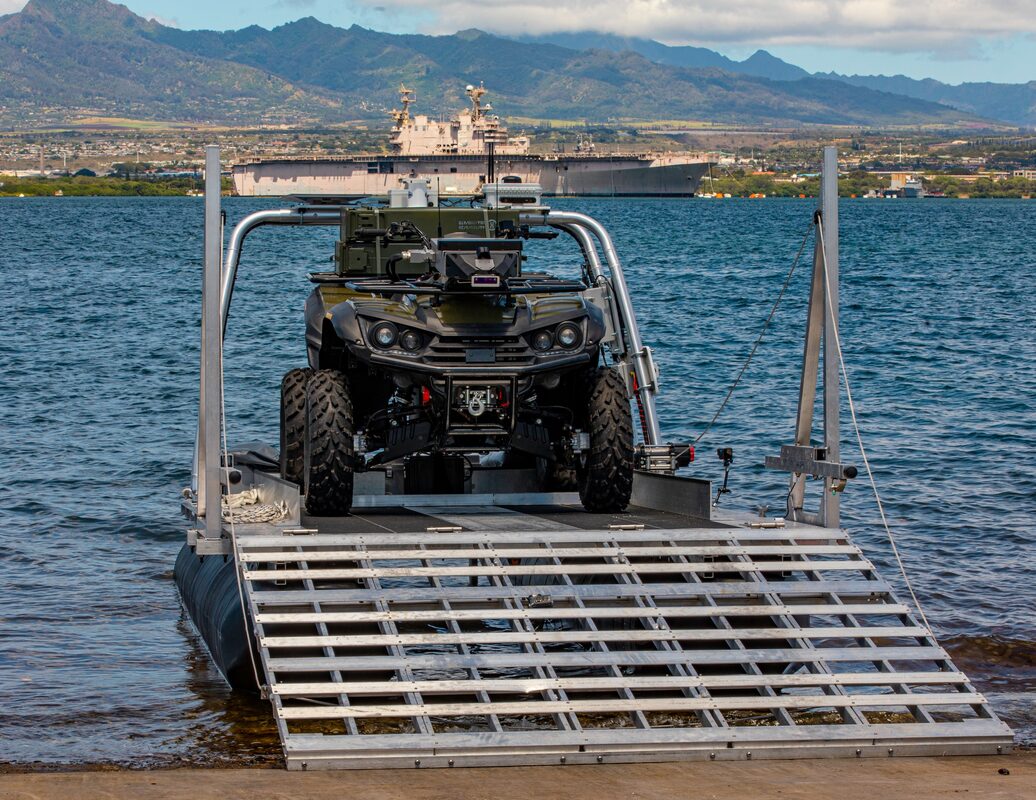
Ukraine's ground robots have become regular supply carriers on the front. On 29 September 2026 one of them carried supplies through water. The 'Alter Ego' unmanned ground vehicle (UGV) unit of the 93rd Separate Mechanized Brigade 'Kholodnyi Yar' finished a resupply run that Ukraine's Brave1 defense-technology cluster describes as the first logistics mission by an amphibious ground robot. The route covered about 40 km of land and water, according to a Brave1 post from 29 September. That is the kind of ground where rivers and wetlands have stopped conventional UGVs, Army Recognition notes.
Officials have said little about the vehicle. In an interview with The War Zone (TWZ), the commander of the Alter Ego unit, who uses the call sign 'Electric' and is fighting in the Kostiantynivka sector, described how the unit built the system and what the mission involved.
A problem handed down from the ministry
Electric said the project started when a department of Ukraine's Ministry of Defense asked his unit to solve one specific problem: getting UGVs across water obstacles. Ground robots now handle a large share of front-line resupply. Electric told TWZ that UGVs carry "hundreds of tons" of logistics, probably more than any other means on the front line. Before this mission, however, water obstacles stopped them from serving some parts of the front.
He said the whole process from development to battle deployment took less than three months. The unit surveyed amphibious solutions on the market in Ukraine and abroad, then took two approaches and says it is using both:
- Converting a ground UGV. Take one of the main land UGVs the unit already uses and make it amphibious. Electric said the unit kept what made it effective on land and added waterproofing and specific mechanics.
- Fixing a commercial amphibious platform. Take an amphibious solution already on the market and fix its shortcomings for front-line use. TWZ says the unit modified a variant of the Triton for this.
For the amphibious platform from the market, Electric said the unit changed almost everything, starting with the electronics, software, waterproofing and communications. The manufacturer's communications were "not sufficient at all" for the battlefield, he said, so the unit installed its own. He said the vehicle has two separate control systems, one for water and one for land, and switches to whichever is needed.
Army Recognition reports that the robot used may be a Triton. It also reports that the vehicle switched from wheeled mode to swimming mode within seconds and that the cargo stayed on board through the transition. Brave1 established a dedicated amphibious UGV development track in June 2026, according to the same report.
The mission
The vehicle carried food and other supplies, Electric said. He told TWZ that the UGV went 40 km one way and then returned, for probably around 70 km in total. Brave1's public post gives only the 40 km figure for the land-and-water mission.
It did not work the first time. Electric said the unit had one failed attempt, caused by a technical problem. On the successful run the robot came under Russian fire and survived, he said.
Operators drove it by hand. Asked about autonomy, Electric said the operator fully controls the UGV manually at the moment and that the unit used no AI on the mission. Operators who had only driven UGVs on land also had to learn to handle them in water, he said, and the unit had to develop tactics for the vehicle. Commentary on battlefield robots often assumes autonomy, so this matters. By his account, the hard parts were the hardware, the communications link and the operator training, not software intelligence.
What isn't known
Ukraine has not disclosed the vehicle's range, payload, speed or endurance, Army Recognition notes. The 40 km and roughly 70 km figures describe this one mission. They are not a stated maximum range. Electric would not say when or where the mission took place, or how many other amphibious missions have been flown or what they delivered. He confirmed only that there have been others. Electric's account, as TWZ reports it, of a modified Triton variant and Army Recognition's "possibly Triton" are as specific as public sources get on what the vehicle actually is.
Why It Matters
Water is one of the oldest problems in ground logistics, and it is now a problem for robots as well. TWZ notes that large areas of the front line are bisected by rivers and wetlands. Where a river, flooded field or wetland breaks a UGV route, the load has to move by other means, and Electric said UAVs and other means cannot fully meet that need. An amphibious robot that changes mode quickly and keeps its cargo on board, as Army Recognition describes, could remove that break in the route without putting anyone on the water.
Electric said the unit's task now is to scale the technology to other similar parts of the front with water obstacles. Asked whether the vehicle could later be used for strike missions, he said only that "we can use it in different ways in the future." He also said he thinks it can operate in mud the same way it operates in water.
Building it fast was the other result. By Electric's account, the unit went from a ministry request to a vehicle in combat in under three months, and it used a market amphibious platform alongside a converted ground robot. Army Recognition reports that Brave1 funded the development.
The wider UGV build-up
The mission comes as ground-robot production is rising sharply, both in Ukraine and among its foreign partners.
Ukrainian manufacturer Trinity Robotics plans to build some 2,200 UGVs in 2026, double the roughly 1,100 it had initially planned, C4ISRNET reported in July. Co-founder Oleksii Konik said the company works with the Ukrainian military procurement agency and more than 20 military units directly. Its Konyk One, suitable for logistics and medical evacuation, weighs 460 kg in its standard version and has a load capacity of up to 300 kg, according to the producer. A turreted variant is in development, and the company is in talks with an unnamed French producer about a joint venture. Konik called the "robotization of the battlefield" the company's most important mission.
From abroad, Estonia's Milrem Robotics expects deliveries of more than 150 THeMIS UGVs to Ukraine by the end of 2026, according to Janes. That total includes 100 vehicles being assembled by VDL Defentec in Born, the Netherlands, and the deliveries are partly funded and coordinated by the Netherlands. Milrem told journalists on 23 September 2026 that its Tallinn facility produces one THeMIS a day and can scale to 500 a year. The company said an arson attack on Milrem on 18 August did not affect production.
Those programs are about volume, putting more land robots on Ukraine's supply routes. The 93rd Brigade's mission is about where those robots can go. If amphibious UGVs can be built in numbers, robot logistics would no longer have to stop at the riverbank.
Sources
- Inside Ukraine's First Combat Deployment Of Robotic Amphibious Vehicles (The War Zone)
- Ukraine deploys amphibious UGV on first 40 km frontline supply mission across rivers and marshland (Army Recognition)
- Ukrainian ground robot maker doubles production, eyes ventures with foreign partners (C4ISRNET)
- Ukraine conflict: Milrem expects to deliver over 150 THeMIS UGVs for Ukrainian army by end of 2026 (Janes)