
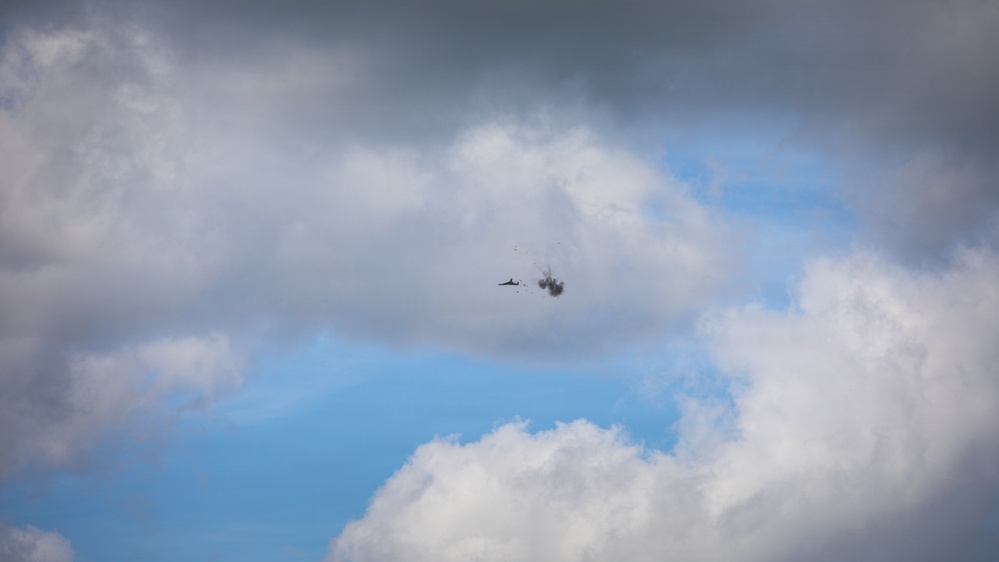
The Royal Netherlands Navy is moving to arm its warships with a new class of counter-drone weapon that looks less like a missile and more like a disposable aircraft. On August 25, 2026, C4ISRNET reported that the Dutch Ministry of Defence has signed a Concept Development & Evaluation (CD&E) contract with European aerospace firm Destinus to integrate the company's Hornet B2 interceptor aboard Royal Netherlands Navy vessels, with a target completion date of the second quarter of 2027.
Destinus confirmed the agreement in a statement on its website dated August 24, 2026 — the day before C4ISRNET's report — and Naval News separately reported matching details on the contract's scope and timeline. All three sources describe a program built around a single premise: naval air defense, as currently equipped, was not designed for a world in which the incoming threat is a cheap commercial-grade quadcopter rather than a cruise missile.
What the Hornet B2 Actually Is
The Hornet B2 is the newer, still-in-development sibling of the Hornet B1, which according to C4ISRNET is already in serial production. Both are counter-UAS interceptors built around an unusual launch-and-flight profile rather than a conventional rocket-propelled missile body.
The interceptor sits inside a sealed canister and is launched by a rocket booster. Once airborne, it deploys wings and transitions to electric propulsion for the cruise and terminal phases of flight. Guidance comes from electro-optical/infrared (EO/IR) sensors paired with AI-based terminal guidance, which the system uses to identify, track, and close on its target. The stated mission is countering one-way-attack (OWA) drones — the loitering munitions and kamikaze-style UAS that have become a defining threat in recent conflicts — with the Dutch Ministry of Defence citing the rising threat of drones at medium range as the rationale for the program.
The pitch is economic as much as technical. Destinus CEO Mikhail Kokorich framed the problem bluntly in comments cited by C4ISRNET and Naval News: "Low-cost aerial threats have inverted the economics of naval air defense: no navy can sustainably trade multimillion-euro missiles against low-cost threats arriving at volume." A rocket-boosted, electrically cruising interceptor with commodity sensors is Destinus's answer to that math — a weapon cheap enough to expend against swarms without draining a ship's magazine of missiles that cost orders of magnitude more than the targets they're built to kill.
Q&A: The Program in Brief
Who signed the contract, and when?
Destinus and the Netherlands Ministry of Defence, in a Concept Development & Evaluation agreement announced August 24, 2026 and reported by C4ISRNET and Naval News on August 25, 2026. Destinus's own announcement confirms the CD&E structure specifically covers Hornet B2 naval integration.
What's the timeline?
Both C4ISRNET and Naval News cite a target completion date of Q2 2027 for integrating the Hornet B2 aboard Royal Netherlands Navy warships. A CD&E contract is a development and evaluation phase rather than a production order, so Q2 2027 marks the point at which the concept is expected to be proven out on Dutch ships, not necessarily when it enters full fleet service.
Has anything like this flown before?
Yes. Destinus's own site reports that the Hornet's predecessor variant, Block 1, was launched from the Spanish Navy frigate F-81 Santa María, in an announcement dated June 18, 2026 — giving the underlying canister-launch, wing-deploy, electric-cruise concept an at-sea test record ahead of the Dutch program.
Why a navy specifically?
Warships present a distinct version of the drone-swarm problem seen on land battlefields: limited magazine depth, high-value assets, and — increasingly — exposure to cheap OWA drones launched from shore, from other vessels, or from unmanned surface platforms. A ship's existing air-defense missiles are engineered for high-end threats like anti-ship missiles and aircraft; using them against a swarm of inexpensive drones is a losing cost exchange even when it works technically.
Why It Matters
The Hornet B2 program is a concrete data point in a broader shift the drone war in Ukraine has forced onto conventional militaries: the realization that layered air defense needs a cheap tier, not just an expensive one. Navies have historically defended against aerial threats with interceptor missiles, close-in weapon systems, and electronic warfare — all effective against a handful of sophisticated threats, all poorly suited to absorbing a swarm of low-cost, expendable drones arriving in numbers.
A rocket-launched, canister-stored interceptor that cruises on electric power and uses AI-guided EO/IR terminal homing is notable less for any single technology in it — canister launch, wing deployment, and EO/IR seekers are all established — than for the combination aimed squarely at cost-per-kill. If the Hornet B2 performs as described, it gives a frigate or destroyer a magazine option that can be expended against a multi-drone raid without touching its higher-end interceptor missiles, the way a ship's close-in gun exists to avoid firing a missile at a single small boat.
The Netherlands is not acting in isolation. The June 2026 Hornet Block 1 launch from the Spanish frigate Santa María shows at least one other NATO navy already testing the same underlying system, and the pattern — a European navy contracting directly with a specialized counter-UAS startup rather than a legacy prime — mirrors how ground-based counter-drone procurement has moved over the past several years. Whether the Hornet B2 reaches Q2 2027 on schedule and whether it performs against real swarm tactics rather than controlled test firings remains to be demonstrated. But the contract itself signals that European navies now treat counter-swarm defense as a distinct procurement category, not an afterthought bolted onto existing missile systems.
Sources
- Dutch Navy to equip fleet with Destinus C-UAS interceptor drones — C4ISRNET
- Destinus and the Netherlands Ministry of Defence launch Hornet B2 naval counter-UAS development program — Destinus
- Destinus to Develop Hornet B2 Naval C-UAS for Royal Netherlands Navy — Naval News
- Hornet interceptor launched from Spanish Navy frigate — Destinus