
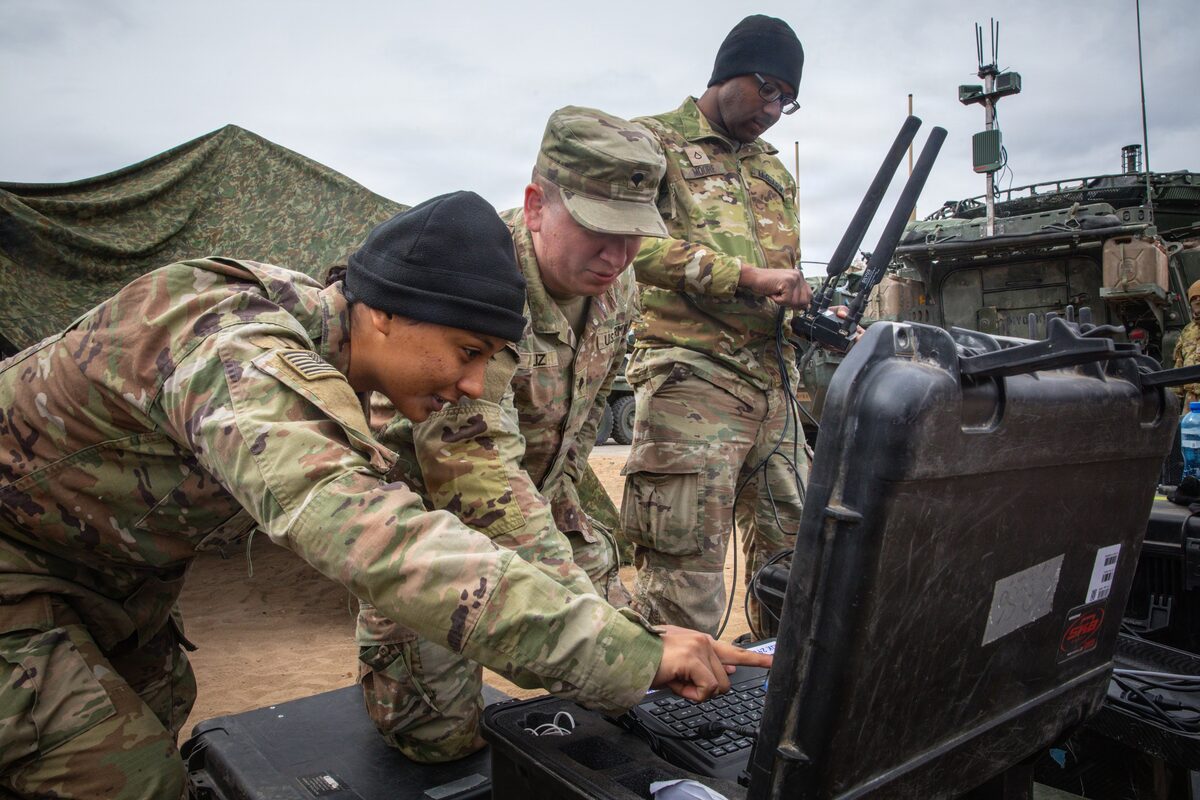
On September 15, DroneShield announced that it has finished installing and getting acceptance of its DroneSentry-X Mk2 vehicle-mounted counter-drone system on U.S. Army Infantry Squad Vehicles (ISVs), establishing initial operational capability (IOC) roughly 80 days after contract award. The work was done under a contract with Joint Interagency Task Force 401 (JIATF-401), and a recent contract modification covers three additional DroneSentry-X Mk2 units.
The headline number is the schedule. The company's release says the roughly 80-day span covered delivery, installation on the vehicles, acceptance testing with live uncrewed aircraft, and operator training. What is missing is most of the detail: neither the contract value nor the number of units in the first batch has been disclosed.
What Was Delivered
DroneSentry-X Mk2 is described as a vehicle-mounted system that combines detection with electronic countermeasures. Army Recognition's report on the announcement adds that the system was installed on ISVs, which it describes as built on a Chevrolet Colorado ZR2 architecture, and lists the following characteristics:
- Hemispheric detection with directional bearing
- Software-defined operation, either automated or operator-controlled
- Use while mobile or stationary
- An optional DC-to-DC converter for vehicle power
Unmanned Airspace, which reported the news on September 16, wrote that the integration with the ISV "allows the C-UAS capability to be used while forces are mobile or stationary, rather than being limited to fixed sites." DroneShield personnel performed the installations and supported acceptance testing using live uncrewed aircraft, according to that report and the company release.
What is not public is just as notable. Army Recognition notes that the sensor and effector configuration on the fielded vehicles, weight, power draw, detection and effector ranges, and frequency coverage were not disclosed. Without those figures, the claim of "hemispheric detection" cannot be compared against other vehicle-mounted systems, and the effectiveness of the electronic countermeasures against any specific class of drone is unstated. The acceptance testing is described only as using live uncrewed aircraft; the release does not say which aircraft, at what ranges, or what pass criteria applied.
The Marketplace Angle
DroneShield states that its technology is available to authorized U.S. government customers through the JIATF-401 C-UAS Marketplace, which the company describes as an established procurement pathway. The release does not say that the ISV order itself was placed through the marketplace; it describes the work as falling under DroneShield's previously announced JIATF-401 contract. The two are presented side by side: a task-force contract fielded on a standard vehicle on a compressed schedule, and a separate purchasing route open to authorized customers.
Nate Webb, DroneShield's Director of Strategic Projects, framed it in schedule terms: "Counter-UAS capability has to be deployable at the speed the threat is evolving." That is a company statement, and the release is company-supplied, so the 80-day figure is DroneShield's account of the timeline rather than an independently audited one. The Army Recognition and Unmanned Airspace reports both repeat the 80-day figure, but the material available to us does not indicate either outlet verified it independently.
Army Brig. Gen. Matt Ross, the JIATF-401 Director, is quoted in the release saying the threat continues to change and that "our work at the Southern Border is not finished." The release also quotes him saying "there is no silver bullet to defeat every drone threat and that counter-UAS capabilities go beyond technology." Army Recognition attributes a further line to Ross: "Counter-UAS cannot depend on a single technological solution."
A Companion Document
Those Ross quotes echo a message from a separate JIATF-401 publication. On September 8, the task force released its 2026 Counter-Small Unmanned Aircraft Systems Quick Reference Guide. In the Department of War announcement, Ross said: "There is no silver bullet or single solution to address this challenge."
According to the announcement, the guide provides a common technical baseline for sensors, command and control, and the interception of Group 1 to 3 drones in both deployed and homeland settings, and it includes a lessons-learned section. Air Force Col. Jonathan Beha, chief of the task force's data, analysis, requirements and training division, said the guide gives operators a concise reference and gives policymakers new to the mission a starting place.
Read together, the two releases outline the task force's stated approach: publish a shared technical vocabulary, avoid reliance on any single technology, and put effective solutions into the hands of warfighters quickly. Whether the DroneSentry-X Mk2 installation reflects the guide's baseline in any specific way is not stated in either document.
Open Questions
- How many vehicles? The first-batch unit count is undisclosed. Only the three additional units under the modification are stated.
- What did it cost? The contract value is not stated in the company release.
- What can it do? Ranges, frequency coverage, weight and power draw were not published.
- Which units receive the vehicles? None of the source material names a receiving unit.
- What does IOC mean here? The sources establish IOC and describe the work leading to it, but do not define the criteria used.
Why It Matters
According to DroneShield, the point of mounting the system on an ISV is that forces can carry detection and electronic countermeasure capability with them as they move, extending protection beyond established bases and fixed infrastructure, in the release's words. A detection and jamming package that moves with an infantry squad's vehicle is a different proposition from one guarding a base perimeter.
The schedule is the second point. If the 80-day contract-to-capability figure holds up under scrutiny, it would be a quick turnaround from award to trained operators. But the evidence is thin: a vendor release, two outlets relaying the same timeline, and no published performance data. The more meaningful test will be the three additional units and whatever the Army and JIATF-401 say publicly about how the fielded systems perform. Until then, the announcement establishes that the systems were installed, accepted and that operators were trained, and not much beyond that.
Sources
- DroneShield Completes Installation and Acceptance of DroneSentry-X Mk2 Under U.S. JIATF-401 Program (DroneShield, Sept. 15, 2026)
- U.S. Infantry Squad Vehicles Receive Mobile Drone Defense with DroneSentry-X Mk2 Under Rapid Fielding Program (Army Recognition)
- DroneShield completes C-UAS installation on US Army Infantry Squad Vehicles (Unmanned Airspace, Sept. 16, 2026)
- Joint Interagency Task Force 401 Publishes Counter-UAS Reference Guide (U.S. Department of War, Sept. 8, 2026)