
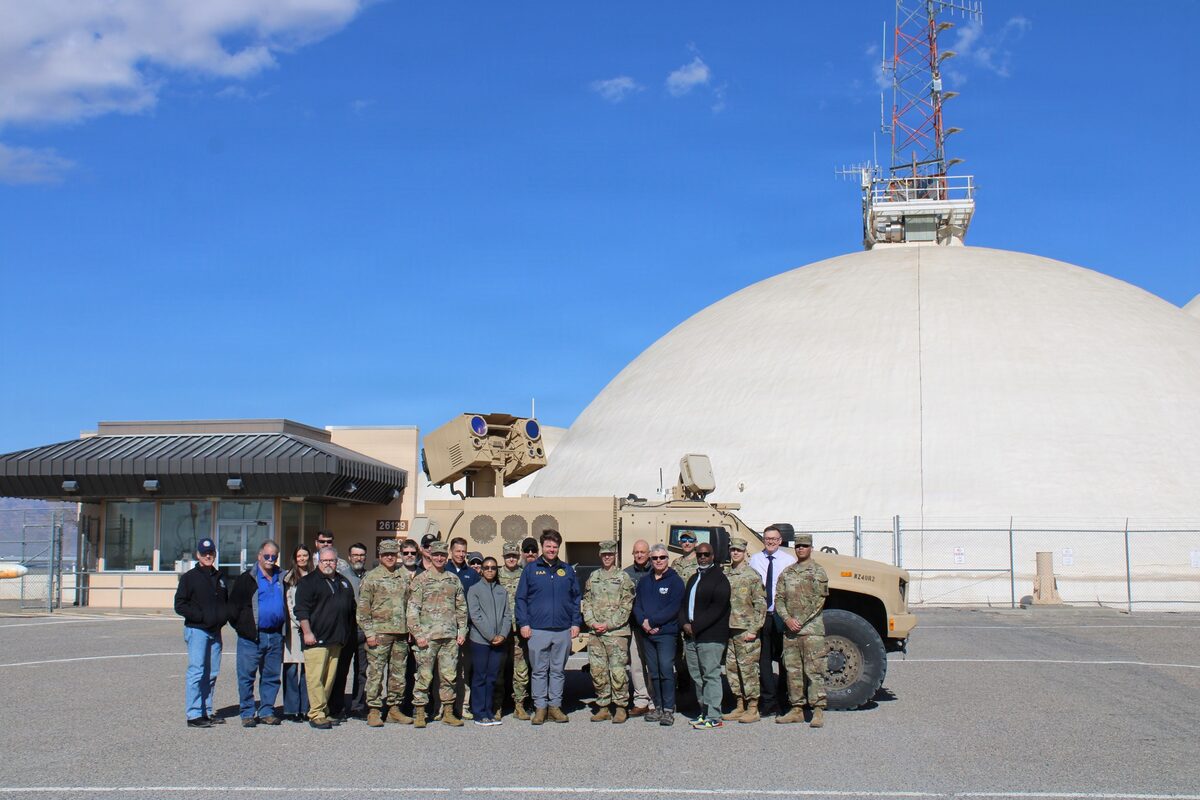
DroneShield, the Australian-listed counter-drone company (ASX:DRO), is adding a laser to its kit list without building one. Under a collaboration announced on 14 September 2026, the company will make its DroneSentry platform interoperable with the Fractl high-power laser made by Melbourne-based AIM Defence. On 18 September, a DroneShield spokesperson gave Janes more detail on what the two companies are actually trying to do.
The short version: DroneShield's RF-sensing, electronic-warfare and command-and-control stack gets a path to a hard-kill effector. The longer version is more modest. What has been announced is an agreement to build a technology roadmap. It is not a supply contract, and neither company has published a dollar value, a delivery schedule or a named customer.
What was actually signed
According to DroneShield's press release, datelined Sydney on 14 September, an MOU was signed at AIM Defence's headquarters by DroneShield chief technology officer Angus Harris and Jenelle Frewen, AIM's Director of Strategic Initiatives, according to the release's photo caption. The company frames the deal as an expansion of its open counter-drone architecture to include Fractl as an effector. DroneSentry, it says, will be interoperable with the laser.
The release also says initial engagement will focus on selected military and government end-users. That wording matters. It suggests a targeted approach to a small set of customers rather than a commercial product launch, and the release states no timeline for when any integrated capability might be offered.
The Janes detail: a roadmap, and a link between two C2 layers
Janes, in a report by Nishanth P dated 18 September, adds the clearest description of the intent. A DroneShield spokesperson told the outlet that the agreement is meant to establish a technology roadmap to support the delivery of integrated counter-UAS capabilities. The planned technical connection is between DroneShield's command-and-control (C2) capability and Fractl, for information sharing and coordinated operations across detection, tracking and defeat.
In practice, that would let an operator coordinate RF sensing, AI-enabled software, sensor fusion, C2 and directed-energy engagement from a common operating environment, according to DroneShield. Janes reports that DroneSentry uses SensorFusionAI, described as a sensor-agnostic 3D data-fusion system that combines data from multiple sensor types, with the stated aim of improving situational awareness and accuracy and reducing false positives. The spokesperson said that by combining RF detections with radar and electro-optical/infrared (EO/IR) tracking data, SensorFusionAI and Fractl could contribute to a common operating picture giving operators "greater confidence" in target identification and tracking.
That last point is the technical crux, and the next step is our inference rather than something either source states. A laser is a line-of-sight, precision effector, so it would be reasonable to expect the quality of the cueing data from the sensing layer to matter a great deal, and the fusion layer is the part of DroneShield's stack that would be expected to do that work. Neither source gives engagement logic, handover latency or any performance figures for the integrated system, so how well that handoff works is not something the public record can currently answer.
Q&A: What do we know, and what do we not?
Is there a contract? Not according to anything published. The press release describes a collaboration, with an MOU signing shown in its photo caption, and states no dollar value or delivery schedule.
Has the integration been demonstrated? Neither source reports a demonstration. Janes describes the connection as planned, and the DroneShield spokesperson framed the agreement as the basis for a roadmap. AIM's Frewen, in the release, describes the collaboration as a framework for more customer demonstrations, interoperability work and future deployment opportunities.
Who is the intended customer? Selected military and government end-users, per the press release. No specific customers are named.
Is the laser proven? The evidence is mixed in kind. DroneShield's release calls Fractl one of the few counter-drone lasers in the world to have been operationally deployed, and says it is currently being exported to multiple countries. That is a company claim, and the release does not name the countries. For context, AIM Defence's own news page, in an item dated 8 October 2024 that points readers to InnovationAus.com, reported that AIM had delivered two more counter-drone laser systems to Defence. It said that took AIM's work with the department above $10 million over the past year, and that a new $4.8 million deal had been signed at the end of August 2024, less than four months after AIM supplied Defence with its first directed-energy weapon. That page is an excerpt and not a recent story, but it does establish that Fractl has a delivery history with the Australian Defence customer, at least as AIM tells it.
The same page describes the Fractl Portable High Energy Laser as "powerful enough to burn through steel" and able to track objects as small as a 10-cent piece travelling 100 km/h a kilometre away, in each case according to Defence. Those are descriptions attributed to the customer in a 2024 item, not test data, and they should be read as such.
Government money behind the laser
The Janes report carries one further figure. Its photo caption states that AIM Defence will receive AUD21.3 million to advance its Fractl portable high-energy laser system under Australia's 2026 Integrated Investment Program. Janes does not say in the material available to us how that funding will be phased. The point for DroneShield is that its laser partner is slated to receive government funding to advance the effector it plans to connect to.
Why It Matters
DroneShield describes its own solutions as highly effective for many RF-controlled drone threats, and says AIM's directed-energy offering provides an additional engagement option for scenarios where different defeat mechanisms are operationally advantageous. The release also points to unmanned threats increasing in scale, autonomy and complexity. Read together, a directed-energy effector aligns with a way to talk about defeat that does not rest on RF alone. Adding that capability through a partnership, rather than developing a laser in-house, appears to be the faster and lower-risk route, though neither source says why DroneShield chose it, and it fits the "open architecture" framing DroneShield uses in its own release.
It could also shift where the value sits. If a customer already owns a Fractl, or is evaluating one, the differentiator may become the C2 and sensor-fusion layer that cues it. DroneShield appears to be positioning DroneSentry as that layer. Whether customers accept a vendor's C2 as the front end for a laser built by another company is the commercial question this collaboration does not settle.
The caution is equally plain. An MOU is an intention to work together. The press release states no value and no schedule, limits initial engagement to selected military and government users, and Janes describes the technical link as planned. Until there is a demonstration, a customer or a contract, this is a roadmap announcement. The clearest signals to watch are a named end-user, a live-fire or field integration event, and any statement on whether the link runs through DroneShield's C2 in a fielded configuration.
Sources
- Australia's DroneShield enhances C-UAS suite with laser technology (Janes, 18 Sept 2026)
- DroneShield and AIM Defence Collaborate on Directed Energy in Counter-Drone Architecture (DroneShield press release, 14 Sept 2026)
- AIM sells two more anti-drone lasers to Defence (AIM Defence news page, 8 Oct 2024)
