
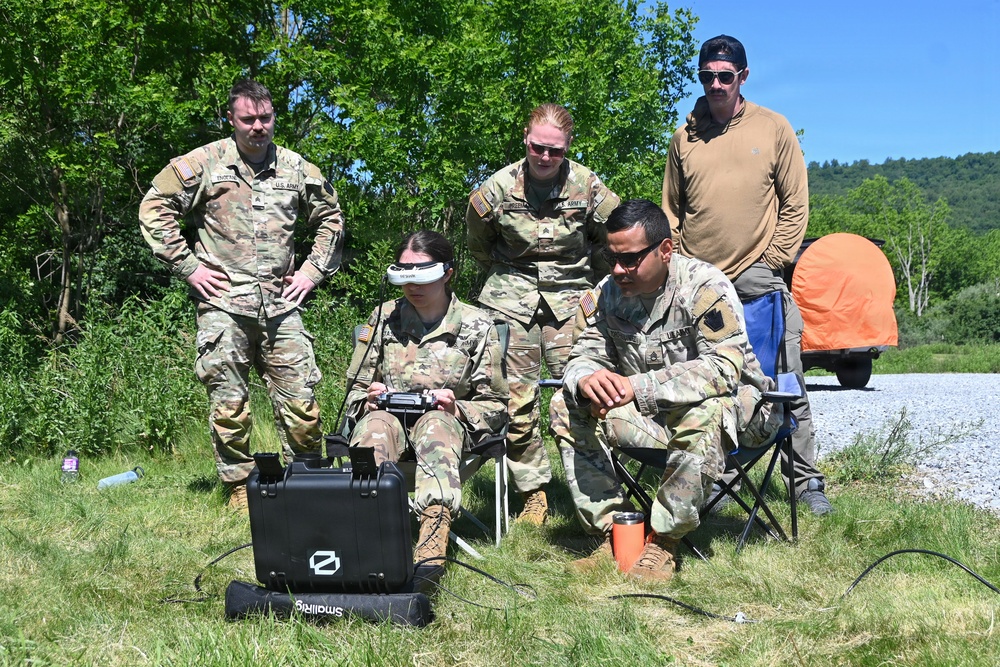
The Pentagon's Drone Dominance Program has published the results of its second "Gauntlet," and the leaderboards show which vendors came out on top in the department's low-cost strike drone competition. Perennial Autonomy took first place in the long-range "deep strike" mission. Neros took first in "close quarters battle." About 60,000 drones are slated to be bought from the winning vendors, roughly double what the first Gauntlet produced.
Defense Daily's report is dated Wednesday, Sept. 16, 2026, and says the program announced the winners on Tuesday. DefenseScoop published its fuller breakdown of the rankings on Sept. 18. Both outlets describe the same event, though they label the two mission categories differently: Defense Daily calls them "Long Range Strike" and "Tactical Assault in Confined Environments," while DefenseScoop uses "Deep Strike" and "Close Quarters Battle."
The Program in Brief
The Drone Dominance Program (DDP) is a $1.1 billion, two-year effort operating under Executive Order 14307. According to a background analysis from the Challenging Defence Markets newsletter, it is organized as four "Gauntlet" events, with a target unit price that falls from about $5,000 to about $3,000 over the life of the program. DefenseScoop reports that the stated goal is to field more than 200,000 unmanned aircraft systems by 2027.
DefenseScoop describes the drones as "cheaper, more capable, and sourced from a supply chain more closely tied to the American industrial base." That phrase is a fair summary of the program's thesis. The Gauntlets are competitive events rather than traditional multi-year contracts: vendors fly their aircraft against defined missions, the Pentagon ranks them, and the top performers receive orders.
The Leaderboards
DefenseScoop lists the top five in each of the two scored missions.
Deep Strike
- Perennial Autonomy
- Hyperscale
- Neros
- Skycutter
- Swarm Defense Technologies
Close Quarters Battle
- Neros
- ORQA US
- XTEND Reality
- Vector
- ModalAI
Neros is the only company to appear on both leaderboards. It placed third in deep strike and first in close quarters battle. A Defense Daily image accompanying its report shows the Neros Archer FPV drone.
A number of other vendors flew in the deep-strike event without landing on the leaderboard: Ascent Aerosystems, Auterion Government Solutions, Griffon Aerospace, ORQA US, Stellarion and UDD Tech. ORQA US appears in both places, on the close quarters battle leaderboard and on the deep-strike list of non-leaderboard participants.
How Many Drones, and Who Gets Them
The headline figure is about 60,000 drones to be procured from the winning vendors. The split between vendors is less clear from the available reporting.
Defense Daily's excerpt cites 8,000 drones for first place and 7,000 for second, and puts the total competition value at $300 million. DefenseScoop attributes the 60,000 total to the program but, in the material reviewed here, does not break it down by vendor, and the per-place figures Defense Daily reports are not reconciled with that total. Per-vendor order quantities should therefore be read as reported figures, not settled ones, and the 60,000 total is the better planning figure at this stage.
For scale, the first Gauntlet bought about 30,000 drones. Challenging Defence Markets puts that event at roughly $150 million, with 26 companies competing at Fort Benning from February to March 2026 and 11 winners selected.
What the Testing Showed
DefenseScoop reports that 1,858 sorties were flown across 23 platforms from 19 companies. The most concrete performance data point concerns range. All 11 platforms in the long-distance event reached 15 kilometers. In Gauntlet I, only 24 percent of platforms reached 10 kilometers. That is a meaningful shift in a single cycle, though the reporting does not say whether the same designs, or the same standards, were involved in both events.
Getting to Fort Carson
The path to the leaderboard was a narrowing funnel. According to the Challenging Defence Markets analysis, a qualifier at Camp Grayling, Michigan, ran June 8-19. There, 49 companies were invited and roughly 79 drone designs were tested; 19 companies advanced. The main event was held at Fort Carson, Colorado.
The Army's own account of the Fort Carson phase puts the evaluation window at Aug. 16 to Sept. 5, 2026. It involved about 40 Group 1 unmanned aircraft systems from 19 drone vendors, plus five payload vendors.
The Safety Angle
One part of the event was live-payload testing. The Army article, posted Sept. 11, describes how engineers from the Army Aviation and Missile Command (AMCOM) Safety Office supported the evaluation. A live-payload test area, called the "Kinetic Lane," reviewed payload preparation, installation, aircraft handling and the controls meant to prevent unintended detonation or missed targets.
The safety team also assessed RF links, mission displays, navigation, obstacle avoidance, operator workload and video-feed reliability. Those factors bear directly on whether a drone can be trusted with a live payload.
"While the operations teams were focused on performance, the safety team was focused on mitigations we could see during the tests," said Kira Thomas, AMCOM Safety's software system safety lead.
Dr. Laurence Mutuel, acting director of AMCOM's Safety Office, framed the payload as half the problem: "To be successful in the mission, you need both the drone to be successful in delivering the payload and the payload to be performing its role."
A Vendor Perspective, With Caveats
XTEND AI Robotics is one of two publicly listed companies the background reporting identifies as direct competitors, alongside Red Cat's Teal Drones. It issued a release on Sept. 16 calling itself a Gauntlet II top performer in close quarters battle. The company (NYSE: XTND, headquartered in Tampa and founded in Tel Aviv, CEO Aviv Shapira) said 10 companies were selected for Gauntlet II. DefenseScoop's leaderboard lists XTEND Reality third in that mission.
XTEND says its STRIKER system, running on the XTEND Operating System (XOS), is built for confined, GNSS-denied missions. It says it delivered and demonstrated 120 STRIKER systems in operationally realistic scenarios evaluated by warfighters; the Challenging Defence Markets analysis describes the Gauntlet II production challenge as delivering 120 payload-fitted drones within five weeks. The company also claims more than 12,500 systems deployed in more than 30 countries. Those are company statements, and the other sources reviewed here do not independently confirm them.
What Comes Next
The schedule is compressed. Per DefenseScoop:
- Gauntlet 2.5, focused on bomber drones, launches next month.
- Gauntlet 3 follows about six months after Gauntlet 2.
- Gauntlet 4, the final event, comes about six months after that.
Why It Matters
The Drone Dominance Program is an attempt to buy small strike drones in volume, at falling target prices, through repeated competitive events rather than traditional multi-year contracts. Two Gauntlets in, the reported numbers point in the program's favor. Range performance moved from a minority of platforms reaching 10 km to every long-distance platform reaching 15 km, and the order size doubled from about 30,000 to about 60,000.
The leaderboards also suggest a market that is still fluid. Only Neros appears on both mission leaderboards, and Perennial Autonomy tops the deep-strike ranking. Because a Gauntlet is held for each phase and further events are scheduled, it appears no vendor has a lock on the program, though that is an inference rather than something the sources state.
Two open questions remain. First, the per-vendor quantities are unclear: the figures Defense Daily reports are not reconciled with the 60,000 total in the sources reviewed, and that will matter to the companies involved. Second, the program's goal of more than 200,000 systems by 2027 would presumably require the unit price to fall toward the $3,000 target while the American-industrial-base sourcing emphasis holds. Gauntlet 2.5 and the two events that follow will show whether both can be met at once.
Sources
- Pentagon unveils top performers in latest 'Gauntlet' for Drone Dominance Program | DefenseScoop (Sept. 18, 2026)
- Perennial Autonomy, Neros Take Top Spots In Drone Dominance Gauntlet II Competitions | Defense Daily
- AMCOM Safety supports Gauntlet 2 drone evaluation at Fort Carson | U.S. Army (Sept. 11, 2026)
- XTEND Selected as Gauntlet II Top Performer in $1 Billion U.S. Drone Dominance Program (company release, Sept. 16, 2026)
- Drone Dominance Gauntlet II | Challenging Defence Markets (background)
