
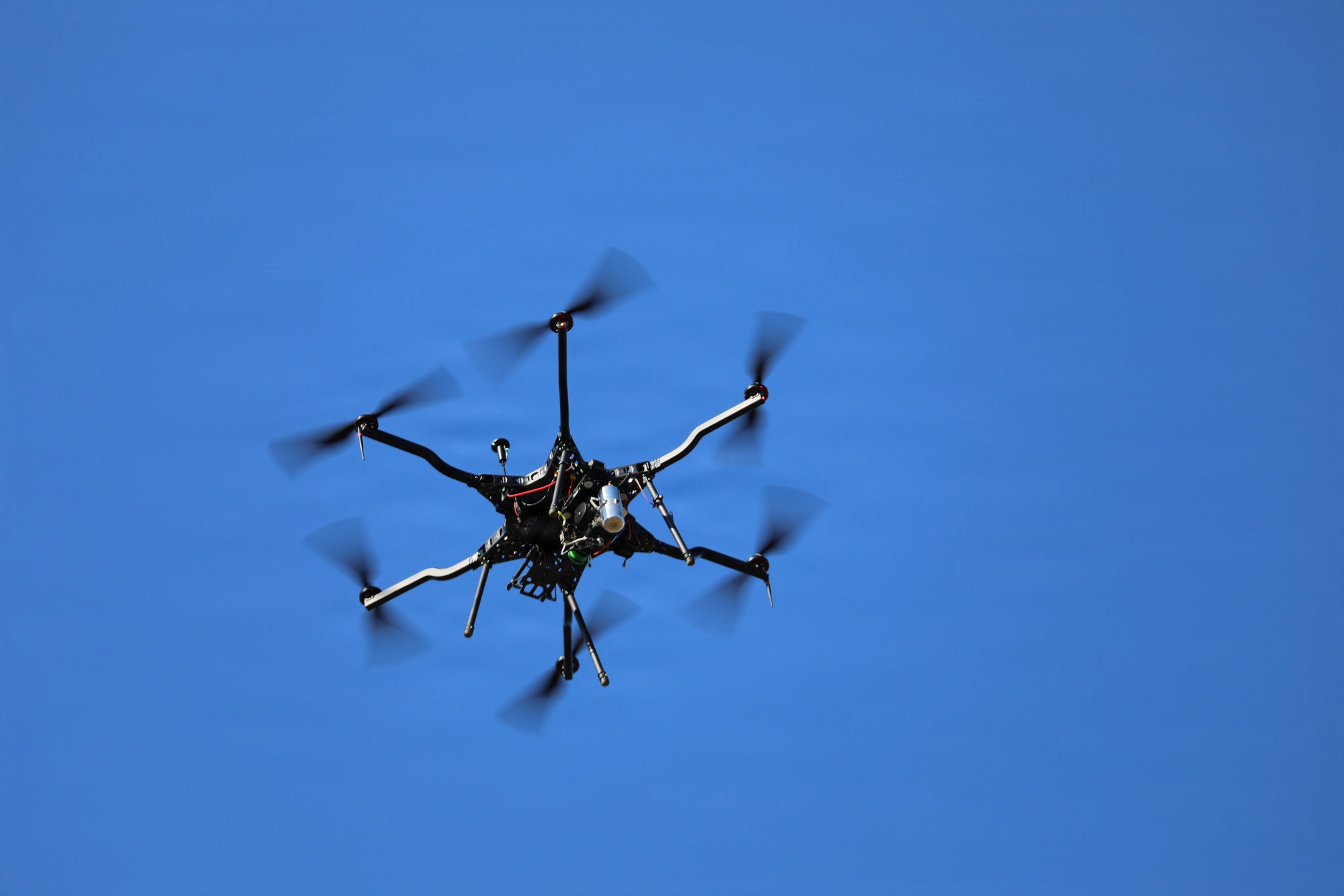
DoorDash has stopped being only a customer of other companies' drones. At its Dash Forward 2026 event on Sept. 30, the delivery marketplace unveiled a purpose-built six-propeller aircraft with an onboard winch, along with what it describes as an end-to-end system called DoorDash Air. Pilots are slated to begin in suburban Northern California with restaurant partners Chipotle and Popeyes, with Momo N Curry also named as a partner, according to DoorDash's announcement.
The move shifts the company's role. DroneDJ reports that DoorDash has so far brought drone deliveries to customers through partners including Wing and Flytrex, meaning it dispatched orders onto someone else's aircraft. With its own aircraft, ground infrastructure, software and FAA Part 135 certification, it is positioning itself as the aircraft operator rather than the middleman.
What DoorDash Showed
The aircraft carries six slow-spinning propellers at the ends of its arms. DoorDash says that layout limits cruising noise to roughly that of a passing car at delivery height. That is a company claim; the announcement does not publish decibel measurements or test conditions, so it cannot yet be compared with other delivery aircraft.
Pickup and dropoff are handled by a winch. Rather than landing at a restaurant or a customer's home, the aircraft can lower the package on a line. DroneDJ notes the winch lets the drone remain airborne at drop-off. DoorDash also says the aircraft has added failsafe systems designed to safely lower it to the ground in rare events.
The software layer is the Autonomous Delivery Platform, or ADP, which DoorDash says uses smart routing that weighs weather, flight range and ground traffic to narrow down which orders make sense to send by air. TechCrunch reports that both DoorDash Air and the ADP came out of DoorDash Labs, the R&D team that also built the company's sidewalk delivery bot, Dot. DoorDash says the same ADP already coordinates Dashers, Dot and other autonomous delivery partners, so the drone is presented as another mode within a larger network rather than a standalone operation.
The Numbers, and What They Do Not Say
Two figures headline the announcement, and both need careful reading.
- About 80% of orders. DoorDash says roughly 80% of today's typical restaurant orders are light and small enough for the aircraft to carry safely; the claim carries a footnote in the company's release saying it is based on estimates using U.S. restaurant deliveries of limited distance, size and measurement period. DroneDJ is explicit that this does not mean 80% of orders will automatically qualify for drone delivery: weather, flight range, distance, traffic and the contents of an individual order all affect the decision. It is a statement about size and weight, not a forecast of drone volume.
- Under five minutes. Based on estimates from initial tests, delivery times from restaurant to door averaged under five minutes, per DoorDash, whose footnote says the sample was of limited distance and size and that delivery times are not guaranteed. DroneDJ frames this as an early testing figure, not a promise for every future drone order.
One thing is conspicuously absent from the sources: a payload figure. DoorDash describes what fraction of orders fit, but the material reviewed here gives no maximum payload weight, range or speed for the aircraft. Those specifications are the ones that determine what the aircraft can actually do.
The Regulatory Gate
DroneDJ describes DoorDash's drone operation as FAA-certified under Part 135, and TechCrunch reports the company announced in July that it would launch the business after receiving a Part 135 air carrier certification from the FAA. The FAA's package delivery page says operator certification runs under Part 135 and that package delivery flight paths must stay under 400 feet.
The certificate is not the only requirement. The same FAA page lists airspace authorization among the things drone package delivery operators must obtain, and says operators that want to fly beyond visual line of sight (BVLOS) need an exemption or waiver on top of the Part 135 process. It also describes unmanned traffic management (UTM) as the system most deliveries are expected to eventually operate within once it is fully developed. The agency says it has completed more than 20 environmental assessments for individual package delivery proposals, each ending in a finding of no significant impact, plus one programmatic environmental assessment, and that it is developing a draft programmatic assessment evaluating package delivery operations nationally. The sources reviewed here do not say which specific authorizations DoorDash holds for its Northern California pilots.
A Local Fight in San Francisco
The hardware has a local angle. SFist reports the drones are being built at a roughly 40,000-square-foot research and development facility in the Mission District. Harrison Shih, Head of DoorDash Air, said the company is making enough to get started but expects to scale through 2027, and pointed to a strong commitment to onshoring.
Outdoor testing at that site is not yet cleared. SFist says DoorDash will still need San Francisco Planning Commission approval under legislation from Supervisor Jackie Fielder. Teamsters Local 665 challenged the company's earlier testing plans, and the Board of Appeals rejected the union's appeal, per SFist. The pilots in suburban Northern California, which DoorDash says have fewer obstacles for its six-rotor drones, are therefore separate from whether the aircraft can fly outdoors near where it is built.
Why It Matters
Drone delivery has largely been a story of partnerships: restaurants provide the food, DoorDash the marketplace and customer relationship, and specialized drone companies the aircraft and aviation operation. By building the aircraft and the software and pursuing its own Part 135 operation, DoorDash is taking on more of that stack itself. DroneDJ argues this could give the company more control over how drones integrate with restaurants and customers. Being the air carrier also means carrying the operational and safety responsibility that comes with it. TechCrunch's note that DoorDash has previously disclosed more than 500,000 restaurants on its marketplace shows the scale of demand it is trying to serve, though the 80% figure is a statement about order size and not a forecast of drone volume.
The open questions are the practical ones. No payload figure has been published. The noise claim is a comparison to a passing car, not a measurement. The under-five-minute average comes from early tests on a limited sample. And a San Francisco planning decision for outdoor testing at the Mission site remains outstanding. Until those are resolved, DoorDash Air is a certified operator with a new aircraft, not yet a proven delivery network.
Sources
- DoorDash Air Unveils Drone Delivery System for Local Businesses (DoorDash News, Sept. 30, 2026)
- DoorDash goes all-in on its own drone delivery ecosystem (DroneDJ, Sept. 30, 2026)
- DoorDash's drone strategy started on the ground (TechCrunch, Sept. 30, 2026)
- DoorDash Plans Northern California Deliveries Using Drones Built In the Mission (SFist, Sept. 30, 2026)
- Package Delivery by Drone (Part 135) (FAA)
