
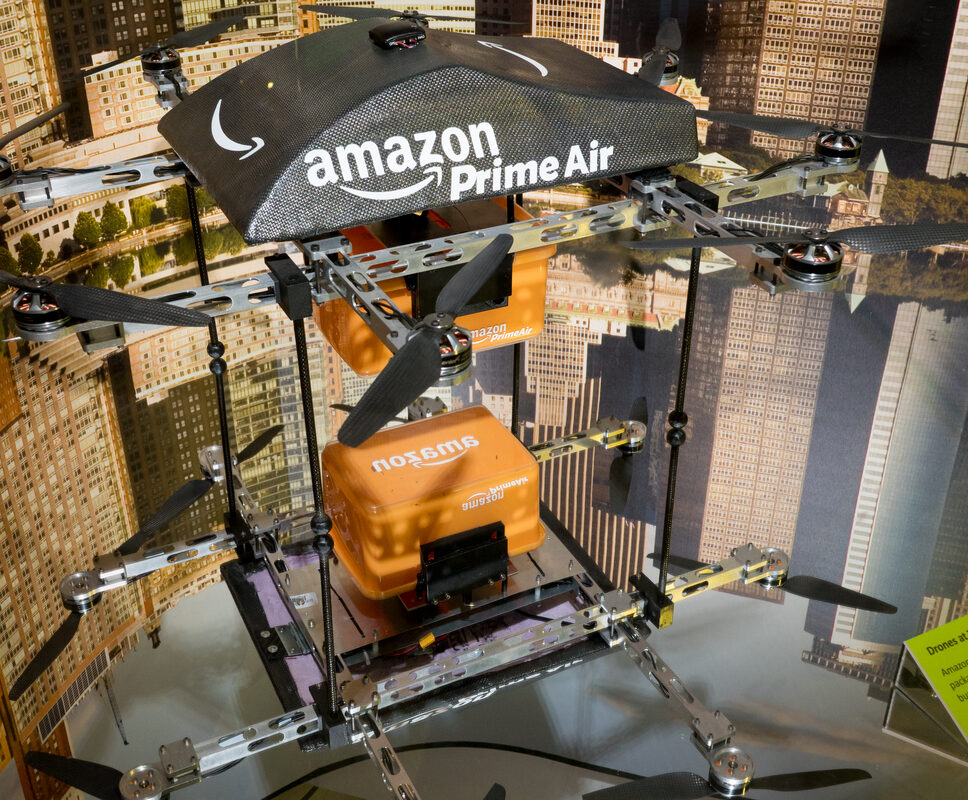
Six weeks after roughly 100 residents filled a hall at Broadmoor United Methodist Church to complain about drone noise, Amazon has changed how its Prime Air drones fly over Baton Rouge. DroneXL reported on November 15 that, according to the Wall Street Journal, Amazon adjusted the heights its MK30 drones fly at and spread its traffic over a wider area. The Journal story is by Kris Maher, and UASFeed has seen it only through DroneXL's account. Amazon also told the paper that about 30 drones an hour now leave its Cortana Place hub.
For a company running a drone service in residential neighborhoods, that counts as a fast response to local opposition. The details are thin, though. According to DroneXL, the Journal report doesn't give the new altitude or a date for the change, and it doesn't say whether the Federal Aviation Administration approved it. DroneXL says the FAA's public index still lists the Baton Rouge environmental review as a draft.
How Baton Rouge got here
Prime Air came to Baton Rouge on July 7, 2026. WBRZ reported then that it was the first Louisiana city with Amazon drone delivery. The service covers customers within 7.5 miles of the Cortana Place fulfillment center off Airline Highway and carries packages up to 5 pounds. Before dropping a package, the drone scans the area below for obstructions. WBRZ said Prime Air also operates in parts of Phoenix, Detroit, Houston, San Antonio and Dallas, as well as Waco, Tampa and Kansas City.
Within three months, the neighborhoods closest to the hub were complaining. WAFB reported on the October 1 community meeting, where residents of Broadmoor and Sherwood, near the Cortana facility, described constant buzzing overhead. Representatives from Amazon, the FAA, the Baton Rouge Police Department and parish departments attended. DroneXL says the meeting ran more than two and a half hours.
Resident Ric Lecompte told WAFB that the drones fly "barely over the trees" at his house. He said that if they went up to 350 to 400 feet, "that would resolve almost all the stuff." Metro Councilman Cleve Dunn said the feedback was mixed and that his office could take the input and make recommendations or change policy. WAFB reported that, per Dunn, residents were split between those who wanted the service improved and those who wanted it discontinued.
The altitude numbers
Amazon's Mike Limburg gave the most specific operational details at the meeting. According to DroneXL, citing WBRZ, Limburg said the drones typically fly out at 200 to 250 feet and return at 300 to 350 feet. He also said: "we are looking at options in order to better distribute our flight patterns."
That means Lecompte's suggested 350-foot floor sits at the top of the return band Amazon described and well above the outbound band. Whatever Amazon changed in November, the public reporting doesn't say whether outbound flights now reach the altitude residents asked for.
Amazon has made a change like this before. DroneXL notes that in Richardson, Texas, Amazon raised its average outbound altitude to 225 feet by March. If Baton Rouge follows the same pattern, the increase could be modest: a shift within the existing band rather than the 100-to-150-foot climb some residents wanted. That is an inference from one other city, not something Amazon has said about Baton Rouge.
Whose decibel numbers?
The noise figures discussed don't line up, partly because they measure different things.
- Resident measurement: DroneXL reports that Michael Cole told the Journal he measured drones over his backyard at up to 87 dB. No distance from the drone was given, so the reading can't be compared directly with the other figures.
- Amazon's figure: Limburg told the October meeting a delivery measures about 68 dB in the backyard where the package is dropped.
- FAA filing: According to DroneXL, the draft environmental filing lists 92.1 dB SEL at 25 feet for a delivery and 63.7 dB SEL for a drone cruising at 200 feet.
SEL, or sound exposure level, packs the total sound energy of an event into a single one-second value. It is a regulatory metric and doesn't match how loud a flyover feels in the moment, or what a backyard meter reads. Still, the filing's own figures show a large gap between a drone at the delivery point and one passing at cruise altitude. Residents' complaints, as WAFB reported them, center on constant buzzing and drones flying low over their homes.
30 an hour, and the ceiling
The traffic figures matter as much as altitude. Amazon told the Journal that about 30 drones an hour leave Cortana Place. DroneXL points out that the FAA draft environmental assessment analyzed up to 1,000 MK30 flights a day between 6 a.m. and 10:30 p.m. Spread evenly over that 16.5-hour window, that comes to about 60 flights an hour. DroneXL notes the Journal doesn't say which hours the 30 covers; held across the whole window, 30 an hour would be about 495 flights a day.
So the operation residents are already complaining about runs at roughly half the rate the draft assessment would cover. Spreading the routes may mean a given block sees fewer drones, but nothing reported suggests the hub's total output has fallen. DroneXL notes that some residents told the Journal traffic increased in other areas. If the operation grows toward the ceiling analyzed in the draft EA, more routes could mean more drones over more blocks.
Why It Matters
The Baton Rouge change is undocumented. Amazon reportedly adjusted heights and spread out traffic, but the reporting gives no new altitudes, no date for the change, and, per DroneXL's reading of the Journal story, no word on whether the FAA signed off. Residents can't check the change against a published standard, and the FAA's environmental review, which DroneXL says is still listed as a draft, analyzed flight parameters that may no longer apply.
That matters because the environmental assessment is the main federal document where noise exposure gets analyzed and where the public can read the assumptions behind it. If the routes and altitudes change while that document is still unfinished, it's fair to ask which version of the operation the final assessment will describe: the one Limburg described in October, the one the Journal reported in November, or the 1,000-flight-a-day ceiling.
The timing also matters beyond Louisiana. WAFB reported that Amazon says it plans to expand Prime Air service to 500 other cities and towns by the end of the year. Baton Rouge looks like an early example of how neighborhood opposition can play out: residents show up and the company changes flight patterns, while the federal review stays in draft. Councilman Dunn's remarks about making recommendations and changing policy suggest local officials may want to weigh in. Cities further down the expansion list may want terms in writing before the drones start flying.
What to watch
- Whether Amazon or the FAA publishes the revised outbound and return altitudes for Cortana Place, and whether outbound flights reach the 350-to-400-foot range residents asked for.
- Whether the final environmental assessment reflects the revised routes and keeps the 1,000-flights-a-day ceiling.
- Whether the Metro Council follows through on policy recommendations after the Broadmoor meeting.
- Whether hourly departures climb from about 30 toward the roughly 60 an hour the draft EA would cover.
Sources
- Amazon Changed Baton Rouge Drone Routes After 100 Neighbors Showed Up (DroneXL, Nov. 15, 2026)
- Baton Rouge residents raise noise concerns over Amazon drone deliveries at community meeting (WAFB, Oct. 1, 2026)
- Baton Rouge becomes first city in Louisiana to receive Amazon's drone delivery system (WBRZ, July 7, 2026)
