
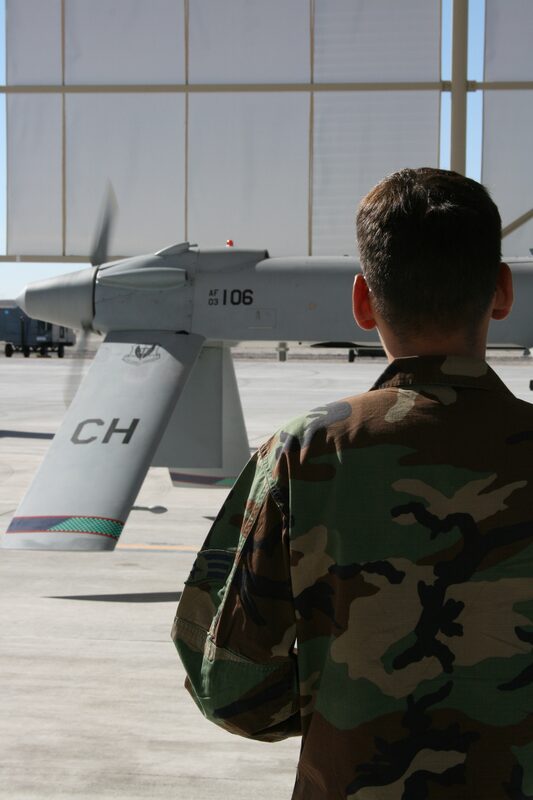
China's People's Liberation Army Ground Force (PLAGF) has quietly moved a new armed drone from prototype to operational service, according to reporting published August 4, 2026 by Janes. The aircraft, designated KVD002, is built by China Aerospace Science and Technology Corporation (CASC) and marks the ground force's first fielded unmanned combat aerial vehicle (UCAV) with an organic strike capability.
The rollout was not announced through a formal PLA press release or arms fair unveiling. Instead, it surfaced in a CCTV documentary broadcast July 31 to mark the PLA's 99th founding anniversary. That program showed 13 KVD002 airframes lined up at an airbase in southern China, along with footage of an operator identified as Staff Sgt. 2nd Class Zhao Lichuan conducting missions with the type. The same segment included a live-fire sequence in which a KVD002 launched a missile strike against an unmanned surface vessel during a joint exercise — the first publicly aired evidence of the drone's weapons employment in a realistic engagement scenario.
What the KVD002 Is
Per Janes' reporting, the KVD002 is equipped with a 20x zoom camera package, and the CCTV footage showed the limits of its automated targeting rather than a flawless engagement: the unmanned surface vessel's fast, evasive movements prevented the drone's onboard computer from reliably locking onto the target, forcing Zhao to switch to manual control. With roughly a minute remaining before the engagement window closed, he manually positioned the KVD002 and guided the missile to a hit. PLAGF induction of the type reportedly began in 2023, meaning the aircraft has been in service for roughly two to three years before this level of detail about its capabilities and operational status became public.
Outside reporting has drawn a visual comparison between Chinese UCAVs and General Atomics' MQ-9 Reaper, the U.S. Air Force's long-serving hunter-killer drone — though for the KVD002 specifically, the comparison runs through an intermediate step. Eurasian Times, describing the KVD002 as PLAGF's first unmanned reconnaissance-and-strike aircraft, reported that Chinese state media have suggested the KVD002 is likely derived from the CASC-built CH-4 (Cai Hong 4), based on its configuration and the presence of an AR-1-type missile — and it is the CH-4, not the KVD002 directly, that has previously been noted for resembling the Reaper's airframe. Eurasian Times was explicit that neither the PLA Army nor the manufacturer has officially confirmed a link between the KVD002 and the CH-4, and no official technical lineage between either Chinese type and the Reaper has been confirmed by either government. The similarity appears to be, at most, a case of convergent design for a similar mission set — medium-altitude, long-endurance reconnaissance-strike — rather than evidence of direct copying.
State Media's Framing
Chinese state outlet Global Times covered the same CCTV footage, describing the KVD002 as an "armed reconnaissance drone" and detailing the strike against the moving unmanned surface vessel off China's southeast coast. Global Times' coverage aligns with a broader pattern in Chinese state media of using PLA anniversary programming to signal new capabilities without the specificity of a formal defense-ministry disclosure — anniversary documentaries function as a controlled venue for revealing systems that have already reached service but not yet received an official unveiling.
Janes' reporting notes that Global Times, citing Chinese military commentator Song Zhongping, characterized the widespread fielding of the KVD002 as a signal that the PLA Army as a whole — not the drone type in isolation — has "achieved full combat and support capabilities." That framing, if accurate, indicates PLAGF is presenting its drone operations as a mature, integrated capability rather than a limited trials program, though the underlying claim is a military commentator's assessment relayed through state media rather than an independently verified metric.
Why It Matters
The KVD002's emergence fills a specific gap in PLAGF force structure. China's air force and navy have fielded armed drones for years, and Chinese industry has exported strike-capable UCAVs like the CH series widely abroad. But a ground-force-operated, organically armed reconnaissance-strike drone gives PLAGF combined-arms units a persistent surveillance-and-strike asset they control directly, rather than requesting support from sister services. That matters for scenarios where PLAGF formations need on-call precision fires against time-sensitive targets — armor, air-defense nodes, or, as demonstrated in the CCTV footage, surface vessels — without routing a request through the PLA Air Force or Navy chain.
The live-fire strike on an unmanned surface vessel is also notable in isolation. Testing an armed drone against a naval target in a joint exercise suggests PLAGF is training the KVD002 for roles beyond traditional ground-force fire support, potentially including littoral and counter-USV missions — a relevant skill set given how disruptive low-cost unmanned surface vessels have proven in other conflicts in recent years.
The two-to-three-year gap between reported induction (2023) and this level of public detail also fits a familiar pattern with Chinese military disclosures: capabilities are fielded quietly, then revealed through curated anniversary media once the program has matured enough that a controlled unveiling carries more benefit than risk. For open-source analysts, the KVD002 disclosure is a reminder that PLAGF drone capability should be assessed on a longer lag than official announcements suggest — systems already in service may not become visible until years after fielding.
For now, key technical specifics — range, endurance, payload capacity, weapons compatibility beyond the missile shown in the CCTV footage, and total fleet size beyond the 13 airframes visible at one base — remain undisclosed. Janes' report and the underlying CCTV/Global Times material represent the fullest public picture of the program to date, but they describe a single documentary segment and a single joint exercise, not a comprehensive capability assessment.
