
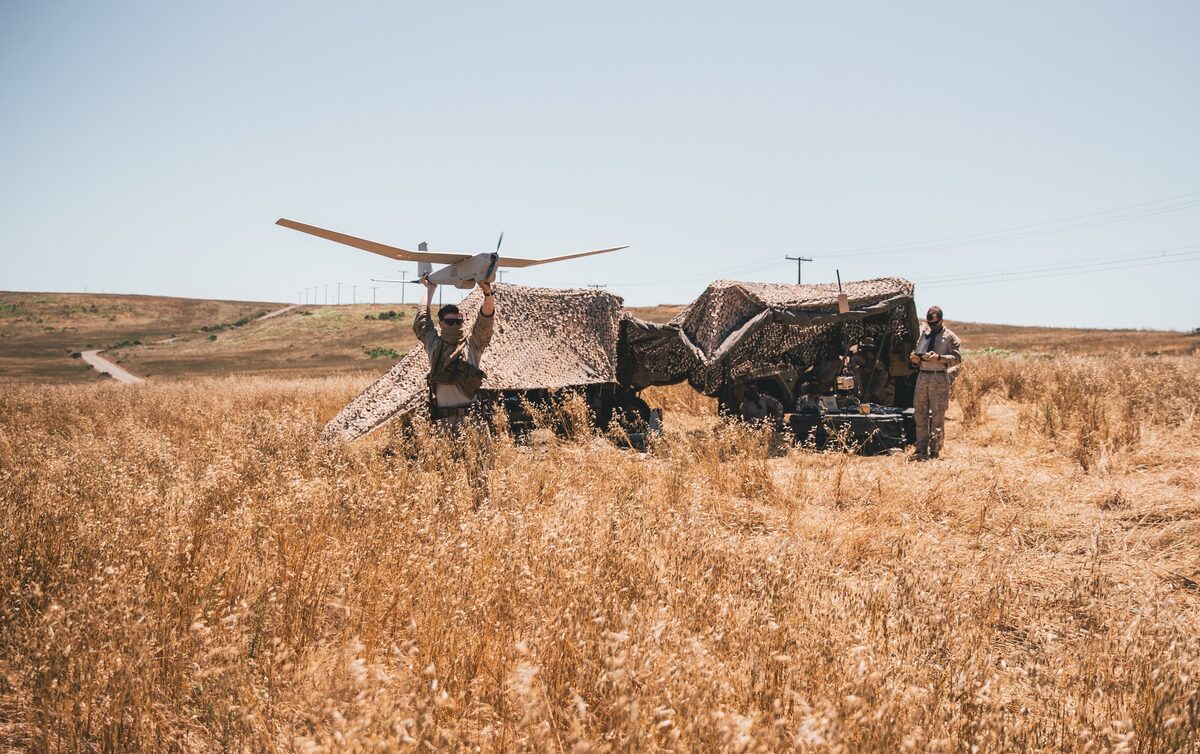
The British Army's latest reconnaissance buys run from drones weighing under 250 grams to a long-endurance aircraft that can carry up to 50 kilograms of sensors. On 16 September 2026, Defence Readiness and Industry Minister Luke Pollard put contracts behind both ends of that spectrum, announcing the deals at the DVD 2026 show at Millbrook.
The larger award is a contract worth up to GBP400 million to Tekever to bring the AR5 into Army service. The AR5 replaces Watchkeeper, which has been in use since 2014. The smaller award is a GBP16 million package with three UK small and medium-sized enterprises for more than 1,025 small intelligence, surveillance and reconnaissance (ISR) drones. Pollard described the combination as a "David and Goliath" style mix of spy drones.
The Goliath: Tekever's AR5
According to the Ministry of Defence (MoD) press release, the AR5 is a long-endurance surveillance drone that carries up to 50kg of cameras and sensors. The MoD says it is built at a new Tekever factory in Swindon and has "already been used by Ukraine against Russia". The Defense Post, which describes Tekever as Lisbon-based, puts the contract at $536 million and says the AR5's electro-optical and infrared systems collect, process and transmit high-resolution video in real time.
The MoD says the contract supports more than 1,000 skilled jobs by 2030, across sites including Bristol, Swindon, Lydd, London, Southampton, Edinburgh and West Wales Airport. The release carries quotes from Pollard and from Tekever UK managing director Karl Brew.
Six aircraft or 24?
The two official documents describe the order slightly differently, and the difference matters for anyone trying to size the buy.
- MoD press release: the order starts with an initial six drones, rising to up to 24 by 2029, under a contract "worth up to" GBP400 million.
- Pollard's DVD 2026 speech: the contract will "bring twenty four of their AR5 drones into service by 2029".
These read as reconcilable. The release says the order starts at six and rises to up to 24, and the speech quotes the end state. The "up to" wording on both the value and the fleet size in the release suggests the GBP400 million figure is a ceiling rather than a fixed price for a fixed number of airframes, though neither document breaks down what the money covers. Neither document, as we read them, says how much of the contract's value is for aircraft as opposed to support, training or the Swindon production line.
The David: 1,025 Small Drones
The GBP16 million small-drone deal (Janes puts it at over USD21 million) is split across three suppliers. The MoD says deliveries are nearing completion, so this is closer to a fielding announcement than a start-of-programme one.
- 245 FOXE-NATO from Evolve Dynamics (Hampshire). The MoD says the aircraft weighs under 250g and carries infrared cameras for use at night. Janes adds dual 4K electro-optical and infrared sensors and 35 minutes of endurance.
- 670 Skydio X10 INTL from Marlborough Communications Ltd (Surrey). The MoD says the aircraft can be ready to fly in under a minute and reaches up to 45mph. Janes, which does not name the aircraft, says the company states it can be deployed in under 40 seconds, with a maximum speed of 72 km/h and 40 minutes of endurance, carrying cameras in modular sensor packages.
- 110 SONORA from Brigantes Consulting (Exeter) with Harmattan AI. Both sources describe these as being for training soldiers before they use similar drones in real operations.
The three lines add up to 1,025 aircraft. The MoD says "more than 1,025", while Pollard and Janes say "more than a thousand" or "more than 1,000". These appear to be the same order at different levels of rounding. The MoD also says the deal has created more than 30 new roles so far, 18 of them already filled.
On the specifications, the discrepancy is smaller than it looks. 45mph is about 72 km/h, so the top speeds agree. The gap between "under a minute" and "under 40 seconds" is consistent, since the second is a tighter version of the first. We use the MoD's figures where they exist and attribute Janes's additional detail, such as endurance and sensor fit, to Janes, because the MoD release does not give those numbers.
What Recce Strike Is
Pollard called both purchases, along with a third award, "vital components of Recce Strike", the concept he described as built around better targeting, better battlefield surveillance and more lethal long-range fire. The small-drone order was delivered by the UK National Armaments Director Group under Project Rapstone, the Army programme whose stated goal is to double the Army's fighting power by 2027 and get new equipment from industry to the front line within 24 months.
Pollard's speech listed these Recce Strike investments, the first three as examples of upgrades over the next four years:
- GBP190 million for short-range ballistic missiles
- GBP400 million for inexpensive one-way-attack drones and weapons
- GBP220 million for Project Nyx, advanced armed autonomous drones to fly alongside Apache helicopters
- GBP370 million to roll out Project Asgard, which he said has proven itself as the "brains" behind the Recce Strike concept and has worked in Estonia
By our arithmetic, those four lines come to GBP1.18 billion. The speech does not give a time period for the Asgard figure, so we do not treat the total as a single four-year envelope. Pollard set the programmes against the Defence Investment Plan he cited: GBP298 billion of spending over four years, with more than GBP19 billion on land warfare capabilities and GBP11 billion on weapons and ammunition. He also announced contracts to MBDA and Thales to explore a beyond-line-of-sight anti-armour weapon, a capability he said the Army has lacked since Swingfire left service more than 30 years ago.
Janes, which reported the speech on 19 September, calls the small-drone awards the first Recce Strike contracts. It says they were announced on the first day of the DVD 2026 exhibition, which ran 16-17 September.
Why It Matters
Two things stand out. First, the Army is buying at opposite ends of the size scale rather than betting on one class. The MoD frames the small drones as giving soldiers real-time awareness on the front line and the larger aircraft as giving commanders detailed intelligence over longer distances and periods of time. Splitting the buy across GBP16 million of small, quickly delivered aircraft and up to GBP400 million of larger ones matches Pollard's framing, and it is a very different shape from a single, exquisite platform.
Second, the pitch leans on combat experience elsewhere. The MoD's release stresses that the AR5 has already been used by Ukraine against Russia, and Pollard said the three contracts apply lessons from Ukraine and that Asgard, the Recce Strike targeting backbone, has worked in Estonia. That is a procurement argument as much as a technical one: buy what has already been used under fire. The small-drone deliveries sit under Rapstone's 24-month target for getting equipment to the front line, and are nearing completion. For the AR5, the test will be delivering a Watchkeeper replacement by 2029, the year the order is due to reach its 24-aircraft ceiling, and whether that argument holds.
There are open questions. The MoD release gives the 2029 end date but no schedule for how the AR5 order moves from six aircraft to 24, and does not say how the up-to-GBP400 million ceiling divides between hardware and support. Nor do the documents describe how the 1,025 small drones will be distributed or how they will connect to Project Asgard. The GBP400 million for one-way-attack drones is a line item without a named contractor in the material we reviewed.
A note on naming: gov.uk calls the show "Defence Vehicle Dynamics", while Janes calls it "Defence Vehicle Demonstration". We follow the government's usage.
Sources
- New 'spy' drones to give Army greater powers on the battlefield (UK Ministry of Defence, 16 September 2026)
- Minister for Defence Readiness and Industry Luke Pollard MP's speech at DVD 2026 (gov.uk)
- DVD 2026: UK announces first Recce Strike contracts (Janes, 19 September 2026)
- Tekever Wins $536M British Army Deal for AR5 Spy Drones (The Defense Post, 18 September 2026)