The U.S. Army has selected Vulcan Elements, a Durham, North Carolina-based rare-earth magnet manufacturer, to supply Neodymium Iron Boron (NdFeB) magnets for the brushless DC motors that drive its small unmanned aircraft systems (sUAS) under the SkyFoundry initiative. The selection, announced September 23, 2026, closes one of the last gaps in a program built around a single premise: an American-made drone should not depend on Chinese magnets to fly.
Brushless DC motors are, as Vulcan Elements put it in the announcement reported by Jane's defense correspondent Daniel Wasserbly, "the primary engine powering the Army's small drone capabilities." Every one of them needs a rare-earth magnet at its core, and until now the Army's push to manufacture those motors domestically had an unresolved dependency: the magnets themselves. China controls the overwhelming majority of global rare-earth magnet production and processing, making it the default supplier for nearly every drone motor built anywhere in the world, including in the United States. The Vulcan Elements contract is meant to close that loop.
What SkyFoundry Is Trying to Build
SkyFoundry was announced in October 2025 as a pilot program pairing the Army with industry and academic partners to dramatically scale domestic production of small drones. According to Jane's, the original goal was 10,000 systems a month by the end of 2026, though it remains unclear whether the program is on track to hit that mark. Vulcan Elements, in its own announcement, described a more ambitious longer-term target: one million drones a year produced at Tobyhanna Army Depot in Pennsylvania.
The division of labor is straightforward. The Army handles the airframes, batteries and propellers. Industry partners supply the components the Army cannot yet build at scale itself — chief among them, until recently, the motors and their magnets.
That began to change on June 30, 2026, when Tobyhanna Army Depot opened a brushless DC motor assembly line with capacity for "upwards of 500,000 motors annually," according to Jane's. The line represented the Army's first real step toward building its own motors rather than buying them finished from outside vendors. But a motor assembly line still needs magnets to assemble into it, and that is the piece Vulcan Elements now supplies.
The Supplier
Vulcan Elements says the Army required it to demonstrate "a fully domestic, vertically integrated manufacturing process" before winning the contract — meaning the company's NdFeB magnets are not simply finished in the U.S. from Chinese-processed rare-earth material, but built through a domestic supply chain from end to end. The company calls this its 10th Department of War contract, suggesting the Army and its sister services have been building a relationship with Vulcan well before the SkyFoundry announcement.
The scale of Vulcan's ambitions extends well past this one contract. The company is constructing a 1.1-million-square-foot rare-earth magnet factory in Benson, North Carolina, with a planned capacity of 10,000 metric tons per year. Vulcan describes it as "the largest rare earth magnet factory outside of China," and says the facility will create roughly 1,000 manufacturing jobs once complete. The Benson plant is still under construction, so SkyFoundry's near-term magnet supply presumably draws on Vulcan's existing production capacity rather than the new factory's eventual output — neither company statement nor the Jane's report specifies which.
Vulcan Elements CEO John Maslin framed the deal in explicitly strategic terms: "Rare earth magnets are foundational to the military capabilities that we need to defend our country," he said in the company's announcement. "This isn't just a manufacturing challenge; it's a national security imperative."
Why It Matters
Small drones have become consumable, high-volume military hardware rather than the exquisite, low-quantity systems the Pentagon built its acquisition system around. That shift means the supply chain underneath them — plastics, batteries, cameras, motors, and the magnets inside those motors — now matters as much as the airframes themselves. China's dominance in rare-earth magnet processing has been a known vulnerability for years, but the SkyFoundry program is one of the more concrete efforts to actually do something about it rather than merely flag the risk.
Stitching together Tobyhanna's new motor line with a magnet supplier that can certify a fully domestic manufacturing process is meant to produce a brushless DC motor with no Chinese content at any stage — magnet, winding or assembly. Whether that combination can scale to the volumes SkyFoundry is chasing, whether at the pilot's original 10,000-systems-a-month goal or the more ambitious one-million-a-year figure Vulcan cites, is a separate question the public record does not yet answer. What is clear is that the Army now has, at least on paper, a domestic path from raw magnet material to a flying drone that never touches a Chinese supplier.
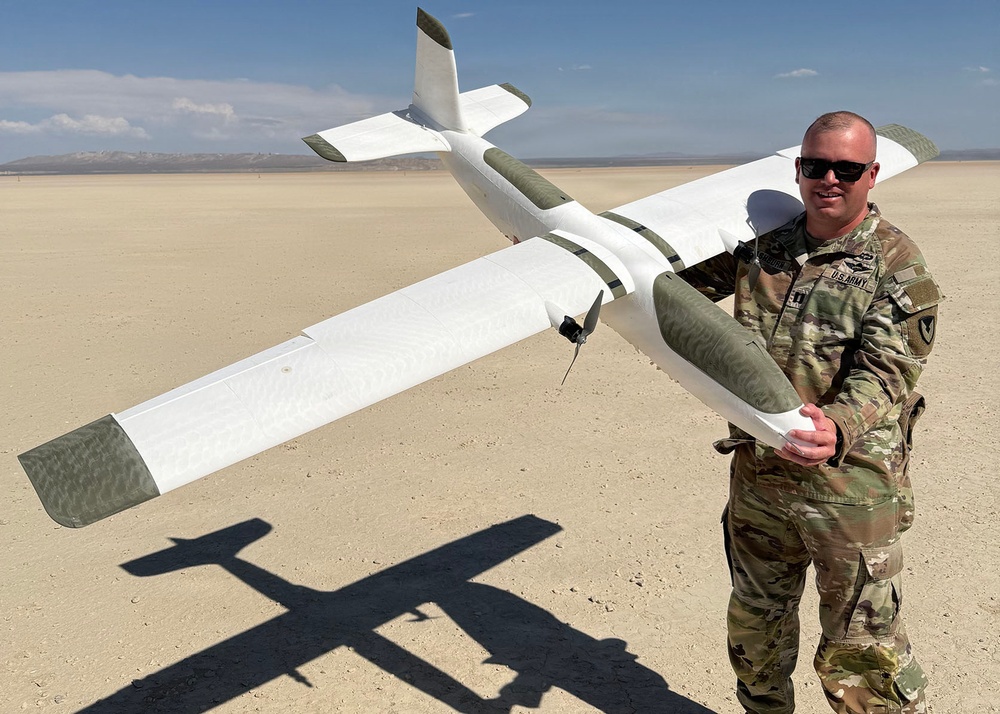
The push also lands against a backdrop of demonstrated need. In August, an Army Materiel Command release described a battery-powered small UAS that flew for more than eight hours in desert heat at Edwards Air Force Base, California, setting what the service called a world endurance record. The motors and other critical propulsion components in that aircraft were assembled by the Army's Organic Industrial Base — the same in-house manufacturing push that Tobyhanna's motor line, and now Vulcan's magnets, feed into. The record flight is not directly tied to the Vulcan contract, but it is the clearest public evidence so far that the Army's homegrown motor-manufacturing effort can produce hardware that performs, not just hardware that is domestically sourced.
What's Still Unclear
Several open questions will determine whether this magnet deal actually moves the needle on SkyFoundry's larger goals. It is not yet public how many magnets Vulcan is contracted to deliver, over what timeframe, or at what price relative to Chinese-sourced alternatives — cost has historically been the main reason U.S. manufacturers default to Chinese rare-earth suppliers despite the supply-chain risk. Nor is it clear whether Vulcan's current production capacity, ahead of the Benson facility's completion, is sufficient to support SkyFoundry at any of its stated production targets. Jane's reporting notes that it remains unclear whether the original 10,000-systems-a-month goal for the end of 2026 is on track, and the magnet contract alone does not resolve that uncertainty.
What the contract does confirm is direction. The Army is treating the rare-earth magnet as a strategic chokepoint worth contracting around explicitly, rather than leaving it as an unexamined line item inside a finished motor purchased from an unspecified vendor. For a program built on the premise that small drones need to be built the way ammunition is built — domestically, at volume, without a foreign dependency buried in the supply chain — that is a meaningful piece to lock down.
Sources
- Jane's: US Army's Skyfoundry sUAS initiative selects magnet supplier for motors
- Vulcan Elements: U.S. Army Competitively Selects Vulcan Elements to Supply High-Performance Rare Earth Magnets for SkyFoundry Drone Initiative
- DVIDS: OIB-assembled motors power drone to world-record flight, showcasing domestic manufacturing leap