
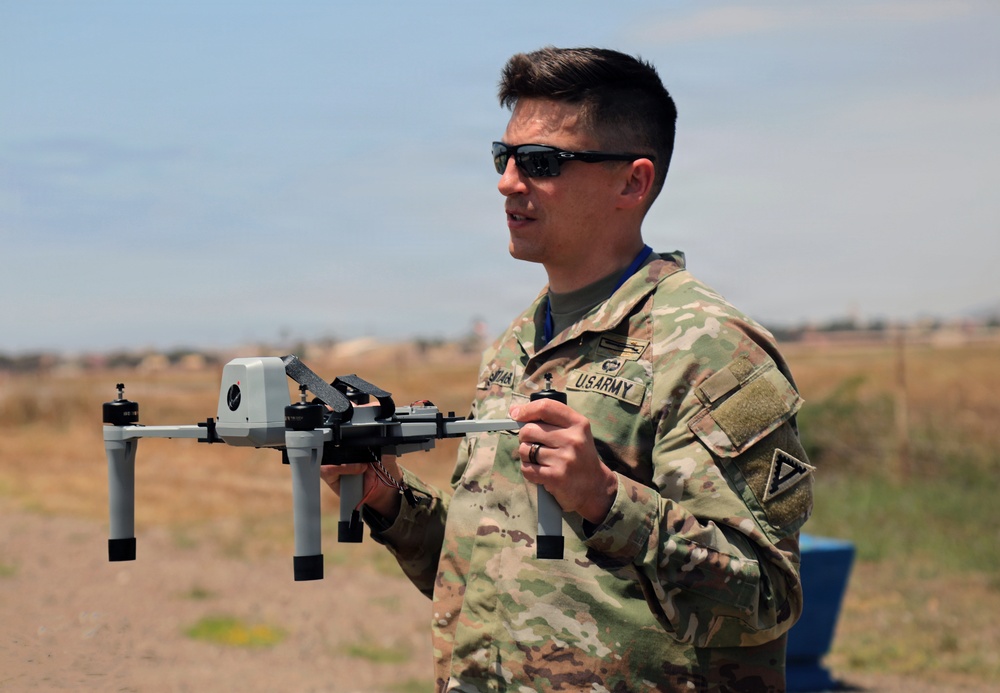
Photos from an Army test event in southern Morocco show a small tracked robot doing something new. It carries a row of sensors, each about the size of a fist, and leaves them on the ground for later. The robot is a FireAnt from Swarmbotics AI. The sensors appear to be built to detect drones. The setting was NANO ACE II, an Army event held from Oct. 3 to 14 at the Moroccan Multidomain Training Area near Tan-Tan.
The idea is simple. Instead of putting an expensive radar on a hill and hoping it lives, you send an expendable robot forward and have it scatter cheap listening posts. The Army has not said how well it worked. Its public release on the event contains no detection ranges, no probability-of-detection figures and no false-alarm rates. What it does show is an Army in a hurry to field this kind of layered, autonomous sensing. It also points back to a problem Army leaders have raised before: the sensors are the easy part.
What did the Army actually test?
NANO ACE stands for Needs-Driven Acquisition for Near-Term Operations Accelerated Capability. According to the Army release on DVIDS, U.S. and Moroccan soldiers worked with more than 10 U.S. industry partners to test uncrewed ground vehicles equipped with counter-UAS capabilities. The goal was semi-autonomous capability sets that extend counter-drone coverage. The service said the effort addresses "an emergent U.S. joint force requirement to field integrated, autonomous sensing and effector capabilities on an accelerated acquisition timeline."
The criteria were basic but strict. Systems had to operate on their own over unimproved terrain and survive a contested electronic warfare environment. That second requirement matters most for counter-drone gear, which often depends on the same radio spectrum an adversary will try to jam.
Nine organizations took part. They included personnel from the Global Tactical Edge Acquisition Directorate, a tactical Army division, Army Test and Evaluation Command (ATEC), U.S. Army Central, U.S. Africa Command and Southern European Task Force, Africa. Preliminary assessments took place in Yuma, Arizona, and finished in September, before the systems went to Morocco.
Lt. Col. Corbett Baxter summed up the process as "test, evaluate, validate and procure." That last word is the important one. This was not a science fair. It was a step toward buying equipment.
What is the FireAnt carrying?
The robot details come from photos, not from the Army release. The War Zone's analysis of the imagery shows a FireAnt carrying six small ground sensors, three on each of two angled rail sets. The sensors slide off the rails and stand on three small legs. Each has a round body and a thin antenna mast.
How they detect drones is not clear. The War Zone noted they could be passive radio-frequency receivers, listening for the control and video links most small drones use. They could also be acoustic, listening for the sound of rotors. Neither the Army nor the vendors have said publicly which it is.
The FireAnt is Swarmbotics AI's roughly 27-kilogram attritable UGV, built to operate in semi-autonomous swarms. "Attritable" is the important word here. The robot is cheap enough that losing one is acceptable, which is the right fit for a job like driving forward into ground the enemy may be watching.
Morocco is not the only place the robot has appeared in this role. The War Zone reported that a separate FireAnt at a recent Army exercise at Fort Hood appeared to carry MaXentric Technologies' Mapleseeds, a low-cost, expendable RF unattended ground sensor. A separate FireAnt version with a fixed acoustic array, the FireFLY system from Invariant Corporation and Hyperion Technology Group, has also been developed for NANO ACE, though it is unclear whether it has been demonstrated at an Army test yet. So the FireAnt seems to be a carrier for several sensor types, not a single product.
Why put sensors on a robot at all?
The War Zone notes that unattended ground sensors offer a lower-cost way to expand coverage where deploying conventional radars would be too risky, and that passive sensors could be hard for enemy forces to find and neutralize. The tradeoff is reach: a small node hears only what is near it, so many are needed, and a swarm of robots can seed that coverage across a broader area faster while reducing risk to human operators.
Maj. Kyle Rau of ATEC put the benefit in plain terms. He said the capability can keep soldiers from "having to go into that kill zone." He added that the tests give leaders "a snapshot" to inform decisions about deployment.
The concept is not new. The War Zone points to Igloo White, the Vietnam-era program that monitored movement along the Ho Chi Minh Trail with remotely placed unattended ground sensors, as the best-known historical precedent. The War Zone notes Igloo White was controversial for its cost, complexity and mixed results. Today's version is aimed at drones and is delivered by robots, though the Army and other services have also experimented with drones that place ground sensors.
Where does this fit in the Army's larger push?
The Army says NANO ACE builds on its Jailbreak series, which is led by the Army chief technology officer and the director of the Pathway for Innovation and Technology. DefenseScoop described Jailbreak as an effort to "hack" the Army's own systems so they can talk to each other. It started with engineers from about 20 defense companies at Fort Carson and grew to hundreds of engineers from more than 50 companies. Army Secretary Driscoll called it the "largest hackathon in human history."
According to DefenseScoop, the framework was meant to connect new systems, especially the tens of thousands of drone interceptors rushed into the field in the early days of Operation Epic Fury. The Army plans to repeat the model. NANO ACE looks like one result: the same urgency applied to ground robots and the sensors they carry.
The Moroccan setting reflects a separate, longer-term arrangement. On July 13, 2026, the Royal Moroccan Armed Forces and AFRICOM signed a memorandum of understanding in Stuttgart. It established the Africa Multidomain Training and Experimentation Center (AMTEC), which includes the Multidomain Training Area, a drone academy and an innovation center. NANO ACE is among the first public signs of that site being used for U.S. experimentation.
What's still unknown
A lot. The Army release does not say:
- What sensing method the FireAnt-deployed nodes use, or how far away they can detect a drone.
- How the nodes network with each other and report back, or how that link held up under electronic warfare.
- How any detections were passed to effectors, the systems that actually defeat drones, as the "integrated sensing and effector" language suggests.
- Which of the more than 10 industry partners met the terrain and EW criteria, and which did not.
The networking question is probably the most important one. The War Zone cites a problem Army leaders have raised before: data overload. Then-Lt. Gen. Scott McKean warned of "too much data," and then-Army Secretary Wormuth pushed for data standardization across systems. One cheap sensor hearing a drone is useful. Dozens of cheap sensors producing overlapping, conflicting and sometimes false alerts is a mess, unless something correlates and filters them before an operator ever sees them.
Why It Matters
Counter-drone defense is shifting from a few expensive systems toward many cheap ones, and robot-placed sensors fit that shift. They are low-cost and expendable, could be hard to detect if they operate passively, and let the Army extend its detection range without sending soldiers forward. The Army clearly wants them soon. Its own release describes an "accelerated acquisition timeline," and Baxter's sequence ends with "procure."
But whether this works depends on fusing the data, not on the hardware. Jailbreak exists because the Army's systems had trouble sharing information, and a field of cheap sensor nodes makes that problem bigger. Until the Army publishes results, or at least explains how these nodes feed a shared picture, NANO ACE shows that the hardware exists. It does not yet show that the system works.
Sources
- US, Morocco test autonomous systems at Africa Multidomain Training and Experimentation Center to accelerate warfighter readiness (DVIDS)
- FireAnt Mini Uncrewed Ground Vehicles Deploy Drone Detection Sensors In U.S. Army Test (The War Zone)
- Operation Jailbreak: the Army's massive push to hack its own systems and make them talk to each other (DefenseScoop)
