The headline number is $4.15 billion. The number that matters for vendors is about $50 million. On Sept. 29-30, Joint Interagency Task Force 401 (JIATF-401) and the Army announced 10 multiple-award indefinite-delivery, indefinite-quantity (IDIQ) contracts for detect-to-defeat counter-UAS equipment to protect U.S. facilities under the Domestic Shield effort. The combined ceiling is $4.15 billion. Only about $50 million was obligated at award, according to reporting by GovConWire, which attributes the figure to Defense One, and Washington Technology, which attributes it to the Army.
The gap between those two figures is the core of the story. An IDIQ ceiling is the most the government could spend through a vehicle. It is not a purchase. What the awards actually do is create a pre-competed shelf that services can order from quickly, which is how JIATF-401's director described the contracts when he said they are "available to everybody."
What the Army Awarded
According to the Army release dated Sept. 29, 2026 (read through a web archive mirror), JIATF-401 made the awards in close synchronization with the Office of the Assistant Secretary of the Army for Acquisition, Logistics and Technology, ASA(ALT). The base IDIQ awards break down as follows:
- $500 million each: Allen Control Systems, Digital Force Technologies, DroneShield, Napatree Technology, RADA Technologies, SRC Inc. and L3Harris WESCAM
- $250 million each: Echodyne and PVP Advanced EO Systems
- $150 million: SmartShooter
Seven firms at $500 million, two at $250 million and one at $150 million add up to the $4.15 billion combined ceiling. Washington Technology describes the scope as covering command and control, sensors and weapons.
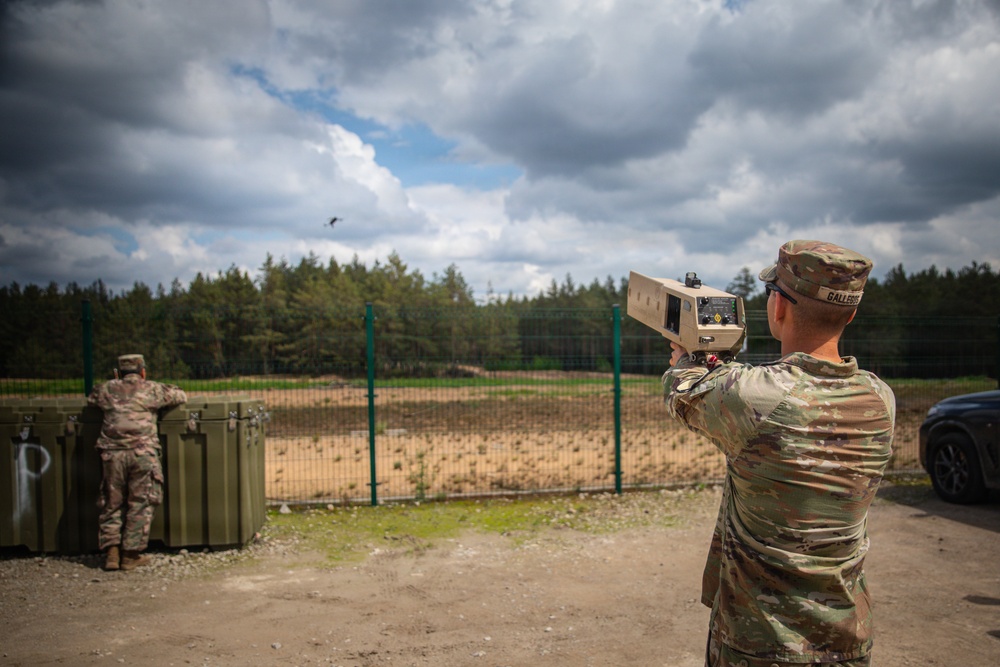
The Army's description of the technology spans a wide range: smart optical scopes that help individual soldiers shoot down drones with standard rifles, automated robotic weapon stations, compact radar systems and long-range tracking cameras. That mix reflects the detect-to-defeat framing, in which the awards are meant to cover the entire process of detecting and defeating drones rather than a single product.
Ceilings Versus Obligations
Readers who see a $500 million figure next to a company name should read it as a limit on what could flow through the contract over its life. The roughly $50 million obligated at award is the better measure of money actually committed on day one, and it is a small fraction of the $4.15 billion headline.
The broader Domestic Shield picture is larger. GovConWire reports, citing Col. Tony Lindh, JIATF-401's lead for rapid acquisitions, that the Army has awarded more than $5 billion against Domestic Shield's $7 billion ceiling, counting these 10 contracts and earlier awards. Washington Technology likewise notes room for up to $7 billion. Lindh said more contracts are expected before the end of next month, according to both outlets.
Earlier awards are part of that total. The sources cite a $500 million IDIQ to CACI in July, with SkyValor selected for the first task order, and a nearly $500 million sole-source IDIQ to AV. AV also booked an $80.5 million Titan MS purchase order in July supporting Air Force Global Strike Command, per GovConWire. That order is a useful illustration of the difference between a vehicle and a purchase: a nearly $500 million ceiling and an $80.5 million order are two different things.
An Open-Architecture Marketplace
The structural claim in the Army release comes from Brent Ingraham, the Army's acquisition chief at ASA(ALT). He says the marketplace enforces open architecture standards to break proprietary vendor lock. In practice, that suggests the government is trying to keep sensors, effectors and command-and-control software from different companies interchangeable, so a base that buys one vendor's radar is not stuck with that vendor's other components.
Washington Technology frames the awards as a test of the Pentagon's new drone marketplace. Whether open architecture holds up in fielded systems is something these announcements cannot show. The release states the requirement; it does not report integration results.
The Fiscal-Year-End Rush
Brig. Gen. Matt Ross, who directs JIATF-401, told reporters on Tuesday, Sept. 29, that the contracts are "available to everybody," and described "a surge of end-of-year requests for procurement" across the department, according to Washington Technology. GovConWire reports him attributing the surge to the fiscal year closing, with an available vehicle making procurement easier to execute.
That is a plain description of how federal budgets work. Money expiring at fiscal year-end tends to find the fastest available contract path, and a freshly awarded multiple-award IDIQ is exactly that. The Sept. 29-30 timing of the awards, at the end of the fiscal year, is consistent with Ross's account, though the sources do not say how the timing was decided.
Why It Matters
For the counter-drone industry, the awards sort the field. Ten companies now hold a place on a vehicle that Ross says is available to everybody, and that is a meaningful advantage when buyers need to spend quickly. The difference between a $500 million and a $150 million ceiling is a cap on the vehicle, not a forecast of who will win orders.
For the government, the open-architecture requirement is the real test. Domestic Shield protects risk-prioritized Department of War facilities and assets inside the United States, a mission where mixed-vendor sensor and effector layers will need to work together. If the marketplace delivers interchangeability, it could lower switching costs. If it does not, the ceilings will matter less than the integration work.
For observers, the practical lesson is to track obligations and task orders rather than ceilings. About $50 million obligated at award is the number to compare against future announcements, along with the more than $5 billion awarded against the $7 billion Domestic Shield ceiling, with additional awards expected before the end of next month.