
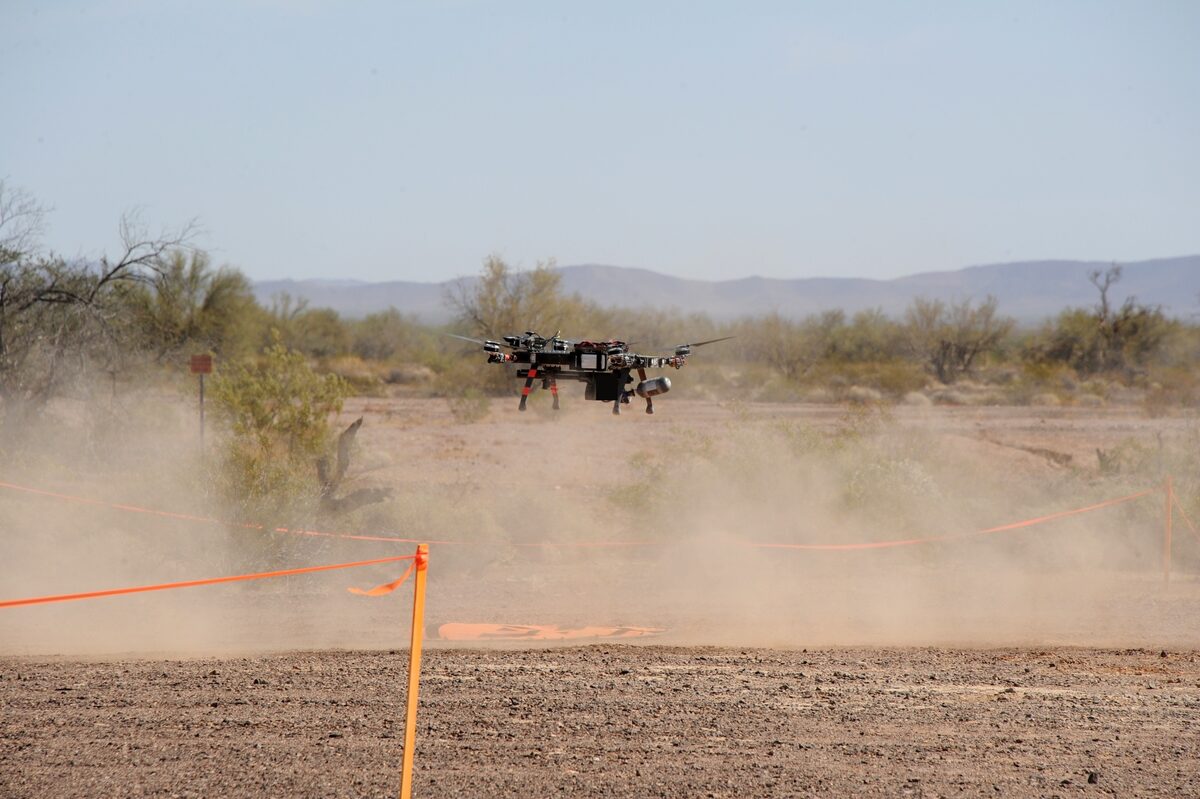
For four weeks this September, the high desert around Yuma Proving Ground, Arizona, hosted something the Pentagon has never run before: a large-scale test of whether roughly 20 different counter-drone companies could fight together through a single piece of command-and-control software that the U.S. government does not own. The software was Anduril Industries' Lattice platform. The exercise was Falcon Peak 26.2, U.S. Northern Command's fourth iteration of its signature counter-small-unmanned-aircraft-systems experiment, and this time the target wasn't a hypothetical adversary drone over a domestic base — it was the threat picture along the 1,954-mile U.S.-Mexico border.
According to an official U.S. Northern Command press release dated Aug. 31, 2026 — read via a Wayback Machine snapshot after the original northcom.mil page began returning an access-denied error to direct fetches — NORTHCOM and Joint Interagency Task Force 401 ran Falcon Peak 26.2 from Aug. 31 to Sept. 25, 2026. The release describes it plainly: "This experiment is designed to address the unique challenges of C-sUAS at the Southern Border and will demonstrate new technologies, expand focus on low-collateral defeat capabilities, enhance collaboration with mission partners, and provide industry with immediate feedback to accelerate the maturation of innovation capabilities with Department of War-wide applicability." It's the fourth Falcon Peak overall, and the first held at Yuma.
Three Lanes, One Backbone
Roughly 20 vendors put systems through somewhere between 15 and 30 intercept attempts apiece, organized into three testing lanes, according to DefenseScoop's reporting from the exercise: drone-on-drone interceptors, kinetic and ballistic mitigation — largely shotgun-based systems — and sensing and detection. Hardware on the range included the Genesis Arms Gen-12 SBM and the Dronebuster counter-sUAS system, among others.
What set 26.2 apart from its three predecessors wasn't the hardware, though. It was the plumbing underneath it. For the first time, Falcon Peak standardized its digital backbone on Anduril's Lattice software, and — critically — the test organization itself, not the commercial vendors on the range, controlled that Lattice infrastructure. In past iterations, individual vendors typically brought and ran their own proprietary command-and-control stacks, forcing NORTHCOM to stitch together whatever interoperability it could get. This time, JIATF-401 and Yuma Proving Ground's sensor branch effectively rented the connective tissue: Lattice was selected under an $87 million contract awarded through the Army's Enterprise Agreement with Anduril, meaning the government is licensing and integrating the software as shared infrastructure rather than owning it outright.
"You can't fight what you can't see," Northcom spokesperson Becky Farmer told DefenseScoop, a line that captures the exercise's underlying logic: before shotguns or interceptor drones can do anything useful, sensors scattered across a border-length test range have to report into a single picture that every vendor's system can read from and write to. Robert Fletcher, who leads the sensor branch team at Yuma Proving Ground, was directly involved in standing up that shared sensing architecture.
Why Falcon Peak Exists at All
Falcon Peak didn't emerge from a border crisis. It emerged from a basing one. Breaking Defense reported in October 2025 that the series was NORTHCOM's answer to a persistent, unglamorous problem: unidentified drones flying over U.S. military installations on American soil, day after day, with no fast, reliable, service-wide way to detect or stop them. Falcon Peak became the venue where the Pentagon could put competing counter-drone systems on a range together, under realistic conditions, and rapidly figure out which ones were worth fielding — a deliberate contrast to the slower, single-vendor evaluation cycles the services had relied on before.
That mission has since broadened. Falcon Peak 26.2 was the fourth iteration in the series NORTHCOM has run since October 2024, when it became the Pentagon's lead synchronizer for domestic counter-UAS testing; Brig. Gen. Jason “Ox” Rueschhoff has already previewed a fifth, urban-focused demonstration still to come, according to a second DefenseScoop report published Sept. 25, 2026, two days after the Yuma exercise concluded. Falcon Peak 26.2's border focus is the latest expansion of that mandate — moving the series from protecting fixed installations toward securing a stretch of geography nearly 2,000 miles long, where drones might be surveilling border infrastructure, smuggling contraband, or simply testing U.S. detection gaps.
Why It Matters
The choice to run Falcon Peak 26.2 on a licensed, vendor-built C2 layer — rather than a government-owned system, or a patchwork of each vendor's own software — is a bet with real consequences either way. Standardizing on Lattice lets NORTHCOM test sensors and effectors from roughly 20 different companies against a common integration standard instead of forcing every pairing to be custom-built, which is presumably why an $87 million Army contract exists to make it the default backbone. But it also means the military's ability to detect and defeat drones over its own bases, and now along its own border, runs through commercial infrastructure it doesn't control the source code of — a dependency the Pentagon has spent years trying to avoid in exactly this kind of mission-critical role. Whether that tradeoff holds up gets tested every time a new vendor has to plug into Lattice to even participate in the next Falcon Peak, and every time the government negotiates the next contract extension from a position where switching costs are already high.
There's a second, more immediate stake: none of this happened in a vacuum. It happened at Yuma, in open desert, where a system that shoots down the wrong thing mostly just puts a hole in sand. That will not be true of what comes next.
Next Stop: A City
NORTHCOM has already said where the counter-drone program goes from here, even if it hasn't said exactly where the "here" is. The command's next major demonstration will be held in a dense urban environment for the first time — a shift DefenseScoop's Sept. 25 report frames as introducing an entirely different set of problems: buildings that block or multipath radar returns, civilians moving through the engagement zone, and collateral-damage and rules-of-engagement questions that simply don't arise when the nearest structure is miles away.
"Homeland defense is not about protecting from outside, it's also protecting inside," Brig. Gen. Jason "Ox" Rueschhoff said, according to DefenseScoop — a statement that reframes counter-UAS not as a perimeter problem but as one that follows the drone wherever it flies, including over American cities.
The location and date of that urban iteration haven't been announced. But the shift itself tells you what NORTHCOM learned at Yuma isn't really about whether a Gen-12 shotgun round or a Dronebuster jammer can stop a small drone in open air — vendors have been proving that for years. It's about whether roughly twenty different companies' hardware can be knitted into one coherent picture fast enough to matter, on infrastructure the government leases rather than owns. The desert was the easy version of that test. The city is next.
Sources
- What's unique about Northcom's Falcon Peak 26.2 counter-drone exercise — DefenseScoop
- Northcom's next counter-drone demo will be its first in an urban area — DefenseScoop
- With daily drone incursions over bases, NORTHCOM takes aim through Falcon Peak — Breaking Defense
- USNORTHCOM, JIATF-401 Launch Falcon Peak 26.2 Experiment at Yuma Proving Ground — U.S. Northern Command (via Wayback Machine)