
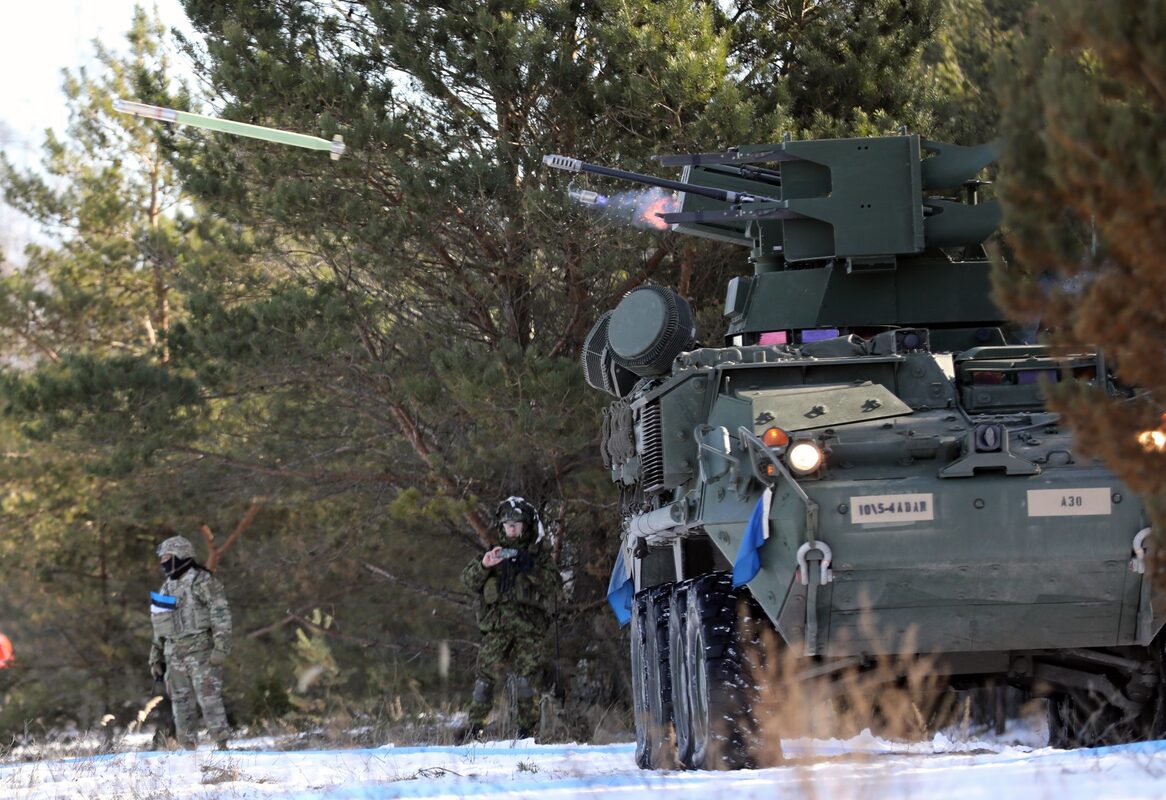
The Army has set a date for its next maneuver air defense system, and it is later than the service first planned. According to briefing slides from an industry day in Huntsville, Alabama last month, which TWZ reported on Nov. 10, the Army now plans Initial Operational Capability for Maneuver-Short Range Air Defense Increment 4 (M-SHORAD Inc 4) in fiscal 2030. The First Unit Equipped milestone, a battalion-sized element, is set for the first quarter of FY2030, which runs from Oct. 1 to Dec. 31, 2029.
The Army had earlier aimed to field the capability between FY2027 and FY2029. The new slides put the first battalion's equipment in the final weeks of calendar 2029 at the latest, so the program has moved from a fielding window that began with FY2027, which started Oct. 1, to one that now closes about three years from now.
One caveat applies to everything below. The slide deck is posted on SAM.gov, but the listing is a JavaScript application that UASFeed could not render. The schedule and requirement language here come from TWZ's reading of the slides, not from our own review of the source document.
A Pallet, Not a Vehicle
Earlier increments were built around vehicles or specific technologies. Increment 1 is the Stryker-based Sgt. Stout. Increment 2 covers directed energy. Increment 3 covers the Next-Generation Short-Range Interceptor and the XM1223 30mm Multi-Mode Proximity Airburst round. Increment 4 breaks from that model. The Army wants a vehicle-agnostic palletized kit it calls a "Self-Loading Equipment Dock," or SLED, that can be mounted on the Joint Light Tactical Vehicle, the Infantry Squad Vehicle, or uncrewed ground vehicles. According to TWZ, the Army does not want options that require additional trailers.
The kit also has to meet light-force logistics requirements. Each system must be able to operate independently for 72 hours and semi-independently with the supported force for three to seven days. It must be C-130 loadable, air droppable, and sling-load capable. Those requirements point to airborne, air assault, and light infantry formations.
The sled concept has been in development for at least a year. In October 2025, DefenseScoop reported that Army Chief of Staff Gen. Randy George had approved the Capabilities Development Document for Increment 4, including the sled. Col. Marc Pelini, then military deputy for the Fires Future Capability Directorate at Army Transformation and Training Command, described the goal as an effort to "converge the best of breed from our counter-UAS and our M-SHORAD capabilities" fielded over roughly the past decade, including the Stout vehicle and the Mobile Low, Slow Unmanned Aircraft Integrated Defense System (M-LIDS).
What It Has to Kill
The threat list is broad. According to the slides as described by TWZ, Increment 4 must defeat small quadcopters at one end and long-range one-way-attack drones such as the Shahed 136 at the other, either singly or in swarms. It must also provide point defense against helicopters and fixed-wing aircraft, and it needs a secondary "direct fire capability for ground targets."
That last requirement matters for light units. A crew on a JLTV or ISV cannot always count on another vehicle nearby to handle a ground threat. A gun that can engage both a quadcopter and a technical makes the system more useful to a brigade commander who has only a few vehicles to assign.
DefenseScoop's 2025 reporting described the threat set in Army group terms: swarms of Group 1 and 2 drones, plus Group 3 one-way-attack drones. On sensors, Pelini said there are acoustic, bistatic, active radar, and EO/IR options, and that the Army wants to fuse them at the platform. He described a pallet that recognizes swapped hardware and automatically changes the user interface.
Open on Sensors and Shooters
The Army has not chosen specific radars or weapons. The requirement, as quoted by TWZ, calls for a "reconfigurable multi-effector MEP [mission equipment package] integrating kinetic effects (e.g. missiles, direct-fire guns), and non-kinetic defeat." At AUSA 2025, Pelini, now a brigadier general and the Army's top air defense artillery officer according to TWZ, called this a "menu of options." His examples included swapping an X-band radar for a Ku-band unit, or a Coyote interceptor pod for a Stinger pod.
TWZ lists L3Harris, Leidos, Leonardo DRS, MDH Strategic Services, Moog, MSI Defense Solutions, SAIC, and Sierra Nevada Corporation among the contractors working on related efforts.
At least one proposal is already public. At AUSA 2026, General Dynamics Land Systems showed a candidate design, Army Recognition reported. It uses an MSI Defense Solutions common deck mounted on a Ford Ranger and combines a 7.62 mm chain gun, Echodyne radars, and an APKWS guided-rocket capability described as L3Harris' VAMPIRE, which L3Harris says can engage aerial targets at up to 6 km with suitable ammunition. Army Recognition says the range for GDLS's Ranger installation has not been confirmed. GDLS offers the sled in light, medium, and heavy configurations and says the approach can scale up to the FMTV truck. Ford, Epirus, EOS, Echodyne, and MSI Defense Solutions were identified as partners. Army Recognition stresses that this is a proposed configuration and that its information does not establish an Army selection, production contract, or delivery schedule.
The Effectors Picatinny Is Building in Parallel
The non-kinetic half of the "kinetic plus non-kinetic" requirement is still being developed at Army labs. On Nov. 12, an Army release on DVIDS described counter-UAS demonstrations at the DEVCOM Armaments Center's ArmamentsX event at Picatinny Arsenal, New Jersey.
David Goldstein, the center's Counter-UAS Technical Area Manager, described a low-power, low-cost, lightweight laser that can "instantly and permanently blind the threat UAS sensors." His reasoning was that "even GPS-guided one-way-attack drones rely on cameras for ensuring terminal accuracy." The center is also evaluating M858 plastic short-range training ammunition fired from a .50-caliber machine gun to disable Group 1 and 2 drones with little to no damage to surrounding areas. That could matter for units defending positions near friendly troops or civilians.
The event also included a networked engagement. BLADE 2.0, callsign HOOLIGAN, used an ECHOSHIELD radar to detect multiple FPV attack drones. A fire-control application called CNALT prioritized the threats, and its operator tasked HOOLIGAN and Advanced Fire Control Technologies, or AFCT, a networked rifle system that provides a dismounted last line of counter-UAS defense, to engage them. BLADE 2.0 engages with the Common Remotely Operated Weapon Station (CROWS). The Picatinny Common Lethality Integration Kit (CLIK), an open-source design standard, is part of the same architecture. Bhavanjot Singh, acting director of the Weapons and Software Engineering Center, said lethal unmanned and counter-UAS capabilities can operate "collectively rather than as standalone technologies."
None of the Picatinny systems is identified as an Increment 4 component. They do show the kinds of effectors and the open, networked design that a "reconfigurable multi-effector" pallet would need to accept.
Why It Matters
The schedule change is the main news. A fielding window that was meant to begin in FY2027 now begins with a single battalion in late calendar 2029. Light and airborne formations are the intended users of this kit, and they will wait several more years for a purpose-built answer. In the meantime, they will presumably depend on interim counter-UAS kits and whatever the heavier M-SHORAD increments can cover.
The architecture is the other major change. The Army is not buying a vehicle. It is buying a standard dock that can carry different combinations of radar, gun, missile, and non-kinetic effectors, and that can move between a JLTV, an ISV, or a robot. If that works, a light unit could get a different counter-drone package for a Shahed-heavy theater than for one dominated by FPV quadcopters, without new trucks. If it fails, the risk is that one pallet tries to cover everything from quadcopters to helicopters within the weight, power, and C-130 limits of a light vehicle, with an open-ended effector list that delays decisions further. Low-cost options such as optics-blinding lasers and plastic training rounds tested at Picatinny point to a possible way to lower cost per engagement on the pallet. Their combat value against massed one-way-attack drones has not been shown in the sources reviewed.
None of the sources reviewed reports a source selection for Increment 4. The next milestones to watch are formal solicitations and any prototype awards that come out of last month's industry day.
Sources
- Army Wants New Palletized Short-Range Air Defenses In Service By The End Of 2029 (TWZ)
- DEVCOM Armaments Center showcases future battlefield lethality at 15th annual S&T Networking event (DVIDS)
- Army moving forward with 'sled' concept for maneuver air defense against drones, other aircraft (DefenseScoop)
- U.S. Army Requirement Prompts General Dynamics to Develop New Short-Range Air Defense System (Army Recognition)
