
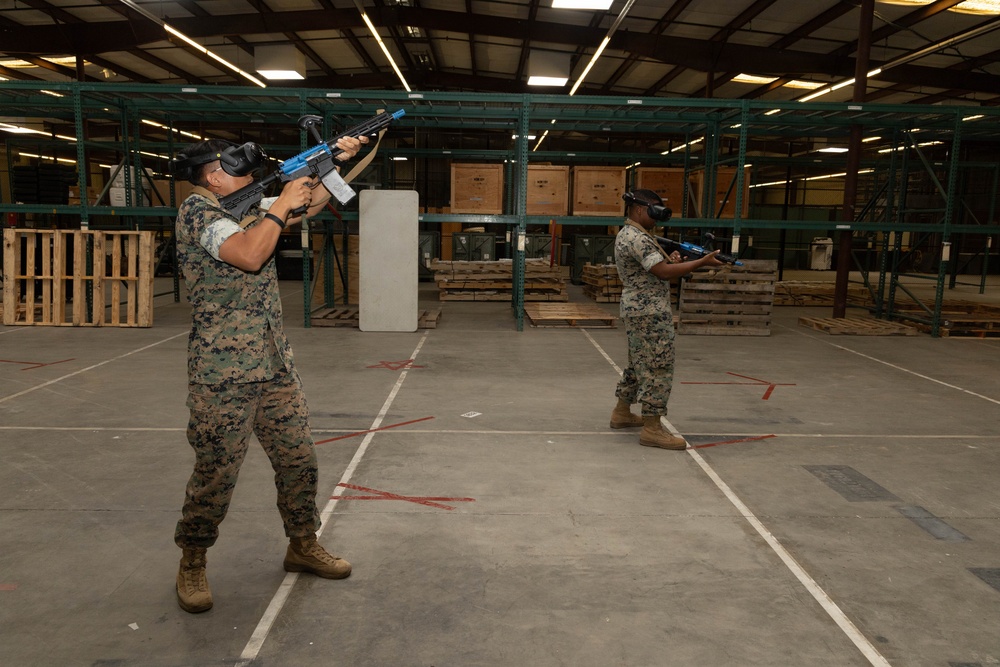
At Camp Pendleton, a logistics battalion that bought virtual-reality headsets to teach Marines how to shoot down small drones has found a second use for them that has nothing to do with drones: suicide prevention.
Headquarters and Service Battalion, 1st Marine Logistics Group, bought 20 OperatorXR training sets in 2025 for $200,000, according to DroneXL, which cites USNI News reporting. That works out to about $10,000 per set. The headsets were bought to put Marines through counter-drone scenarios modeled on Ukraine and the Middle East. Since July, the battalion has also used them for suicide-prevention training. By mid-October roughly 350 Marines had gone through that module, and the battalion's executive officer, Maj. Paul Kim, wants at least 1,000 through it this year.
UASFeed could not reach the original USNI News report because the site blocked automated access. The purchase figures, training numbers and quotes below come from DroneXL's account of that reporting, and from Marine Corps imagery published on DVIDS.
Why logistics units are training against drones
The battalion's commander, Lt. Col. Gloria Luedtke, explained the counter-drone focus in one line quoted by DroneXL: "Logistics is always the number one target."
That fits what drone warfare has shown since 2022. Supply convoys, fuel points, maintenance areas and headquarters move slowly, are hard to hide and sit behind the front line, where troops have historically felt safer. Small commercial and modified drones have erased that safety. A unit whose main job is moving supplies now has to think about the sky above its trucks.
According to DroneXL, the training scenarios were built from news headlines and after-action reports from Ukraine and the Middle East. They are not made-up shooting galleries. They are meant to recreate the kinds of encounters troops have actually reported.
The battalion has not left this only to software. DroneXL reports that the Combat Skills Training School started a Counter-sUAS Course this year, with an outdoor range. The VR system adds to live training by covering the things a range cannot.
What the headset actually does
The hardware is OperatorXR's OP-2 system. DroneXL reports that the OP-2 Interceptor kit fits in a portable hardened case, so it can be carried to a unit and set up there rather than sitting in a fixed simulator building.
On its own website, OperatorXR markets the OP-2 to law enforcement and military customers and says more than 120 customers use it. The company lists a counter-drone (C-sUAS) tactics module and after-action review tools that record eye tracking and reaction times. Those claims come from the vendor's marketing and have not been independently tested. Still, the after-action features matter for this kind of training. A trainer who can see where a Marine was looking when a drone came in learns more than one who only knows whether the shot hit.
Marine Corps imagery shows the system in use. A DVIDS photo by Gunnery Sgt. Jesus Sepulveda Torres, taken Oct. 22, 2026, at Camp Pendleton and posted Oct. 27, shows a Marine from Headquarters and Service Battalion, 1st MLG, using what the caption calls an "Interceptor Counter-small Unmanned Aerial Systems Trainer" in VR against simulated drones. The caption says the system emulates "real world scenarios not practical for live-fire training."
That last phrase hints at why the battalion bought it. Live-fire counter-drone training needs targets, airspace approvals, range time and safety rules that limit what can be shown. A headset can recreate scenarios that are impractical on a range, as many times as needed.
Cpl. Nicholas Muldrow, a supply administrator quoted by DroneXL, compared the experience to skeet shooting. The comparison fits. Hitting a small, fast, unpredictable target means leading it and tracking its flight path, and doing that well takes many repetitions.
From drone targets to crisis conversations
The second use is the less expected one. Since July, according to DroneXL, the battalion has run suicide-prevention training on the same headsets. Instead of tracking a quadcopter, a Marine works through a simulated conversation with an AI-driven Marine in crisis, and the software offers responses at each turn.
The Marine Corps has also published imagery of this training. A DVIDS photo by Sgt. Mary Torres, taken Oct. 15, 2026, at Camp Pendleton, shows Sgt. Isaiah Wilson of 7th Engineer Support Battalion wearing an HTC Vive Pro headset during a Small Unit Leaders Course. The caption says the course used virtual reality simulation to train Marines in active communication, crisis de-escalation and suicide intervention techniques. The photo shows that the training reaches Marines from units beyond the battalion that bought the sets.
Using the same equipment for both programs makes the $200,000 purchase do more work. Hardware that only ran counter-drone drills would be idle whenever a unit was not on that part of its schedule. Running a second, unrelated curriculum on the same headsets spreads the cost over more training hours and more Marines.
Why It Matters
For the counter-UAS community, the Camp Pendleton program matters for three reasons.
First, it shows counter-drone training spreading beyond specialists. A logistics battalion, not only an air-defense unit, is now training Marines, including supply administrators, to find and shoot down small drones. The scenarios draw on the same Ukraine and Middle East conflicts that made logistics a target.
Second, it shows how accessible entry-level counter-drone training has become. About $10,000 per set is modest for a training system. Equipment that fits in a carrying case can go where the Marines are instead of the other way around. That doesn't replace an outdoor range or live fire, and the battalion still runs its Counter-sUAS Course for that reason. But it lets Marines practice more often than range time alone allows.
Third, the dual-use approach is a model other units could copy. Training budgets are always tight. Hardware that teaches Marines to track a drone in the morning and to talk a fellow Marine through a crisis in the afternoon is easy to justify. Whether either kind of training carries over to real situations is the question that matters, and neither DroneXL's reporting nor the Marine Corps imagery offers outcome data to answer it. Better measures than headcounts, such as hit rates, reaction times and intervention outcomes, would show whether the $200,000 bought real skill or only training hours.
Sources
- US Marines Turn Counter-Drone VR Goggles Into Suicide Prevention Tool (DroneXL, citing USNI News)
- 1st MLG trains in the virtual space (DVIDS, U.S. Marine Corps photo by Gunnery Sgt. Jesus Sepulveda Torres)
- 1st MLG Marines conduct virtual reality suicide prevention training (DVIDS, U.S. Marine Corps photo by Sgt. Mary Torres)
- Operator XR: Law Enforcement & Military VR Training Systems (vendor site)
