
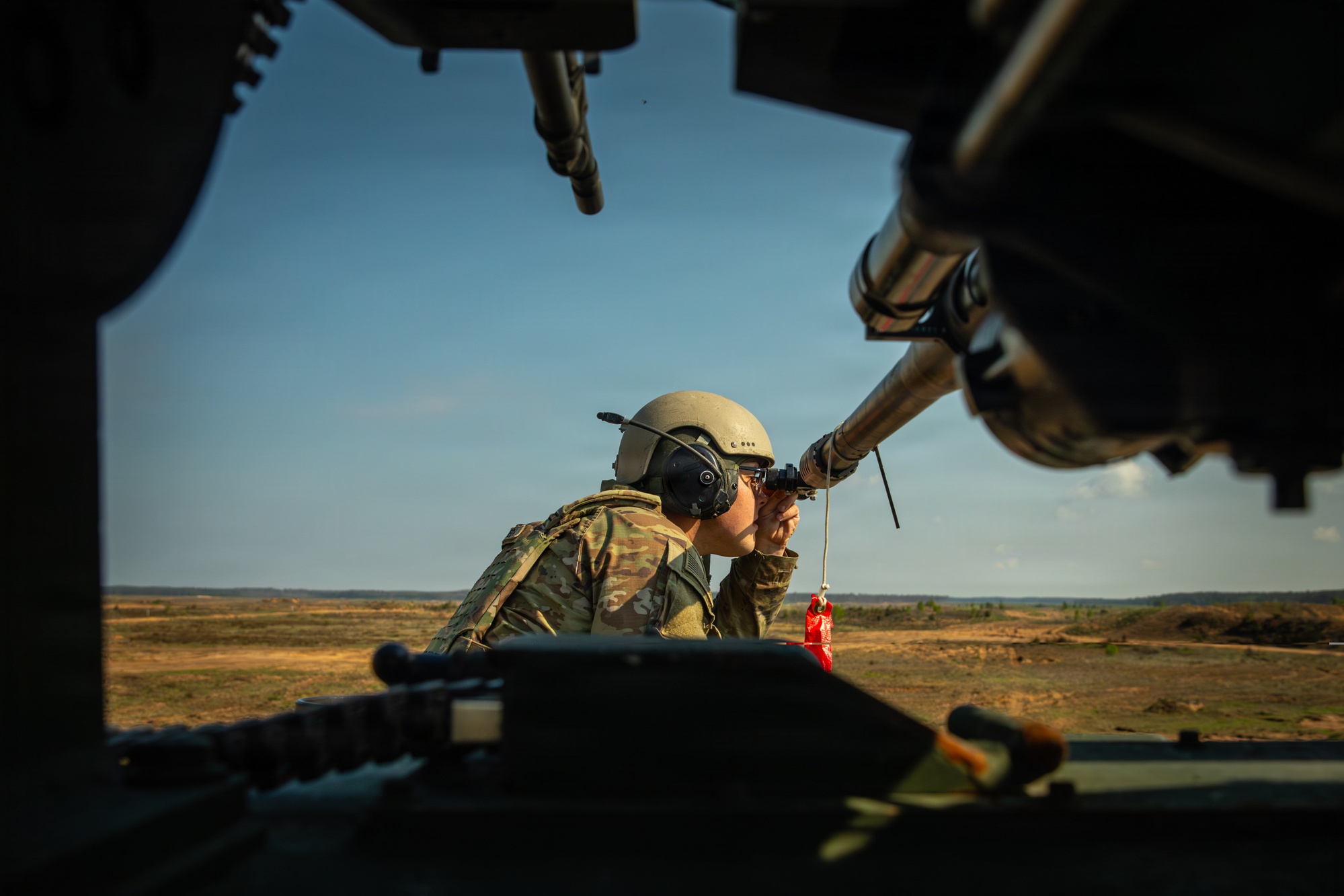
Estonian robotics maker Milrem Robotics has put a large idea in front of NATO planners: a border defence in which unmanned systems, not soldiers, make first contact with an adversary. At a press visit to the company's Tallinn facility on Sept. 23, 2026, capability development director Raul Rikk laid out the concept for what he called an unmanned defence line supporting NATO's Eastern Flank Deterrence Initiative (EFDI), according to a Janes report published Sept. 29.
The important qualifier comes first. This is a company proposal and a demonstrator. It is not a contracted program, and nothing in the material reviewed for this article indicates that NATO or any member state has ordered the system.
What Milrem is proposing
Milrem first presented the concept ahead of Eurosatory 2026, in a company release dated 09/06/2026. It spans the border from Finland to Poland, roughly 3,500 km (about 2,150 miles) according to a GadgetReview article carried by Yahoo. Milrem's release describes a dedicated Robotic and Autonomous Systems (RAS) zone intended "to detect, contain, and neutralise threats before they reach human forces."
The release names the building blocks:
- THeMIS, the company's unmanned ground vehicle, for forward operations.
- HAVOC, a Robotic Combat Vehicle, for higher-intensity roles.
- ARCOS, Milrem's command-and-control software, which coordinates the company's systems.
The release also states: "Particular emphasis is placed on Counter-UAS systems." It does not, in the excerpted text available here, specify which counter-UAS sensors or effectors would be used.
CEO Kuldar Väärsi framed the logic in the release: "Robotising the Eastern Flank allows NATO to create a persistent defensive layer where unmanned systems make first contact, absorb losses, and buy time for decision-making, without immediately putting soldiers at risk."
Rikk's pitch in Tallinn
According to Janes, Rikk told international journalists that EFDI's goal is a high-tech capability that reacts in minutes and makes penetration too costly for an attacker. That is deterrence by denial, delivered through layered defence in depth. He listed the focus areas as persistent sensing, AI, unmanned systems, integrated fires, fortifications and fast decision-making.
He was also blunt about the gaps. Per Janes, Rikk said integration of UAS, sensors and command-and-control remains limited, that fragmented national solutions are not compatible with one another, that no validated operational concepts exist for large-scale unmanned defence formations, and that NATO interoperability is limited. Those are the problems a vendor would want to be seen solving, and they are also the ones a buyer would have to solve before any such line could function.
Rikk envisioned unmanned battlegroups supported by a tactical communications network with electronic warfare and cyber protection, plus a battle management system for manned-unmanned teaming. On the hardware side, Janes reports the HAVOC 8x8 with teleoperation and autonomy for its payloads, alongside THeMIS and Vector tracked UGVs.
The turret and the tethered drone
The Yahoo/GadgetReview piece, a secondary tech-blog source that should be treated cautiously, adds that a Moog RIwP turret on the HAVOC can carry medium cannons, missile launchers, an RF jammer and a tethered drone. If accurate, the jammer and tethered drone are the most direct counter-UAS elements mentioned in the coverage reviewed. This has not been confirmed by Milrem or Janes in the material used here.
Where NATO stands
Careful attribution matters here. NATO's page on strengthening the eastern flank, updated Sept. 29, 2026, does not mention the Eastern Flank Deterrence Initiative, an eastern deterrence line or Milrem, so the concept should not be credited to NATO on that basis.
What the page does describe is the context. NATO launched Eastern Sentry in September 2025 after an unprecedented number of Russian drones and aircraft violated Allied airspace, including Russian drones entering Polish airspace and fighter jets in Estonian airspace, which triggered Article 4 consultations. Eastern Sentry is a flexible, multi-domain vigilance activity, with Allies contributing fighter jets, helicopters, air defence systems and surveillance aircraft. NATO integrated air and missile defence covers airborne threats including drones, and Baltic Sentry, running since January 2025, uses naval drones.
The GadgetReview article says NATO reportedly aims to build its own Eastern Flank Deterrence Line by about 2027, citing United24 Media. It also quotes German Brig. Gen. Thomas Löwin describing the line as a "robotized or automated zone" in which humans keep control of lethal decisions. Both claims come second-hand through that article, and UASFeed did not read the underlying United24 report.
Why It Matters
The airspace violations that prompted Eastern Sentry were drone incursions, which is why counter-UAS sits at the center of Milrem's pitch. A ground-based robotic layer with its own detection and defeat capability would, in principle, add a low-cost, expendable element beneath the crewed aircraft and air defence systems that Allies have contributed so far.
But the value of the proposal lies as much in what Rikk said is missing as in the hardware. If UAS, sensors and command systems remain poorly integrated, and national solutions do not interoperate, then a 3,500 km line of unmanned systems is first an integration and doctrine problem, and only second a vehicle problem. Rikk himself said no validated operational concepts exist for large-scale unmanned defence formations.
Open questions remain: who would fund and command such a line, how lethal-engagement authority would be handled across national forces, and how the RAS zone would be protected from electronic warfare and cyber threats, which Rikk's concept addresses only at the level of a protected tactical network. For now, the concept is a vendor's demonstrator offered into a debate NATO has not publicly tied to it.
Sources
- Milrem proposes unmanned defence line for NATO's Eastern Flank Deterrence Initiative (Janes, Sept. 29, 2026)
- Milrem Robotics Presents a Solution for Robotised Eastern Flank Defence Ahead of Eurosatory 2026 (Milrem Robotics, 09/06/2026)
- Estonia's Milrem Robotics Wants Robots to Guard NATO's 2,150-Mile Eastern Front (GadgetReview via Yahoo)
- Strengthening NATO's eastern flank (NATO, updated Sept. 29, 2026)